As a small business owner, your energy is rightly poured into growing your company and serving your customers. But with every new hire, you also become an employer, stepping into the intricate world of employment law. It can feel like navigating a maze where a wrong turn could put everything you've worked for at risk. This guide is designed to provide the practical, real-world knowledge you need to be a confident leader and manage risk effectively.
Navigating employment law can feel like a minefield, but at its core, it is about a set of fundamental rules that create a fair and stable workplace. Getting these right from the start is not just about avoiding lawsuits; it is about building a strong foundation for your business to grow on. This is not just a concern for large corporations. Small businesses employ a significant portion of the private sector workforce, meaning compliance missteps can have a major impact.
The key takeaway is straightforward: the moment you hire your first employee, you are operating in a regulated world. Understanding your obligations around lawful hiring, classifying workers correctly, and keeping proper records is non-negotiable for long-term success. These rules establish a framework for a secure and protected business.

It is also important to be aware of nuances in state laws. For example, the legality of recording conversations without consent can vary dramatically from one location to another. We unpack more of these complexities in our comprehensive guide to HR compliance for employment.
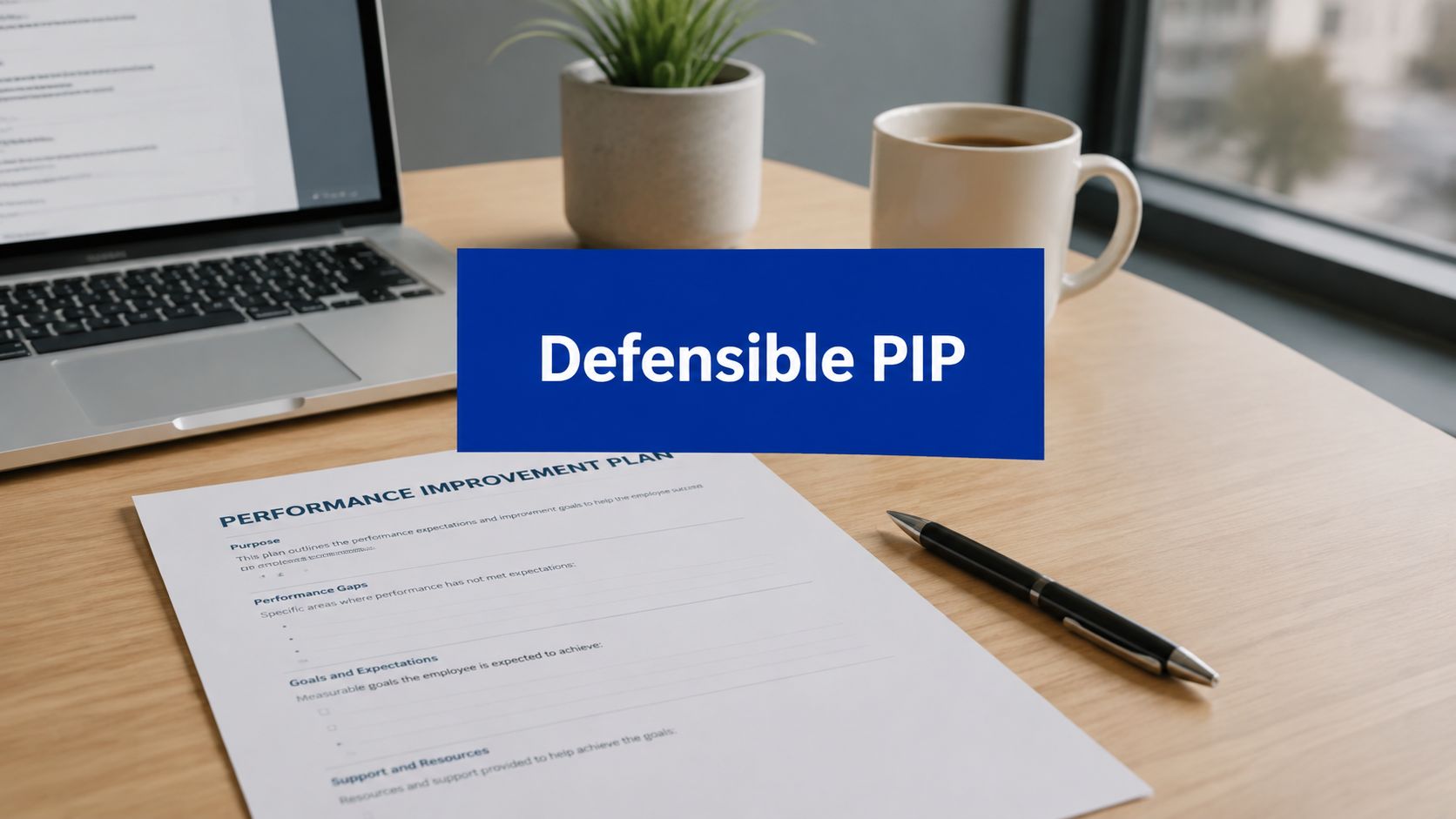
When an employment dispute arises, your single most powerful asset is clear and consistent documentation. It is easy to view paperwork as just another administrative chore, but it is more accurate to see it as your core strategic defense. These records—from performance reviews to disciplinary actions—form a "defensive playbook" that demonstrates your decisions were based on legitimate business reasons, not bias or retaliation.
This becomes especially critical when handling sensitive employee complaints, such as harassment or discrimination. A fair internal investigation hinges on being timely, impartial, and confidential. A poorly managed investigation can easily create more liability than the original complaint itself, making a structured, well-documented process essential.

Properly managing the complex world of employment law for small business means treating your documentation with the seriousness it deserves. Building this playbook takes discipline, but it is one of the most effective ways to fortify your business against preventable legal trouble. If you’re ready to build a more defensible foundation, our expert advisors can show you how. Learn more by contacting us today.
Of all the decisions a business owner makes, letting an employee go carries some of the highest legal risks. A termination that is handled poorly can quickly spiral into a wrongful termination lawsuit, costing you time, money, and stress. This makes having a consistent, fair, and well-documented process absolutely essential.
Think of strong documentation and a clear, legitimate business reason as your first line of defense. Before holding the final meeting, take a step back and perform a quick risk assessment. Ask yourself: is this employee in a protected class? Have they recently filed a complaint or requested protected leave? Answering "yes" raises the legal stakes and means you must proceed with extreme caution.
The termination meeting itself is a critical moment. How you manage it can either de-escalate the situation or create new legal problems.
For a deeper dive into managing this process, our guide on how to fire an employee legally provides a step-by-step breakdown. In particularly high-risk situations, offering a separation agreement in exchange for a release of claims is a smart strategy. When you need guidance, learn more about how we can help by contacting our team.
As more businesses embrace remote work, many are unknowingly stepping into a legal minefield. A policy that is perfectly compliant in your headquarters' state can create massive risk for an employee working just one state over. Think of federal law as the floor—it sets the absolute minimum standard. From there, every state and even some cities build their own set of rules on top of it.

Applying a single set of rules to a distributed team is a recipe for non-compliance. The nuances between states are significant and can appear in unexpected areas. For instance, learning how to calculate overtime in California is completely different than following standard federal rules. This same complexity applies to paid leave requirements, final paycheck deadlines, and minimum wage.
The table below highlights just a few of the common compliance traps that multi-state employers encounter.
| Legal Area | Common Compliance Trap | Example Variation |
|---|---|---|
| Paid Sick Leave | Assuming federal law is sufficient. | Many states (e.g., CO, AZ, MA) and cities have mandatory accrual rates, usage rules, and carryover requirements. Federal law has none. |
| Final Paycheck Timing | Paying terminated employees on the next regular payday. | California requires final pay immediately upon termination, while Texas allows up to six days. Other states have different rules for voluntary vs. involuntary separation. |
| Overtime Rules | Calculating overtime based only on a 40-hour workweek. | California requires daily overtime after 8 hours. Nevada and Alaska have similar daily overtime rules, each with its own specific conditions. |
| Non-Compete Agreements | Using a standard non-compete clause for all employees. | States like California, North Dakota, and Oklahoma have banned non-competes almost entirely. Others (e.g., Illinois, Washington) have income thresholds for enforceability. |
| Meal & Rest Breaks | Not requiring or tracking meal breaks for non-exempt staff. | About 20 states mandate meal periods, with specific rules on length and whether they must be paid or unpaid. The federal FLSA has no such requirement. |
The legal landscape shifts dramatically every time your company crosses a state line. This patchwork of rules makes a location-specific compliance strategy non-negotiable for any business with a distributed team. A proactive, state-by-state compliance strategy is the only way to grow responsibly in today's remote-first world.
Trying to manage employment law on your own is one thing, but knowing when to call for backup is a sign of smart leadership. While not every people problem requires an expert, certain red flags are clear signals that it is time to bring in professional support before a minor issue becomes a major liability. Ignoring these signals is a significant gamble.
Small businesses are powerful engines of growth, but that expansion can quickly reveal cracks in your compliance foundation. This is especially true when you're facing complex situations without a solid grasp of employment law for small business. For a closer look at the data, you can read the full research on job creation.
It’s also important to know who to call. An HR advisor helps build proactive, defensible systems to prevent issues from arising, while an employment attorney provides legal counsel when a specific threat or claim materializes. Building a proactive partnership gives you the confidence to manage complexity and focus on your business. When you’re ready to put a stronger compliance foundation in place, the team at Paradigm is here to help.
As a business owner, you are bound to have questions about the maze of employment laws. Getting these answers right is not just about ticking a box—it is about protecting your business and building a solid foundation. Let’s tackle some of the most common questions we hear from leaders like you.
The most common and costly mistake is misclassifying employees as independent contractors (1099). This single error can lead to significant liabilities, including back taxes, unpaid overtime, benefits claims, and steep penalties. A contract calling someone a contractor means nothing if the reality of the work relationship looks like employment. Government agencies look at the degree of control you have over the worker, not just the title on a document.
Yes, absolutely. Think of it as a critical risk management tool, not a bureaucratic chore. No matter how small your team is, a well-crafted handbook sets clear expectations for everyone and communicates essential policies, like anti-harassment procedures. It also demonstrates your good-faith effort to follow the law and serves as a first line of defense if a claim ever arises.
No. This is a dangerous misconception. While "at-will" employment provides flexibility, it is not a blank check to fire someone for an illegal reason. You cannot terminate an employee for any reason that is discriminatory (based on race, gender, religion, disability, etc.) or retaliatory (like firing them for reporting harassment or taking protected leave). Every termination must be grounded in legitimate, non-discriminatory business reasons.
This is a major challenge for businesses with distributed teams. The general rule is that you must follow the employment laws of the state where the employee physically performs their work. If your headquarters is in Texas but your employee works from home in California, you are responsible for following California’s much stricter laws on wages, leave, and final pay.
Navigating the nuances of employment law for small business requires more than just knowing the rules; it demands sound judgment and proactive planning. When you need a partner to help you make defensible decisions, it may be time to seek expert advisory support. To learn more about how we can help, we invite you to contact us for a consultation.