You can have a solid reason to end employment and still create unnecessary risk in the process. That's what catches many SMB leaders off guard, especially when the employee is in another state, has recently complained about a manager, or sits near a protected leave issue. The decision may be lawful, but the way it's documented, timed, and delivered can determine whether it stays routine or turns into a dispute.
In the United States, at-will employment is the starting point for most termination decisions. Federal employer guidance says all states except Montana allow at-will employment, which means either side can end the relationship at any time, for any lawful reason, unless another law or contract limits that right. For business owners, that flexibility is useful, but it's also easy to overread.
The practical mistake is assuming “at-will” means “risk-free.” It doesn't. The legal baseline is broad, but the exceptions are where employers get exposed, especially when a discharge touches discrimination, retaliation, contracts, collective bargaining agreements, notice rules, or final pay obligations. A plain-language overview of the at-will doctrine is still useful, but the essential work starts after you accept that at-will is only the default, not the whole analysis.
At-will employment gives employers room to make fast staffing decisions. That can be the right answer when a role no longer fits the business, a team member's performance is clearly off, or the company needs to act before a problem spreads.
Practical rule: treat at-will as permission to decide, not permission to skip process.
That distinction matters for multi-state SMBs. A termination can be lawful in concept and still become vulnerable if the records look sloppy or the manager's comments suggest a different motive. In practice, termination legality often turns less on a national rule and more on the state-specific and fact-specific limits around the decision.
If you operate in more than one state, you can't use one termination script everywhere. A single company policy may not match the legal limits in every jurisdiction, and a manager's informal explanation may create problems even when the business reason is real.
That's why defensible employers build a review step before the meeting happens. They ask whether the reason is documented, whether similar cases were handled consistently, and whether another legal issue is sitting next to the performance issue. The answer to those questions usually tells you more than the phrase “at-will” ever will.
The hardest termination cases rarely involve a dispute over whether the company had authority to act. They involve whether the action fits inside one of the legal exceptions to at-will employment. Those exceptions are where a simple dismissal becomes a wrongful termination claim, or at least a claim that needs a serious defense.
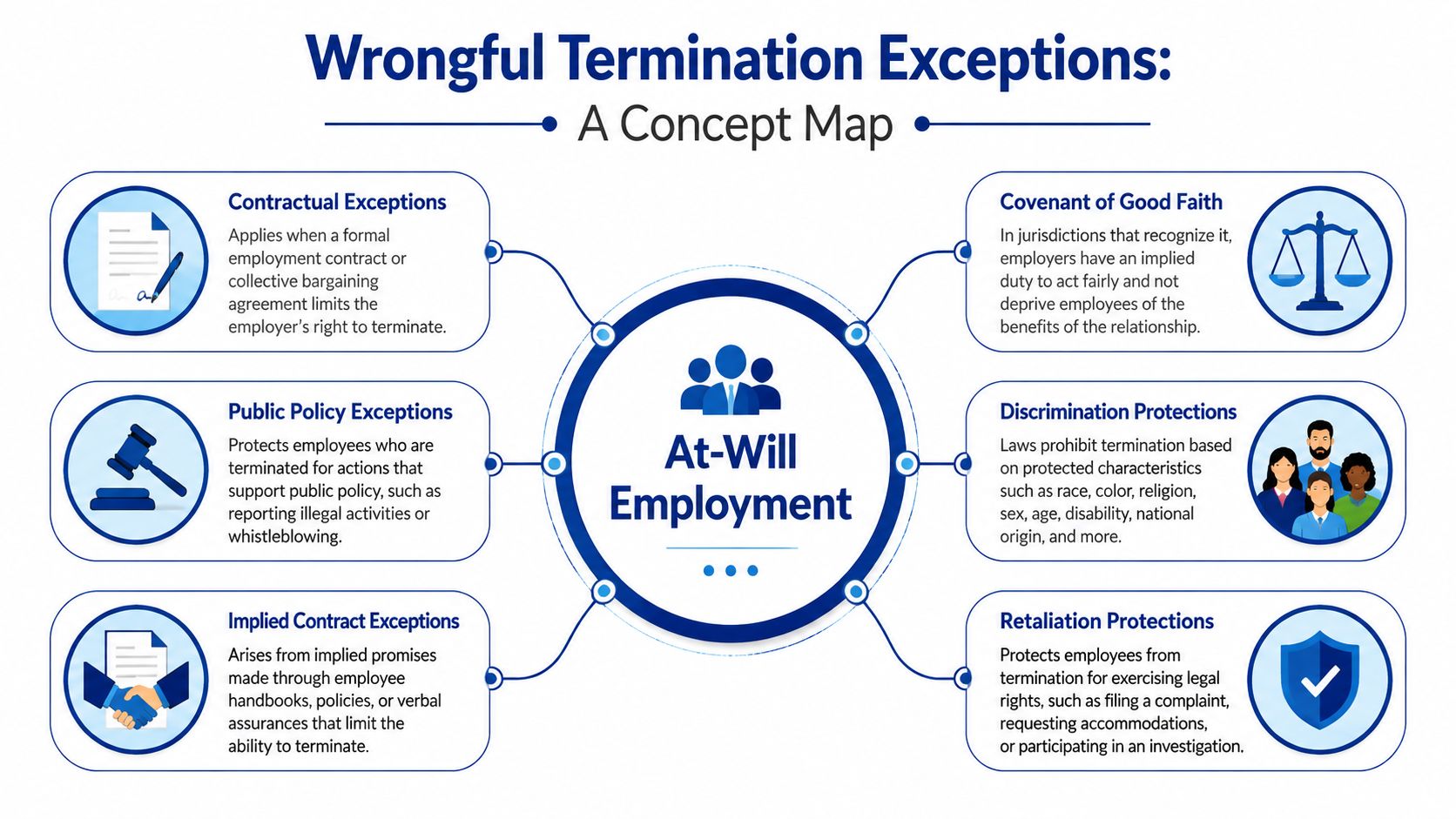
Three buckets matter most for SMB leaders. Contract-based limits can come from an express agreement, a collective bargaining agreement, or an implied promise in a handbook or verbal assurance. Public policy exceptions usually involve terminations that punish an employee for doing something the law encourages or for refusing something the law forbids.
Discrimination and retaliation create the most familiar exposure. Alberta's human-rights guidance makes clear that discrimination can exist even when a protected ground is only part of the reason for termination, not the sole reason. That's the mixed-motive problem leaders miss most often, because a legitimate performance concern can still be undermined if timing, comments, or manager conduct make the protected issue look relevant to the decision. The Alberta human-rights explanation is a good reminder that defensibility depends on the full record, not just the stated reason.
A termination memo should explain the business reason in a way that still makes sense if read by someone who knows nothing about the manager.
Mixed motive risk is usually not dramatic. It often shows up as a performance issue raised right after an employee complains, requests leave, seeks accommodation, or reports misconduct. It can also show up when a manager's informal language contradicts the formal reason given by HR.
That's why documentation is so central. If the file is thin, inconsistent, or written after the fact, the company has a harder time proving that the action rested on a legitimate business reason. For SMBs, the goal isn't to write a legal brief. It's to leave a clean, consistent record that shows why the company acted and how similar cases were handled before.
Before finalizing a termination, ask whether any of these are present:
Those clues don't automatically block a termination. They do tell you to slow down and review the file with more care.
Federal law adds another layer on top of at-will employment, often leading many businesses to underestimate their exposure. The most common mistake is thinking a termination only has to be “fair” in a general sense. In reality, federal statutes focus on protected traits, protected activity, and employer obligations that can attach before, during, or after the separation.

Title VII of the Civil Rights Act is the core anti-discrimination law for race, color, religion, sex, and national origin. The ADA protects qualified individuals with disabilities and often intersects with accommodation and leave issues. The ADEA protects older workers from age-based discrimination.
The FMLA adds retaliation risk when an employee has taken or requested protected leave. A key issue for employers isn't just whether leave was approved. It's whether the termination looks connected to the exercise of rights the law protects. That's why manager training matters as much as legal review.
A 2024 National Employment Law Project fact sheet reports that 40% of U.S. workers have been fired or let go at some point, and among those terminated, 69% say they received no reason or an unfair reason, and 72% say they got no warning or chance to improve, with 66% receiving no severance pay (NELP fact sheet). Those figures don't tell you whether any one termination was lawful, but they do show how often separated employees experience the process as abrupt or poorly explained.
That matters because poor process creates dispute fuel. When the employee feels surprised, unsupported, or singled out, the company often ends up defending not just the outcome, but the manner in which it was reached. In a termination file, calm consistency is usually more persuasive than a dramatic explanation.
For leaders who want an outside decision partner on termination review and multi-state HR risk, AI legal assistant for business owners from LegesGPT can be a useful reference point, especially when you're pressure-testing documentation before action.
Multi-state employers run into trouble when they apply one termination process everywhere. State law can change the timing of notice, final pay, PTO payout, and administrative follow-through, even when the reason for termination is sound. That's why the same separation can be straightforward in one jurisdiction and a payroll problem in another.
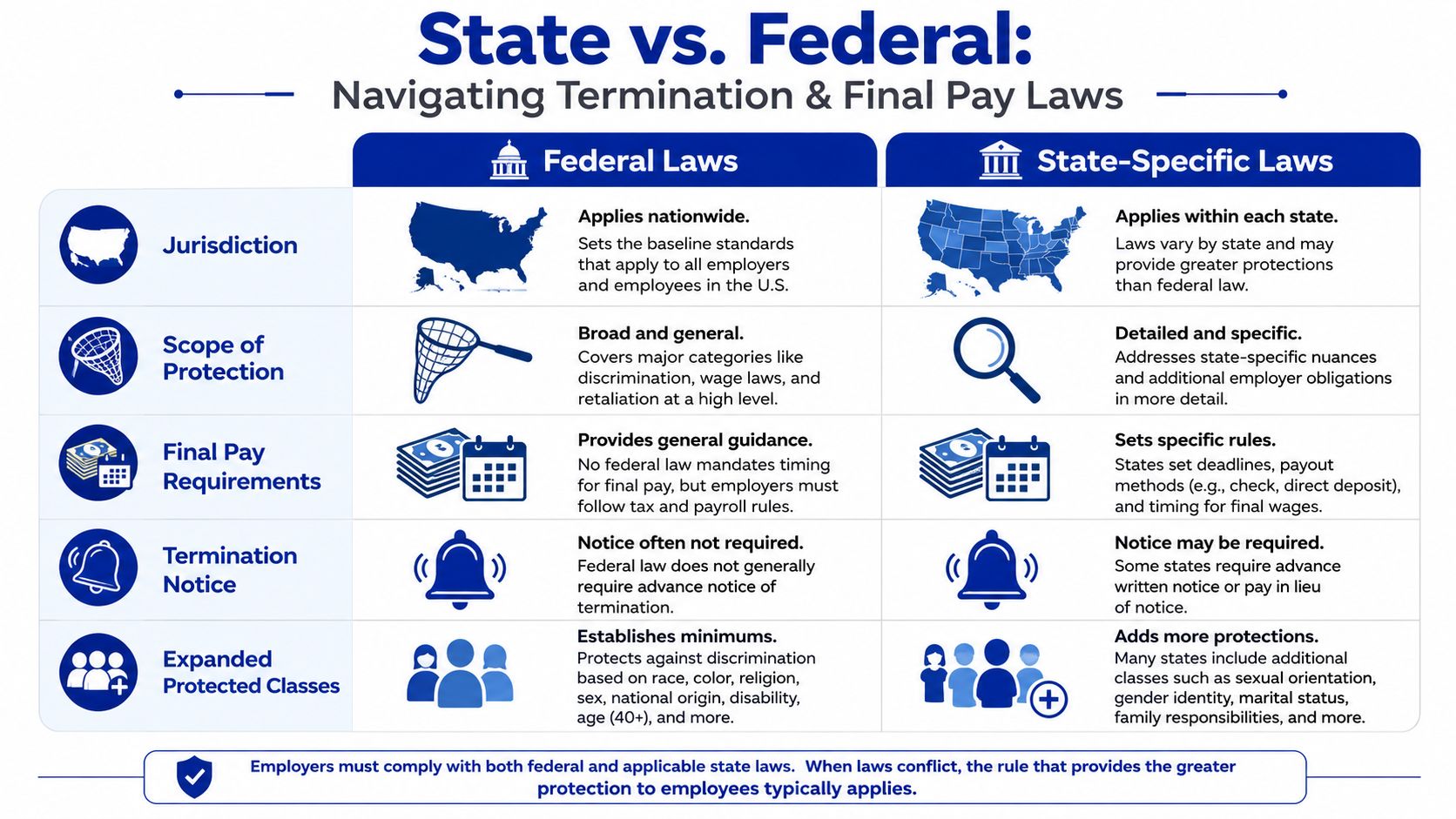
The federal baseline is broad, but states often add their own mechanics. Those mechanics can include final wage deadlines, required notices, and payout timing for accrued benefits. If your HR team treats every termination the same, payroll can become the weak point even when the decision itself was justified.
California is the clearest example of why this matters. Under California Labor Code Section 201, if an employee is fired or laid off, all wages due must be paid immediately upon termination. If the employee quits with at least 72 hours' notice, wages are due on the last day. If the employee quits with less than 72 hours' notice, payment is due within 72 hours after notice is given (Legal Aid at Work factsheet). A state-by-state PTO payout review is often part of the same compliance check, because final pay and leave payout issues tend to travel together.
The biggest mistake is treating final pay as an admin task instead of a legal event. A termination meeting can go smoothly, then payroll misses the deadline or forgets a required component, and the company inherits a wage claim that had nothing to do with performance.
That's especially important for SMBs with employees in multiple states. One state may require immediate payment, another may allow a later deadline, and a third may handle accrued PTO differently. If you don't verify the jurisdiction before the meeting, you're guessing on a compliance issue that should never be guessed at.
Before any termination, confirm:
That short check prevents a lot of downstream friction. It also creates a cleaner handoff between HR, payroll, and the manager who's delivering the separation message.
Most termination problems start before the meeting and end long after it. The legal theory may be sound, but the process often breaks down in the details, especially when leaders move too fast or assume a clean business reason will carry the day without support.
Inconsistent policy enforcement is one of the fastest ways to weaken a termination decision. If one employee is coached and another is fired for similar conduct, the company needs a clear business explanation for the difference. Without that, the decision can look selective rather than reasoned.
Poor documentation causes a similar problem. Notes that are vague, emotional, or assembled after the fact don't help much when the file is reviewed later. Good records stay objective, track dates, and show that the employee had notice of the concern and a fair chance to respond where appropriate.
Operational rule: if the file wouldn't make sense to an outside reviewer, it's not ready for a termination decision.
The termination conversation can create new exposure if it's handled badly. A manager who improvises, overexplains, or debates the employee often says more than necessary. That can create confusion about the reason for termination and invite arguments about whether the stated reason was real.
The better approach is short, respectful, and factual. The message should be consistent with the documented reason, and the meeting should not become a performance review all over again. The moment the conversation turns into a defense session, the company loses control of the tone.
Federal COBRA rules mean termination can trigger continuation rights for group health coverage. The U.S. Department of Labor says some workers and family members who would otherwise lose group health benefits after termination have the right to continue coverage for limited periods of time (DOL termination guidance). That creates notice and administration obligations, which is why offboarding has to include benefits, not just payroll.
The same is true for internal logistics. Company property needs to be returned, access should be revoked, and exit paperwork should be coordinated so one missed step doesn't create another issue. Small operational misses can turn a lawful decision into a messy one.
A defensible termination process isn't about making every separation painless. It's about making the decision consistent, documented, and legally reviewable before anyone says the words in the meeting. That's the standard multi-state SMBs need if they want fewer surprises.
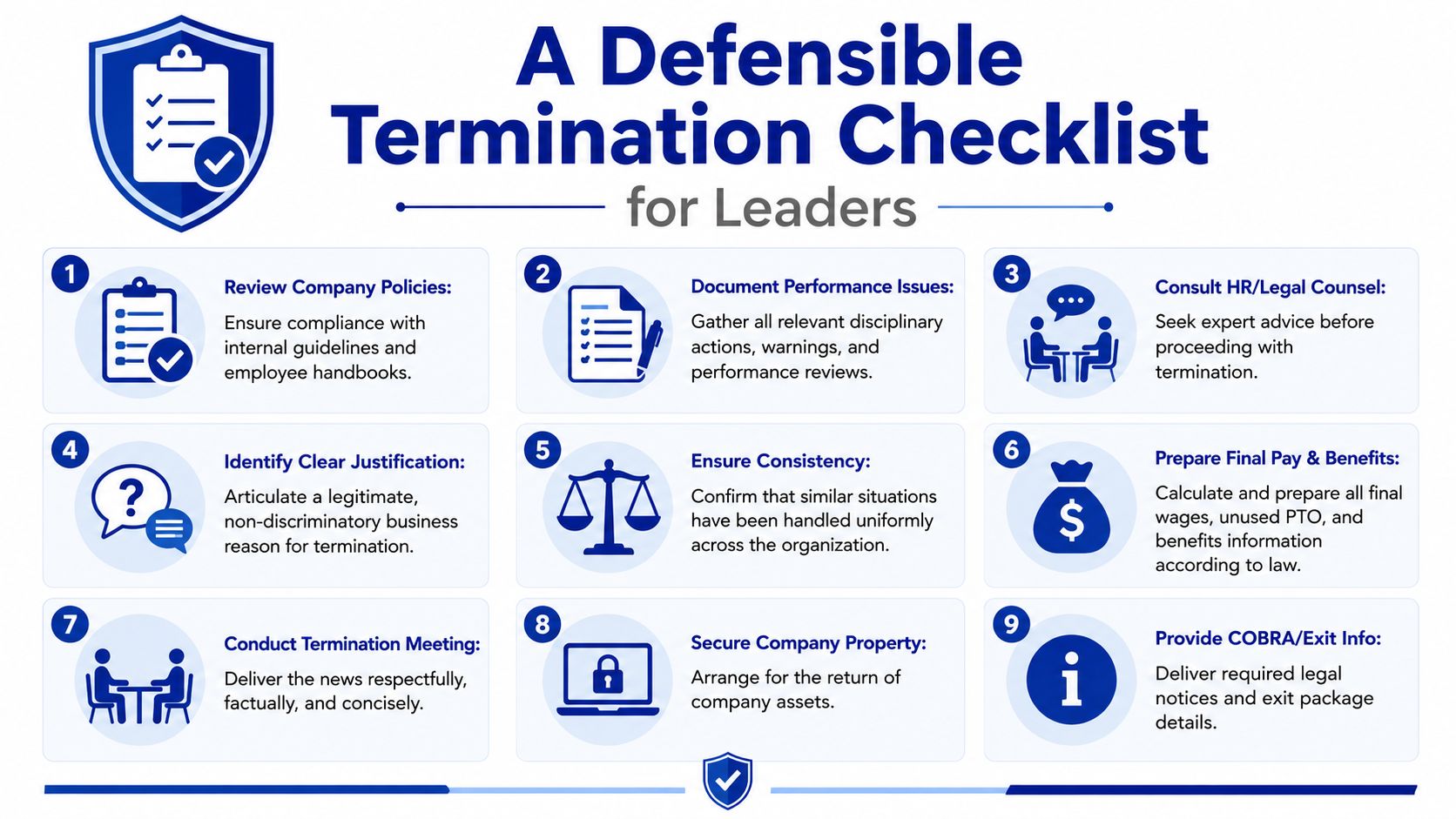
Start with a risk review. Check whether the employee recently complained, requested leave, asked for accommodation, or otherwise engaged in protected activity. Then compare the proposed action with how similar situations were handled so you can spot inconsistency before it becomes a defense problem.
Your documentation should show the business reason, the history, and the response opportunities the employee had. That means performance notes, warning history, relevant policy references, and any HR review that helped shape the decision. Keep the language factual and avoid side comments that sound irritated or personal.
Choose the people who need to be present and keep the meeting tight. The message should be respectful, clear, and consistent with the documented reason. If the employee asks for detail, answer briefly and stay inside the approved script.
After the meeting, confirm final pay timing, benefits notices, and property return. In states with strict wage rules, payroll needs to be ready before the conversation starts. COBRA notices, exit information, and account access should all move on a controlled timeline.
A practical offboarding sequence usually includes:
If you want a structured way to pressure-test terminations, use the checklist above, then compare it with the termination planning tools leading international advisory firms use in their advisory work. That kind of review helps leadership teams avoid the errors that turn a lawful separation into a defendability problem.
Paradigm International Inc. helps SMB leadership teams handle terminations, investigations, manager conduct, and multi-state HR risk with a structured advisory approach. If you're building a more defensible termination process, visit Paradigm International Inc. to learn how they support business owners and executive teams through high-stakes people decisions.