A manager wants to end someone's employment today, but payroll has already closed. The employee works in another state, the vacation balance hasn't been checked, and a commission is still being reconciled. For an owner handling HR alongside daily operations, the immediate question is practical: can the final check wait until payday, or does someone need to arrange payment before the meeting?
A company-wide rule to pay final wages on the next payday can fail when employees work in different states. The deadline may depend on whether the employer discharged the employee or the employee resigned, and the full calculation may involve commissions or accrued vacation.
The table is a selected-state reference for 2026, not a complete statement of final paycheck laws by state. Confirm the current rule for the employee's work state before scheduling payment. An open entry means the deadline needs review against current state law.
Final paycheck deadlines for selected states
| State | Discharged employee | Employee who resigns | Notes |
|---|---|---|---|
| Federal (FLSA baseline) | No universal federal final-pay deadline; regular payday generally applies | Same as discharge | The U.S. Department of Labor's final-pay guidance says federal law doesn't require immediate payment |
| California | Paid at separation | Within 72 hours, or on the last day if at least 72 hours' notice was given | Waiting-time penalties can apply for willful nonpayment |
| Texas | Within six days | By the next regular payday | Separate rules for discharge and resignation |
| Illinois | At separation if possible, no later than the next regular payday | Same as discharge | Applies to final compensation |
| Minnesota | Confirm the current separation deadline with the state labor department | Confirm the current separation deadline with the state labor department | Regular pay frequency appears in the payday table below |
| Wisconsin | Confirm the current separation deadline with the state labor department | Confirm the current separation deadline with the state labor department | Regular pay frequency appears in the payday table below |
| Alabama | No general final-pay timing statute | No general final-pay timing statute | Commissions may be due within 30 days after termination |
| All other states | Check the state labor department | Check the state labor department | Not covered in this table |
The California, Texas, and Illinois rows summarize state wage-payment rules. Alabama requires a separate review of commission terms. An open cell or omitted state is not permission to wait for the next payroll run.
Employees working across state lines may require a legal review to determine which rules apply. The same is true if the employer changes a resignation date or other exit terms.
A deadline chart is only one part of the calculation. Check the applicable pay frequency, each pay component, and accrued vacation or PTO before issuing the final payment. Assign an owner to verify the deadline and calculation.
A company with employees in several states can't safely use one next-payday rule for every separation. Federal law does not set a general deadline for paying ordinary final wages. The U.S. Department of Labor's last-paycheck guidance explains that state law may require an earlier payment.
The Fair Labor Standards Act, administered by the DOL's Wage and Hour Division, sets federal minimum-wage and overtime requirements. It does not generally require immediate payment of ordinary final wages. Employers still need to pay all wages due under applicable federal and state requirements.
Payroll needs the employee's work location and separation facts before it can assign a payment date. A state deadline may require payment before the next regular payday, so a payroll calendar alone cannot determine the deadline.
Set one consistent workflow for every separation: notify payroll, review the wages due, and document payment approval. Build consistency into the workflow; set the deadline from the employee's state.
Practical rule: Use the employee's state-specific requirements to set the payment date.
Workers who have not been paid by their regular payday can contact the DOL's Wage and Hour Division or the relevant state labor department. Keep a clear record of wage calculations, overtime, and the payment date so the employer can explain how it determined the final amount and timing.
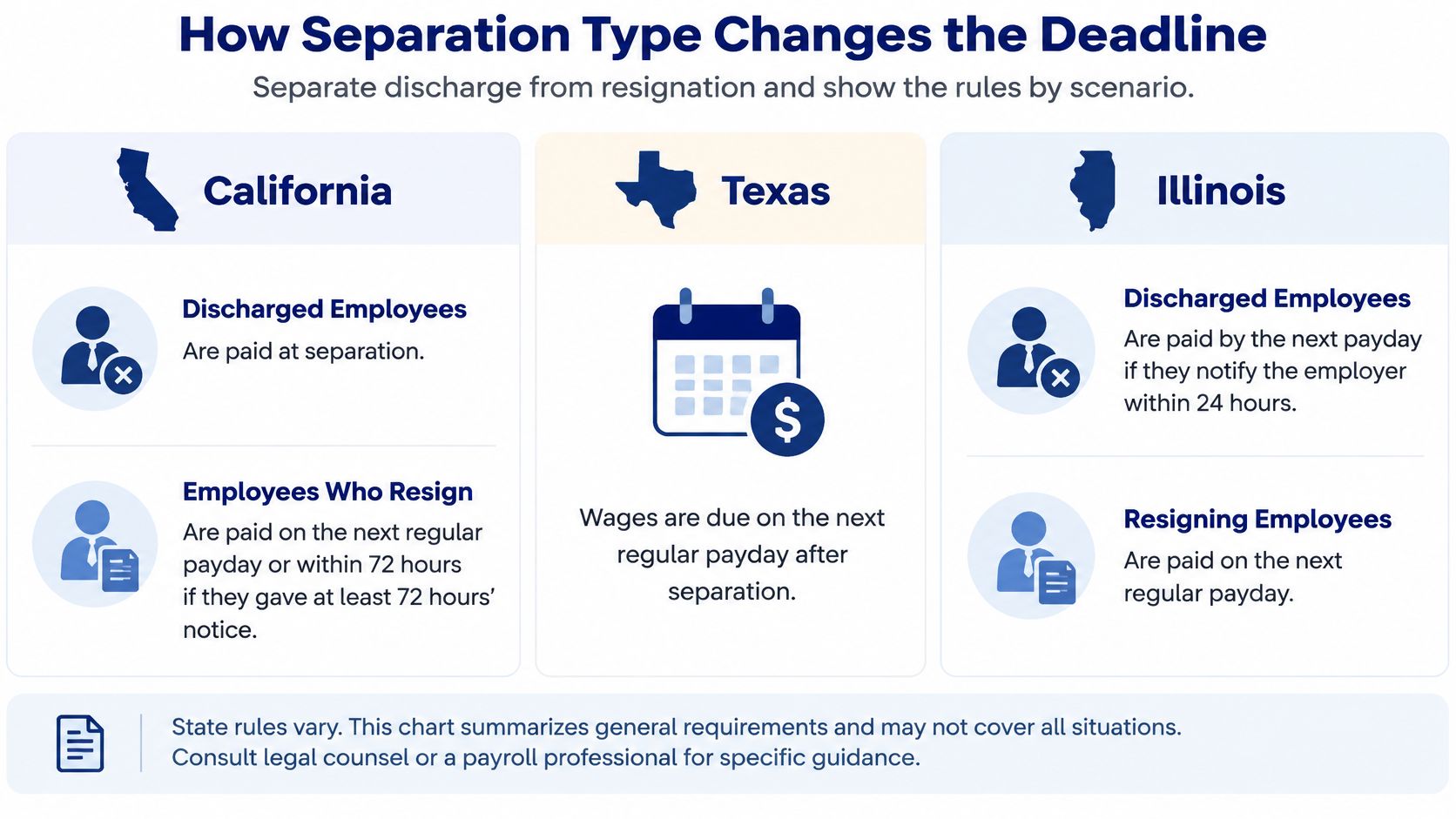
A resignation and a discharge can trigger different payment deadlines in the same state. Build the payroll instruction around how employment ended, not just the employee's last day.
Under the state rules summarized for 2026 in Recording Law's final-paycheck guide, California generally requires payment at discharge, while a resignation without at least 72 hours' notice allows payment within 72 hours. Texas generally sets a shorter deadline for discharge than for resignation. Illinois requires final compensation at separation if possible, and no later than the next regular payday. California's waiting-time statute can impose continuing wages for up to 30 days for willful failure to pay all wages due (California Labor Code section 203).
A planned California discharge calls for payroll preparation before the meeting. Confirm hours, review compensation, and calculate vacation before finalizing the separation. A routine payroll cutoff may not meet the applicable deadline.
In Texas, distinguish an employer-initiated exit from a resignation. A resignation may fit the regular payroll calendar, while a discharge needs its own deadline calculation. If the HR system labels both events as “termination,” payroll may miss the distinction.
In Illinois, review all final compensation, not just base pay. Identify what has been earned and which items belong in the payment. A correct payment date does not fix an incomplete compensation calculation.
The comparison graphic is a visual aid. Use the written state rules and current guidance to set the payment date.
Capture these details in the exit record:
A layoff may be treated under a state's discharge rules, so the label alone does not set the deadline. The distinction between voluntary and involuntary termination can also matter when the employer changes an employee's proposed departure date.
For a separation tied to a complaint, protected leave, an investigation, or a disputed amount, involve qualified employment counsel before releasing the final check. That review can help address both the payment obligation and the circumstances surrounding the separation.
An employee's regular payday can help determine the final-pay date, but the rule varies by state and may depend on the separation circumstances. Treat state payday laws as requirements that set the regular payday, then check whether a final-pay rule changes the deadline.
For 2026 planning, the U.S. Department of Labor's state payday table lists Texas requirements of at least twice-monthly pay for most nonexempt employees and at least monthly pay for FLSA-exempt employees, California's general twice-per-calendar-month requirement, Minnesota's general 31-day wage interval and three-month commission interval, and Wisconsin's general monthly requirement with no more than 31 days between pay periods.
Regular payday rules for selected states
| State | General wage payday rule | Commission rule | Notes |
|---|---|---|---|
| Texas | Nonexempt employees at least twice monthly; FLSA-exempt employees at least monthly | Confirm the applicable commission terms and state requirements | Regular payday may set the deadline for some resignations |
| California | Generally at least twice each calendar month on designated regular paydays | Confirm the applicable commission timing requirements | Exceptions apply; check the statute |
| Minnesota | Wages generally at least once every 31 days | Generally at least once every three months on a regular payday | Includes salary, earnings, and gratuities |
| Wisconsin | Wages earned generally at least monthly, with no more than 31 days between pay periods | Confirm applicable state requirements and compensation terms | Exceptions include certain farm and logging workers |
A single next-payroll rule can miss a state-specific deadline. One employee's regular payday may satisfy the applicable separation rule, while another employee may need an earlier off-cycle payment.
Track each employee's work state, classification, established payday, and the period that payday covers. Separate wage and commission schedules where the rules differ. A wage-and-hour compliance review can help identify gaps between written schedules and payroll practices.
Keep state-specific timing fields in a central process rather than forcing one assumed rule. This adds configuration work, but gives payroll clear instructions for each employee.
A transfer, remote-work move, or change of employing entity should trigger a payday review. Record the pay frequency for the employee's work state and recheck it whenever the employment arrangement changes.
Alabama illustrates why a final-pay chart needs a compensation review alongside it. For 2026 planning, the DOL wage-payment material identifies no general Alabama final-paycheck timing statute, while certain commissions may be due within 30 days after termination, with enhanced liability for nonpayment. Employers should confirm the applicable commission law's scope rather than treating that statement as a universal rule for every sales arrangement.
Base wages and commissions shouldn't be treated as one undifferentiated balance. Each item needs its own calculation, legal timing review, and supporting document. A commission reconciliation doesn't automatically justify delaying undisputed wages.
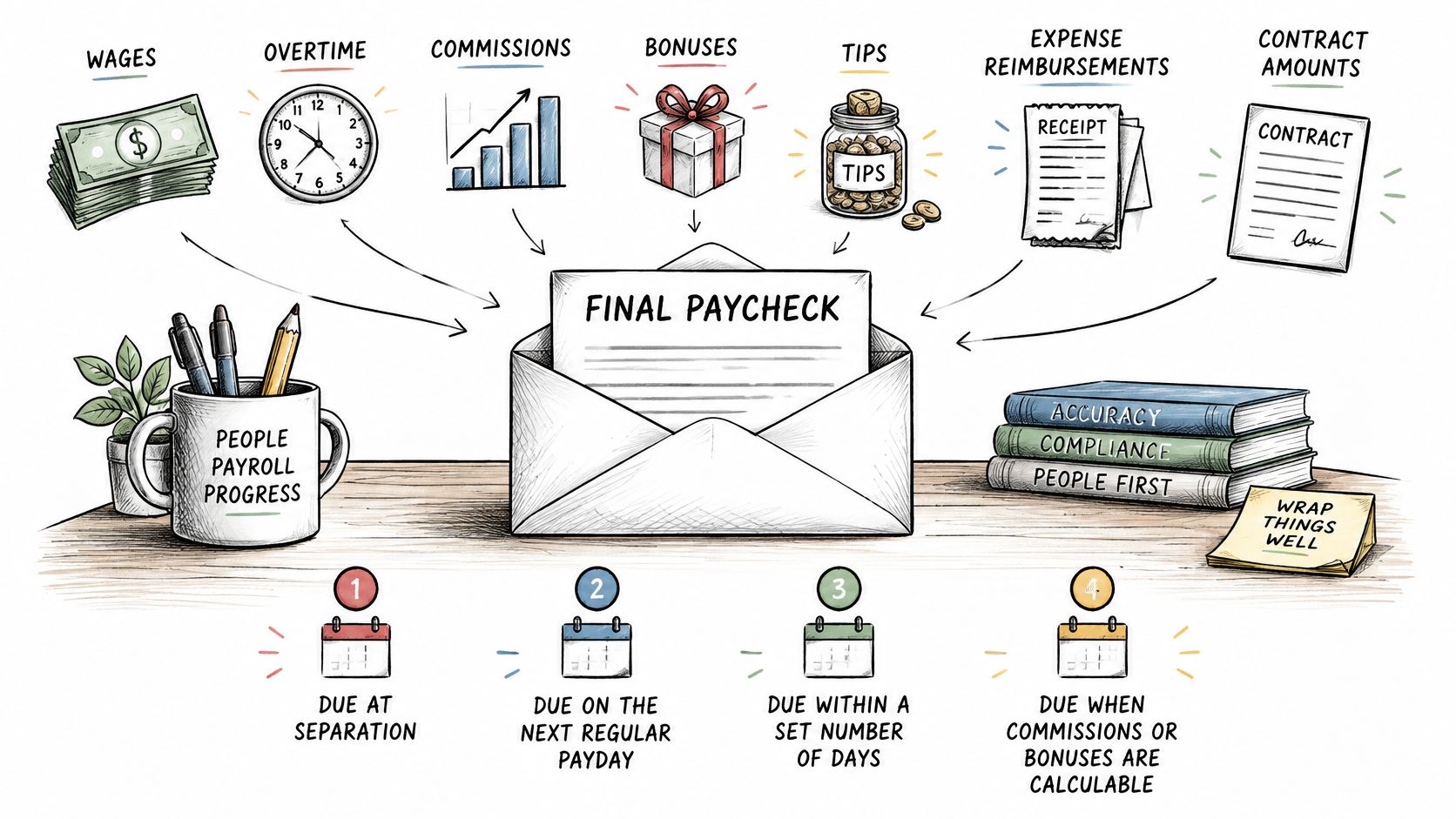
Final pay components and timing categories
| Pay component | Timing category | Common error |
|---|---|---|
| Base wages and salary | Due at separation or the applicable regular payday under state law | Holding wages while other items wait |
| Overtime | Apply the state's final-wage timing rule and confirm calculation requirements | Missing hours from a late payroll close |
| Commissions | Assess when earned, when calculable, and the applicable statutory deadline | Waiting for sales reconciliation beyond the deadline |
| Bonuses | Review the written plan or agreement alongside applicable wage law | Failing to document eligibility or vesting conditions |
| Tips | Review final-wage timing and outstanding tip records | Leaving tip records incomplete at separation |
| Expense reimbursements | Review state law and written policy | Holding reimbursement without a documented basis |
| Contractual amounts | Review the written agreement and applicable law | Failing to locate the governing terms |
Useful working categories are due at separation, due on the regular payday, due after calculation, and controlled by an agreement or policy subject to law. These categories organize the review; they don't authorize postponement. An employer needs a legal basis for the selected timing, not just an internal accounting preference.
For example, a salesperson may have approved hours, an earned incentive, and transactions awaiting confirmation. Payroll should calculate the approved items separately and assign an owner to resolve the transactions. The file should include sales records, plan terms, calculations, and the reason for any later payment.
Before payroll closes, the reviewer should identify every proposed deduction and document its basis. An equipment dispute or alleged overpayment should be escalated for state-specific review rather than inserted as an unexplained adjustment. A written authorization shouldn't be assumed sufficient without checking the governing requirements.
For teams organizing payroll documents, Matil's resource on automating payroll document capture offers context for reducing manual document handling. Document automation supports the file; it doesn't determine whether compensation is earned or a deduction is lawful.
An unresolved pay component needs a named reviewer and a documented resolution path, not an indefinite hold on the entire final payment.
A company-wide rule to pay unused PTO on the next regular payday can miss state requirements. For each departing employee, check the work-state law, the written policy, and any employment contract. A payroll balance shows what the system recorded; it does not, by itself, establish what the employer owes.
Check how the policy treats vacation, sick leave, and combined PTO banks. The benefit's label alone does not settle whether the balance is payable. Review how it accrued, which restrictions employees were told about, and whether the policy complies with the applicable state rule.
California Labor Code section 227.3 treats earned vacation as wages that cannot be forfeited through a use-it-or-lose-it policy. Include the earned balance in the final-pay calculation under the applicable California rule.
Under the Illinois Wage Payment and Collection Act, 820 ILCS 115, payout of earned vacation depends on the employer's policy. If the policy provides for payment of earned vacation at separation, include that amount in the review. Check the work-state rule before applying any forfeiture term in the policy.
A state-specific PTO payout review by state can help identify how vacation and combined PTO balances should be handled. Ask counsel to review unusual accrual arrangements or conflicting policy documents.
A negative PTO balance needs its own deduction review. A payroll system's ability to subtract it does not establish a lawful basis for recovery.
Forfeiture disputes and policy changes made after accrual warrant legal review before action. Changing handbook language may improve future administration, but it does not necessarily resolve amounts already earned. Preserve the historical policy and accrual records.
A final-pay checklist needs clear handoffs, documented decisions, and a release approval. The manager records the circumstances of the separation. HR reviews policy and compliance questions, payroll confirms how payment will be issued, and an authorized leader resolves open issues before release.
Use a controlled spreadsheet alongside the separation form. For each state, record the applicable authority, review date, relevant scenarios, payment-method considerations, and unresolved exceptions. Keep sensitive employee details in an access-controlled personnel record, not a shared payroll calendar.
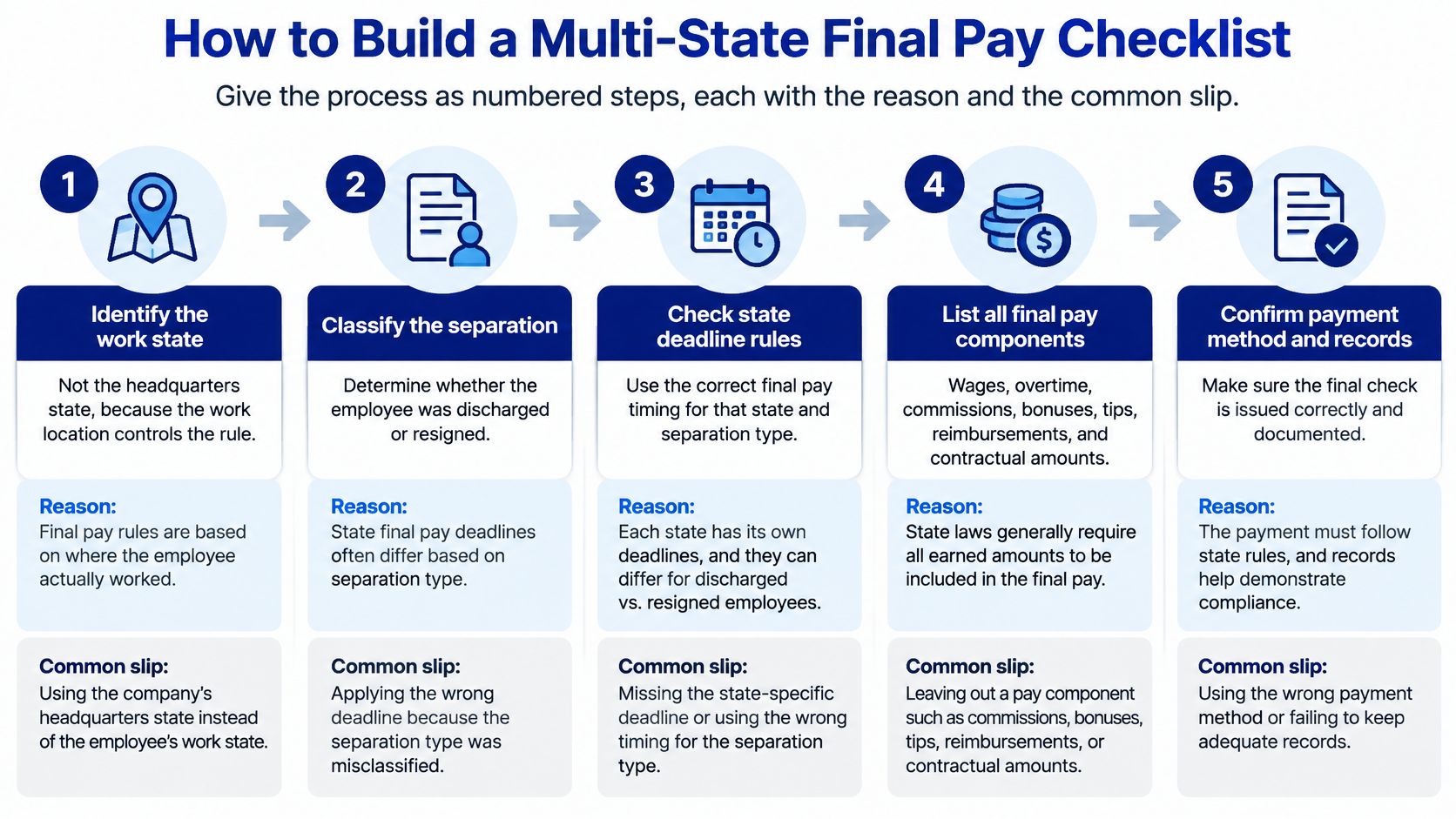
Open a separation record. Document the manager's information and assign an HR reviewer, payroll contact, and approval owner. Keep the decision and payment execution as distinct handoffs.
Build the calculation record. List wages, overtime, commissions, bonuses, tips, reimbursements, and contractual amounts. Note any eligibility conditions, and assign an owner to resolve incomplete items such as pending sales approvals.
Support each adjustment. For every deduction or balance correction, retain the authorization, agreement, or other documented basis. Avoid a lump-sum entry labeled only as money owed to the company.
Reconcile vacation or PTO. Compare the recorded balance with the governing policy, contract, and applicable requirements. Check pending leave entries before approving the figure.
Approve payment execution. Record the planned payment date and permitted delivery method, identify who will execute it, and retain the confirmation or attempted-delivery record with the separation file.
Close the loop. Record the calculation, approval, and payment evidence. Assign an owner to review the state matrix after changes in an employee's work location or employing entity.
A compliance risk assessment can help identify missing owners and unsupported assumptions in the workflow. Test the process with a hypothetical urgent separation: follow the approvals, calculation, funding, and delivery steps. Turn each unanswered handoff into a specific process correction.
For employers in wholesale, new laws shaping wholesale compliance may provide broader industry context. Final-pay decisions still require review of the employment requirements that apply to the employee.
Release control: The approver should be able to explain the calculation and the delivery plan.
The payroll provider or PEO executes payroll, while company leadership remains responsible for confirming that instructions and configuration match applicable requirements. Our firm doesn't provide payroll or benefits administration; those functions stay with the client's PEO or payroll provider. We handle ongoing HR and compliance work and judgment calls, while the client's PEO, payroll provider, or HR app handles payroll and administrative tasks.
A routine exit can become a high-risk decision when an employee has recently complained, taken protected leave, or disputed compensation. Pause before action if the facts or applicable law are unclear, and involve qualified employment counsel where needed.
For a distributed workforce, confirm which state's law applies to a remote employee before final-pay instructions are issued. The answer may depend on the employee's work location and circumstances, so see this guide to which state law applies to remote employees.
An accurate final-pay calculation does not establish that a termination is appropriate. Counsel's review of a sensitive termination does not replace the separate work of calculating and delivering payment. Assign clear owners to both decisions.
Fractional HR support can help employers keep pace with changing employee regulations and laws, maintain consistent processes, and identify matters that warrant counsel. A general guide cannot resolve every fact-specific question.
Paradigm International Inc. provides HR and compliance advisory support, including guidance on sensitive employee matters and multi-state requirements. Its work supports leadership decisions; payroll and benefits administration remain with the client's PEO or payroll provider. Contact Paradigm International Inc. to discuss HR advisory support for multi-state employee matters.
This article is general information, not legal advice. Employment laws vary by state and may change. Consult qualified employment counsel about a specific separation.