An employee reaches week 12 of medical leave, the provider says more time is needed, and a manager asks if the job can be filled permanently now. That question sits at the center of the FMLA ADA overlap. Exhaustion of FMLA leave doesn't end the analysis. It starts a separate ADA review, and for employers with workers in more than one state, it also starts a state law check.
One absence can involve both laws, but they create different obligations. The Family and Medical Leave Act of 1993, under 29 U.S.C. § 2601 and 29 C.F.R. Part 825, provides a defined leave entitlement. The Americans with Disabilities Act of 1990 may require leave or another change as a reasonable accommodation. Handle each law's requirements separately, then compare the results before making an employment decision.
FMLA and ADA obligations compared
| Obligation | FMLA | ADA |
|---|---|---|
| Core entitlement | Up to 12 workweeks of job-protected, unpaid leave in a 12-month period | No fixed leave period; leave is one possible reasonable accommodation |
| Qualifying condition | Serious health condition or another qualifying family or military reason | Qualified individual with a disability |
| Key test | Medical need and eligibility under the FMLA rules | Individualized assessment of whether leave is effective and whether it causes undue hardship |
| Benefits during leave | Group health continues on the same terms as active employment | Not a fixed ADA rule; plan and other law may apply |
| Return rights | Same or equivalent position after qualifying leave | May require reassignment to a vacant equivalent position if essential functions cannot be performed |
| When protected leave ends | Statutory entitlement ends at exhaustion | Accommodation duty may continue after FMLA is exhausted |
The EEOC guidance on the FMLA, ADA and Title VII explains that the FMLA generally covers private employers with 50 or more employees within a 75-mile radius, while the ADA applies to private employers with 15 or more employees. An employer with 30 employees may have ADA duties without federal FMLA duties. An employer with 80 employees may need to assess both laws for the same absence.
The laws also define qualifying circumstances differently. A serious health condition under the FMLA is not automatically a disability under the ADA. A disability does not establish FMLA eligibility, which also depends on service, hours, and worksite counts.
Working rule: Document the FMLA analysis and the ADA analysis separately, then compare them before deciding what happens next.
The ADA asks whether the employee is a qualified individual with a disability, whether leave or another change would enable the employee to perform the job's essential functions, and whether the accommodation would cause undue hardship. Review what counts as a reasonable accommodation under the ADA to understand the framework before applying it to a specific case.
The answer depends on the employee's job, restrictions, expected return date, and the operational impact of the requested accommodation. Apply that individualized assessment even after FMLA leave runs out.
A professional services firm with 30 employees across two offices owes federal ADA duties but generally does not meet the FMLA's employer-size threshold. That does not end the review: a medical leave request still calls for an ADA accommodation analysis.
Which law applies by employer and employee situation
| Situation | FMLA applies? | ADA applies? | Check first |
|---|---|---|---|
| Private employer with 15-49 employees | No | Yes | Confirm total headcount for the ADA threshold |
| Private employer with 50+ employees, employee within 75 miles of 50 employees | Yes, if the employee is eligible | Yes | Confirm 12 months of service and 1,250 hours |
| Private employer with 50+ employees, employee far from the employer's worksites | Generally no under the 75-mile count | Yes | Identify the employee's worksite and any state leave law |
| Remote employee working in a different state from the manager | Worksite count controls | Yes | Identify the work state and its leave and disability rules |
| Employee with a disability who is FMLA-ineligible | No | Yes, if the employer is covered | Run the ADA accommodation analysis separately |
A distributor with 120 employees, most based at one warehouse, also employs a remote salesperson several states away. The company-wide headcount alone does not establish the salesperson's FMLA eligibility. Check the worksite count, then assess ADA duties and the rules tied to the salesperson's work state.
Remote work makes the worksite question harder, not optional. Record where the employee is assigned or reports for FMLA purposes, and identify the state where the employee works before deciding which leave rules apply.
Complete these checks before issuing notices or setting deadlines. If the worksite or employee's state is unclear, resolve that question before making a leave-based decision.
An employee in California may qualify for protected leave even when the employer falls below the federal FMLA threshold. A remote employee can create the same kind of compliance issue in a state where the company has no office. The employee's work state sets the starting point for checking which leave and accommodation rules apply.
The EEOC guidance on reasonable accommodation and undue hardship explains that disability-related leave may be required when no other effective accommodation is available and the leave would not create undue hardship. State programs can also affect how paid and unpaid time is funded, noticed, and coordinated.
State rules that can change the leave and accommodation analysis
| State or case | Rule that can change the analysis | What to check |
|---|---|---|
| California | CFRA applies to employers with 5 or more employees, below the FMLA threshold | Check CFRA leave rights even when the employer falls below the federal FMLA threshold |
| Florida | No general state family leave law like FMLA; Florida Civil Rights Act covers disability for 15 or more employees | Assess disability duties under federal law and confirm the FCRA headcount |
| New York | Paid family leave may apply to eligible employees | Check eligibility, available benefits, and how the program coordinates with other leave |
California illustrates why federal headcount alone is not enough. An employer below the FMLA threshold may still have leave obligations under the California Family Rights Act.
Florida presents a different set of questions. It has no general state family and medical leave law mirroring the FMLA, while disability discrimination duties may apply under federal law and the Florida Civil Rights Act. A state leave bank and an accommodation review are separate issues.
Employers with workers in several states should map state family leave laws for every employee work location, including remote locations. The applicable rules can change even when the company's office locations stay the same.
State requirements change on different schedules. Before making a leave-based separation decision in an unfamiliar state, confirm the current rules with qualified employment counsel.
FMLA administration comes first for a practical reason. The FMLA file becomes the evidence base for any later ADA review. Dates, certifications, restrictions, and usage records created during FMLA leave are the same facts needed to assess additional leave, a modified schedule, or reassignment. A thin FMLA file forces the ADA review to start from memory.
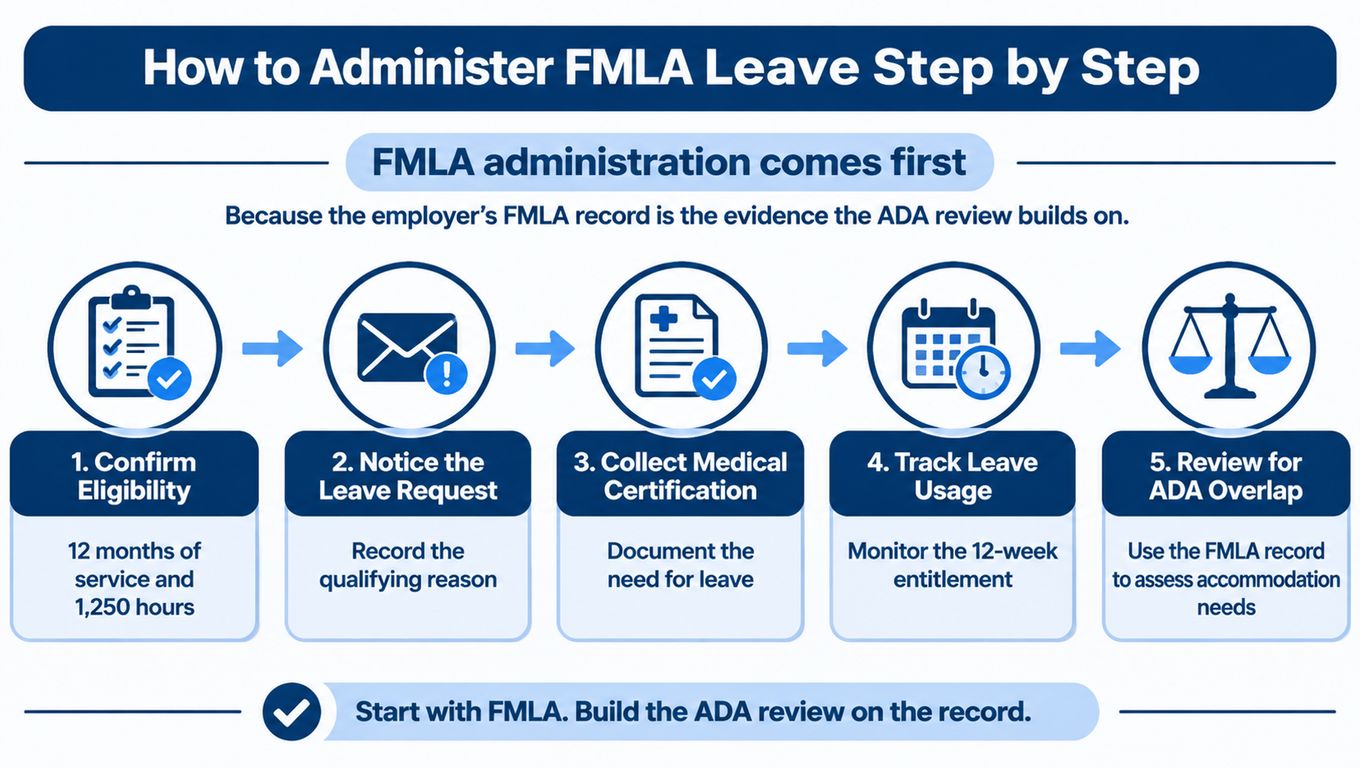
Intermittent and reduced-schedule leave is where informal attendance habits cause the most damage. The Department of Labor FMLA regulations at 29 C.F.R. §§ 825.202-825.203 permit intermittent or reduced-schedule leave for an employee's own serious health condition when there's a medical need best accommodated through that schedule, and 29 C.F.R. § 825.205 requires counting in increments no larger than the shortest increment used for other leave, capped at one hour, without deducting more time than the employee uses.
Scheduling should be coordinated with the employee and the provider's treatment plan where the rules allow it. The goal is a predictable pattern where treatment permits one. Unanticipated flare-ups won't always allow advance scheduling, and the file should reflect that distinction rather than labeling every absence a policy violation.
A complete FMLA file contains the eligibility notice, rights notice, certification, written designation, usage log, and running balance. If one item is missing, the file isn't complete.
Concurrency also belongs in the log. When the same condition qualifies under both laws and leave is properly designated, FMLA leave and ADA leave can run at the same time rather than as separate stacked banks. Recording that designation contemporaneously prevents a later argument that a second full leave period automatically follows the first.
A machinist at a manufacturer with 70 employees exhausts 12 weeks of FMLA leave after surgery. The provider estimates six more weeks of recovery, with a firm return date and full-duty clearance expected. FMLA exhaustion ends the employee's FMLA entitlement, but it does not end the employer's duty to assess whether additional leave is a reasonable ADA accommodation.
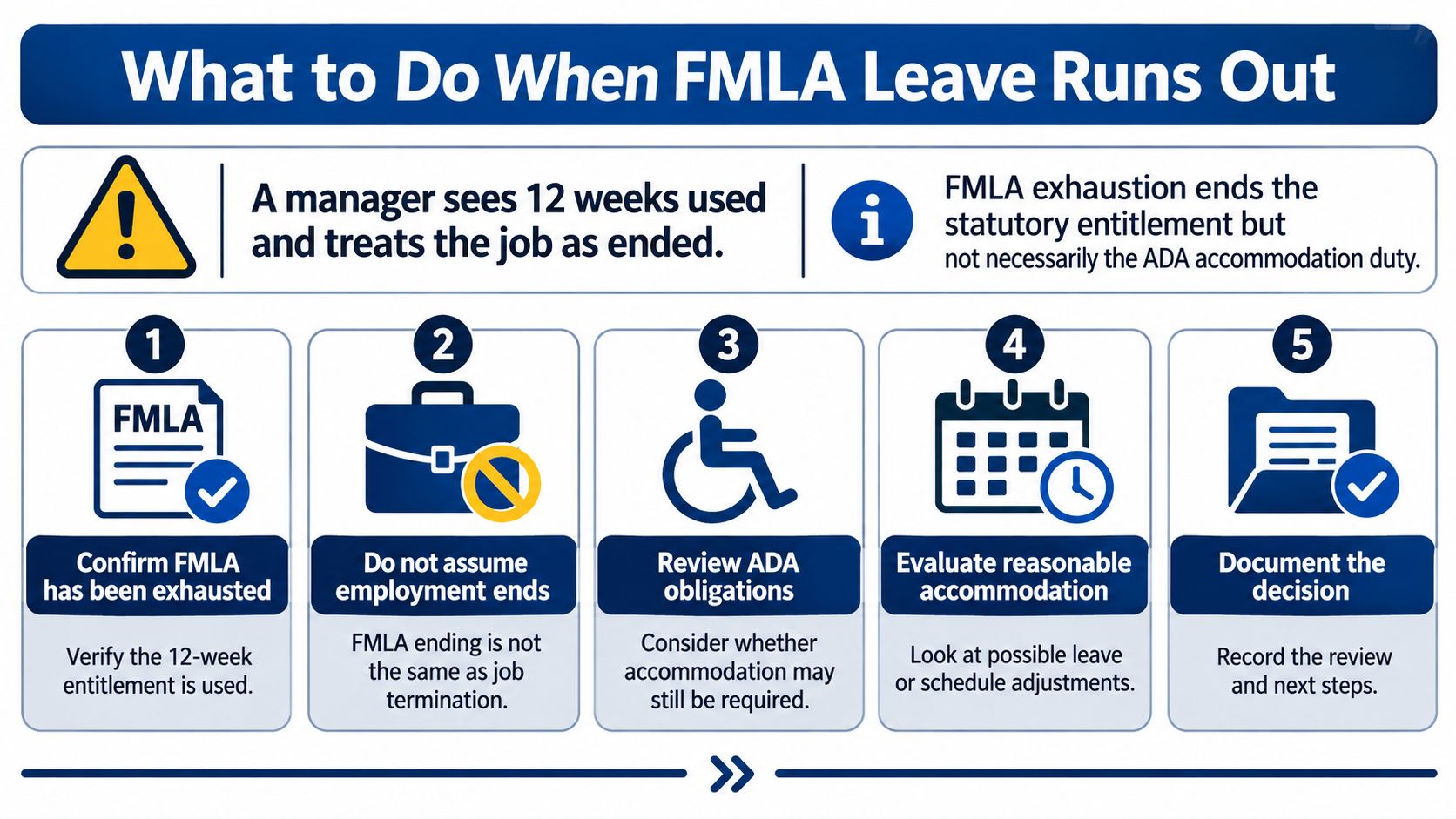
The EEOC guidance on disability discrimination, medical inquiries, leave and telework explains that leave may be a reasonable accommodation when it enables an employee with a disability to return and perform essential functions. An employer does not have to remove essential functions, accept materially lower-quality work, or provide indefinite leave without a reasonably foreseeable endpoint. The ADA sets no universal leave duration. Assess reasonableness based on the individual circumstances and the effect on the employer's operations.
Finite leave and open-ended leave present different questions. An employer must complete the individualized assessment before concluding that a specific extension is unreasonable. In the machinist example, the firm six-week estimate gives the employer a defined request to assess, including temporary coverage, safety, and operational impact.
If the provider gives no return date, updated restrictions are missing, or the employee does not respond to information requests, document what was requested, what was received, and what remains unknown. Those facts shape the assessment; they do not replace it.
Direct point: Apply attendance rules only after completing the ADA review. Consistent enforcement does not make a skipped assessment adequate.
Before making a leave-based termination decision, get expert review, especially when the file also includes a complaint, investigation, or disability-related restriction.
An employee returning from FMLA leave generally has the right to the same or an equivalent position under the FMLA of 1993 and 29 C.F.R. Part 825. When the employee cannot perform the job because of a disability, assess accommodation under the ADA separately.
Under the ADA of 1990, reassignment means considering a vacant equivalent position the employee can perform when no accommodation enables them to perform their current job. Document the search, including each position reviewed and how its requirements compare with the employee's restrictions and qualifications.
FMLA rules separately allow a temporary transfer in certain planned-treatment cases involving intermittent or reduced-schedule leave. Keep that temporary transfer distinct from ADA reassignment, and record the authority for the move. State law and collective bargaining agreements may affect the analysis.
Return clearance needs a clear connection to the job. A fitness-for-duty evaluation should address the employee's ability to perform relevant job functions and the medical facts at issue. A broad medical inquiry untethered to the job can create problems instead of resolving them.
Keep medical information separate from the personnel file and limit access to people who need work-related restrictions. Managers should ask about work limits and dates, not diagnoses. If a supervisor receives a diagnosis, route it to the designated HR contact and avoid follow-up medical questions.
Before denying a return or changing the employee's job, confirm the file connects the job requirements, restrictions, options considered, and decision. If that record is incomplete, finish the analysis before acting.
A termination is pending, an employee's FMLA leave is ending, and a disability-related restriction remains unresolved. Pause before acting. A complaint, open investigation, overlapping leave and accommodation issues, or employees working in multiple states all call for review before leadership makes a decision.
For leave and FMLA matters, Paradigm International Inc. manages FMLA requirements and administration for clients. Its service handles eligibility, accommodations, and return-to-work consistently, state by state. Qualified employment counsel should review legal questions.
Get an expert review before issuing a decision if an FMLA exhaustion date is approaching, restrictions are disputed, or the employee's work and leave involve more than one state. For remote employees, confirm which state's requirements apply based on where the employee works.
This article is general information, not legal advice. Employment laws vary by state. Consult qualified employment counsel about your situation.
Employers seeking support with FMLA administration, accommodation processes, and multi-state leave documentation can contact Paradigm International Inc. for employer-side HR consulting and decision support. A review of coverage, leave records, and return-to-work decisions helps leadership make a better-informed call.