
Navigating employee leave can feel like a complex puzzle, but one document stands out as your best tool for clarity and compliance: FMLA Form 380-E. This is the official Department of Labor form for certifying an employee's own serious health condition. Getting this form right is the key to gathering the medical facts you need to determine if a leave request truly qualifies for FMLA protection, making it a critical piece of compliant leave administration.

When an employee needs time off for a serious health issue, the Family and Medical Leave Act (FMLA) offers essential job protection. For your business, however, this creates a significant compliance burden. Getting the rules wrong can lead to expensive legal battles and regulatory fines. This guide demystifies the process by focusing on its most important document: FMLA Form 380-E.
Stop thinking of this form as just more paperwork. It is your best method for building a fair, consistent, and legally defensible leave process. It provides an official channel to validate an employee’s need for leave while respecting their privacy. When managed correctly, it ensures FMLA protections are used as intended, protecting both your business and your team.
A structured, consistent approach to Form 380-E is fundamental to good HR risk management. It empowers you to:
This guide moves beyond dense legal jargon to give you a clear, actionable playbook for requesting, reviewing, and managing these medical certifications. Understanding the full scope of a leave of absence from work is critical, and this document is a key part of that puzzle. Mastering this form will allow you to handle employee leave with confidence and precision.
Our goal is to provide the practical knowledge to turn your FMLA process from a source of anxiety into a well-oiled system. For personalized support in strengthening your HR compliance framework, our team is here to help. To learn more, contact our team.
When an employee mentions a health issue that might require them to be out of the office, your first thought may be how to manage their absence. However, your first action should be to start the FMLA process correctly. This is exactly where FMLA Form 380-E, the Certification of Health Care Provider for an Employee’s Serious Health Condition, comes into play.
Think of Form 380-E as your official, standardized tool for gathering the facts. It is the Department of Labor’s method for confirming an employee’s need for leave is legitimate. This protects your business and creates a clear, defensible record of how you handled the request. Using this form ensures FMLA is applied fairly and only when truly warranted.
At its heart, FMLA Form 380-E is designed to verify that an employee’s medical issue meets the FMLA's specific definition of a “serious health condition.” It is completed by the employee’s healthcare provider and gives you objective medical facts—not a diagnosis—to help you make a sound decision on the leave request.
This form has been a cornerstone of U.S. employment law since the FMLA was enacted on February 5, 1993. While using the form is technically optional, it is highly recommended. It allows you to verify if an employee qualifies for up to 12 weeks of unpaid, job-protected leave. In fiscal year 2025, Department of Labor data showed that approximately 58% of the 2.8 million workers who took FMLA leave did so for their own serious health condition. You can see more federal leave administration trends to get the bigger picture.
Using a standard form like this helps you apply leave policies the same way for every employee. That consistency is your best defense against claims of unfairness or discrimination. It also gives you a clearer picture of the leave’s potential duration and frequency, which is vital for planning staffing and workflow.
Getting the FMLA certification process right involves three key people, and each has a specific job to do. When everyone understands their role, the process runs much more smoothly.
A common mistake is thinking Form 380-E gives you the right to an employee's diagnosis. It does not. The form is specifically designed to provide only the necessary medical facts to determine FMLA eligibility—like whether it involves inpatient care or continuing treatment—without crossing into private medical details.
The structure of Form 380-E is intentionally straightforward. It is designed to get you the exact information you need to make a solid FMLA decision while respecting the employee’s privacy. It helps you understand the scope of the leave so you can manage your operations. Of course, this all starts with knowing who is eligible for FMLA, which you can double-check with our comprehensive FMLA eligibility checklist.
Once you have a completed form, you can confidently determine if the leave will be for a single block of time, needed on an intermittent basis, or require a reduced work schedule. Every piece of information is a vital part of managing employee leave correctly and staying compliant. If you need an expert eye on your FMLA process to make sure it’s both defensible and efficient, our team is here to help. Connect with us today to discuss your specific challenges.
Getting the process for medical certifications right is not just about paperwork; it's about minimizing legal risk and avoiding operational headaches. The moment an employee indicates they might need leave for a health issue, the compliance clock starts ticking. Handling the request and review of Form 380-E correctly from day one is the backbone of a consistent and defensible leave program.
Your best defense against claims of unfairness or discrimination is a clear, repeatable process that you apply the same way for every single employee. This ensures your decisions are grounded in the objective criteria of the law, not subjective judgment.
The process kicks off the instant an employee gives you enough information to suggest a need for FMLA-qualifying leave. You do not have to wait for them to say the words "I need FMLA." Once you are on notice, you have five business days to provide the required FMLA paperwork.
This initial packet should always contain two key documents:
You must give the employee at least 15 calendar days to return the completed Form 380-E. If an employee states they are trying in good faith but are running into delays—like trouble getting a doctor's appointment—it is wise to grant a reasonable extension. Be sure to document all deadlines and any extensions in writing.
This flowchart maps out the typical back-and-forth between you, your employee, and their healthcare provider.
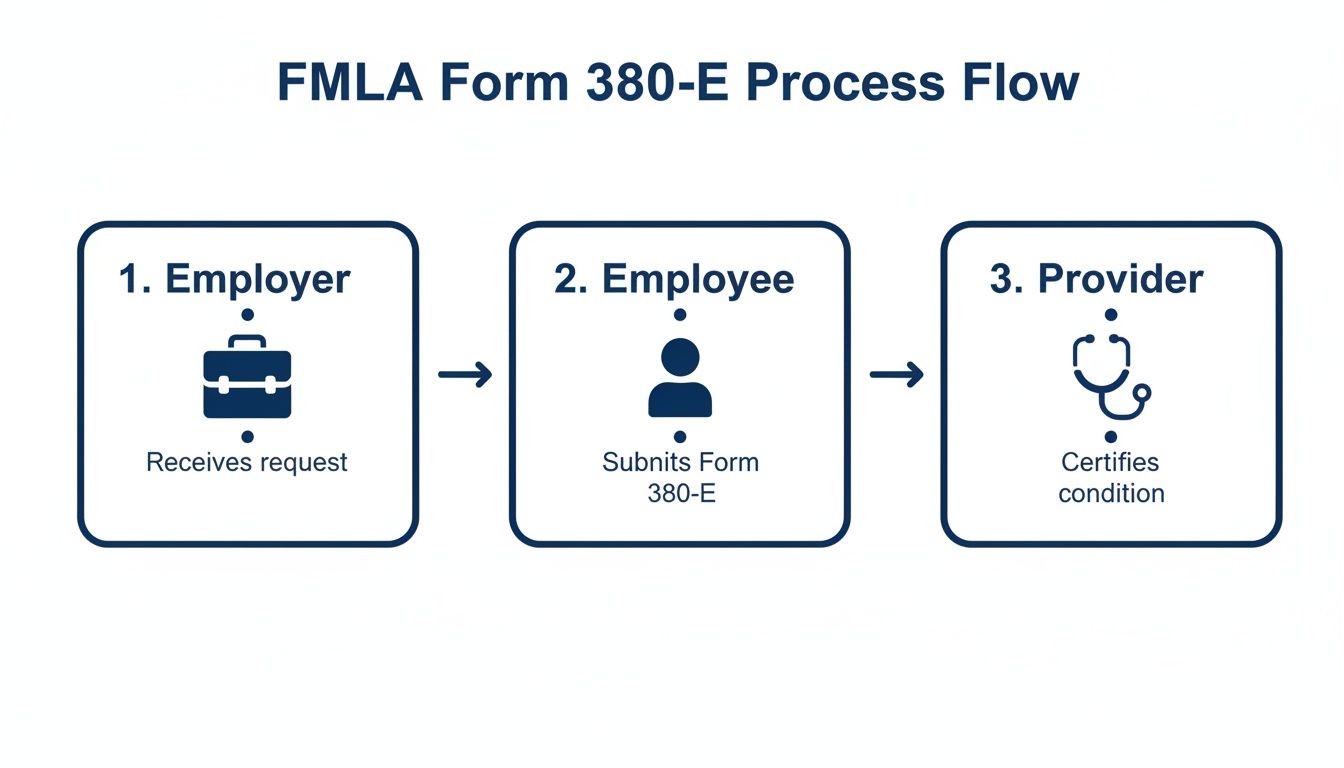
Think of the process as a structured loop. It starts with your request, moves to the employee and their doctor, and ends with your final review. Clear handoffs at each stage are crucial for a smooth process.
Once the completed Form 380-E lands on your desk, your review needs to be systematic. Your job is not to play doctor or question the diagnosis. Your role is simply to verify that the information provided meets the FMLA's definition of a "serious health condition." It’s a fact-finding mission, not a medical one.
When requesting and reviewing these forms, the secure handling of protected health information is non-negotiable. Understanding how to use a HIPAA compliant internet fax can be critical for protecting this data, especially when communicating with a healthcare provider's office.
This table helps you quickly identify the most important information on the form and understand what you are legally permitted to review.
| Section of Form | Information Provided | What to Look For |
|---|---|---|
| Part A | Employer and employee information. | Confirm this is filled out correctly. It is mostly for identification. |
| Part B | Certification from the healthcare provider, detailing the condition's start date, probable duration, and relevant medical facts. | Check that the provider has described a condition meeting FMLA criteria (e.g., inpatient care, incapacity, continuing treatment). |
| Amount of Leave | The provider’s estimate of the frequency and duration of leave needed (e.g., "2-3 times per month, 1-2 days per episode"). | Look for specificity. This information is critical for managing intermittent leave and tracking time used. |
| Job Functions | Whether the employee can perform their essential job functions. If not, the provider lists the functions they cannot perform. | This directly ties the medical condition to the employee's ability to work. You can attach a job description to the initial form. |
By focusing on these specific sections, you can confirm whether the certification is sufficient to approve FMLA leave without overstepping into medical details you are not entitled to. Remember, the form should not contain a specific diagnosis. Its purpose is to certify that a serious health condition exists and to describe its impact on the employee’s ability to perform their job.
Sooner or later, you will receive an FMLA Form 380-E that is missing crucial information. How you handle this moment is a critical test of your company’s compliance discipline. You cannot simply deny the leave request because of a flawed form. The Department of Labor has a specific, structured process you must follow first.
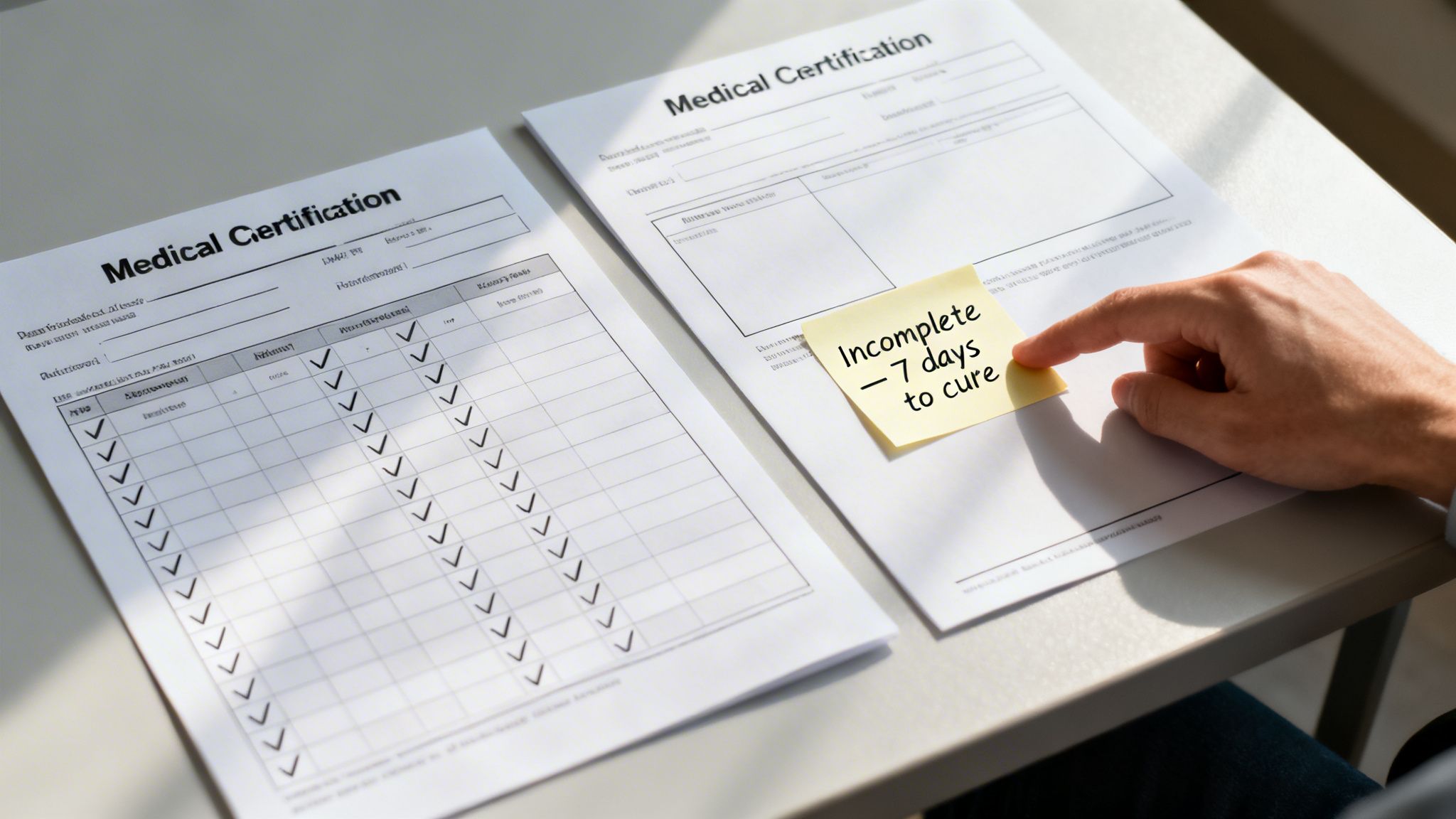
The first step is determining exactly what is wrong with the form. The FMLA has two distinct categories for flawed certifications, and knowing the difference is key to taking the right next step.
A flawed FMLA Form 380-E will fall into one of two buckets. Properly identifying the issue is the first step toward correcting it legally and efficiently.
Regardless of the problem, your next move is the same: you must give the employee written notice and a chance to fix it.
When you identify an FMLA form as incomplete or insufficient, the regulations require you to provide the employee with a written notice that explains exactly what is wrong. You must then give the employee at least seven calendar days to "cure" the deficiency. This means they have a week to take the form back to their healthcare provider to have the information corrected or clarified. Only after this cure period has passed without a corrected certification can you consider denying the leave.
Your written notice to the employee should be a model of clarity. It needs to list, point-by-point, exactly which questions on the FMLA Form 380-E need to be completed or clarified. This creates a clear record that you followed procedure and gave the employee a fair chance to fix the issue.
What if the employee returns the certification after the cure period, and it is still deficient? Or what if they never return it at all? At this point, your options open up, but you still need to proceed with caution. If the employee fails to provide a sufficient certification after being given a chance to cure it, you may deny the FMLA leave request.
In situations where the information remains questionable, you also gain the right to request a second medical opinion. However, there are specific rules for this:
This multi-step process is vital. A 2026 DOL audit of small and mid-sized businesses revealed that 42% failed their initial certification processes, leading to significant penalties. Getting this right is crucial for avoiding costly compliance errors, as detailed in reports on certification form trends and issues.
Navigating these detailed compliance steps can be a minefield. If you need help building a structured, defensible process for managing FMLA certifications and other HR risks, our team can provide the expert guidance you need. To learn more, please reach out to us.
Operating a business in one state is complicated enough, but FMLA compliance becomes even more challenging when you expand across state lines. Federal FMLA rules set the minimum standard—the legal “floor” for employee leave rights. However, federal law does not cancel out state or local laws that give employees more protection.
This forces multi-state employers into a constant balancing act where compliance mistakes are common. If your company operates in more than one state, this is a major source of risk. When federal and state leave laws clash, you are legally required to apply the provision that is most favorable to the employee.
Many states have their own family and medical leave laws, and they rarely align perfectly with the federal FMLA. Some have different eligibility rules, offer longer leave periods, or require their own unique certification forms. This patchwork of regulations means a one-size-fits-all approach is not just inefficient—it’s legally dangerous.
A major point of friction is the medical certification form itself. While the federal Form 380-E is standard, some states have stricter privacy rules about the medical information you can request.
According to a recent legislative overview of the WH-380-E form, failure to account for state-level variations is a leading cause of compliance violations for multi-state employers.
The stakes get even higher when an employee’s FMLA leave runs out, but they are still not medically cleared to return to work. Many employers wrongly assume their obligations are over. In reality, this is often the exact moment your duties under the Americans with Disabilities Act (ADA) kick in.
A “serious health condition” that qualifies for FMLA leave can also be a “disability” under the ADA. Once an employee exhausts their 12 weeks of FMLA and cannot return, you must immediately shift from an FMLA mindset to an ADA mindset. The end of FMLA leave is not the end of your legal duty; it is a trigger to begin the ADA’s interactive process.
The interactive process is a structured conversation between you and the employee to determine if a reasonable accommodation would allow them to eventually return to their job. When the employee’s doctor says they need more time off, that additional leave can itself be a form of reasonable accommodation.
Here’s how to manage that delicate handoff:
Getting the transition from FMLA to the ADA right requires meticulous documentation and a solid grasp of what qualifies as a reasonable accommodation under the ADA. A misstep can expose your business to significant legal liability. If you need help developing defensible protocols for these high-stakes situations, Contact our team of advisors to ensure your processes are built to withstand scrutiny.
Knowing the rules for the FMLA and Form 380-E is one thing; turning that knowledge into a reliable daily process is what truly protects your business. A defensible FMLA strategy is built on consistency, meticulous documentation, and proactive thinking. Getting these fundamentals right is your best defense against compliance headaches.
In the world of FMLA, consistency is your best friend. Every request, from the first mention of a health issue to the final decision, must follow the exact same path. This is how you eliminate the risk of individual managers applying rules inconsistently.
How you handle an employee's medical information is just as critical as how you obtain it. Both the FMLA and ADA have strict confidentiality requirements, and a single slip-up can create a major compliance breach.
One of the most critical compliance rules is to maintain all medical certifications as confidential records. They must be stored in a separate, secure file—never in an employee’s general personnel file. Access to these files must be limited only to HR staff who absolutely need it for leave administration.
Your frontline managers are your eyes and ears. They are almost always the first to hear that an employee might need leave. Their job is not to manage the leave, but to recognize the signs and immediately escalate the situation to HR.
Train them to listen for trigger phrases like "I have to have surgery," "I'm starting a new treatment," or any mention of a serious health condition. They must understand their only responsibility is to notify HR—not to ask for medical details, offer opinions, or try to solve it themselves.
This guide provides a solid framework for managing the FMLA form 380-E with confidence. However, real-world situations can get complicated fast. Fortifying your process with expert guidance is the best way to handle high-stakes cases. To learn more about strengthening your HR compliance, contact our team of advisors.
Even with a solid grasp of the FMLA process, specific scenarios involving Form 380-E can leave HR leaders and business owners feeling uncertain. Here, we tackle some of the most common questions, providing straightforward answers to help you handle these situations with confidence.
The short answer is no—you cannot just pick up the phone and discuss an employee's medical condition. However, there is a very narrow path for making contact. This option only becomes available after you have provided the employee with written notice that their form is incomplete or insufficient and given them the seven-day period to fix it.
If issues remain, an HR representative (and never the employee's direct supervisor) may contact the healthcare provider. This contact is strictly limited to:
You are prohibited from asking for new medical information or details beyond what is needed to understand the certification as submitted.
For ongoing, chronic conditions, the rules for recertification depend on what the initial certification says. As a general rule, you can ask for a new certification no more often than every 30 days, and only in connection with an actual absence.
However, if the original Form 380-E specified a duration longer than 30 days (for example, "intermittent leave needed for the next six months"), you must honor that timeframe before requesting recertification. Exceptions that allow you to request it sooner include:
If an employee does not return the completed Form 380-E within the required 15-day timeframe and fails to give a good reason for the delay, you have the right to deny their request for FMLA leave.
This means any absences will not be FMLA-protected and would fall under your company’s standard attendance and disciplinary policies. Before denying a request, it is critical to have a clear paper trail documenting every step you took to request the form and follow up.
Navigating these detailed compliance scenarios requires precision and sound judgment. If you are looking for advisory support to handle high-stakes HR decisions with confidence, we can help. To learn how we can strengthen your internal processes, please contact us.