There's no legal minimum number of write-ups before termination in the United States. At-will employment in 49 of 50 states generally lets an employer separate an employee without a fixed warning count, but defensible practice usually follows a verbal warning, written warning, final warning, and termination progression.
That distinction matters when a manager asks for approval to terminate after one missed target, or when an employee with a long history of documented problems reaches a final incident. The answer isn't “always three write-ups.” The answer is whether the decision follows your policy, reflects comparable treatment, and rests on records that explain what happened, what the employee was told, and why the business acted.
For a COO or business owner, write-ups are not paperwork for its own sake. They're evidence of judgment. The strongest process gives leaders room to act quickly when conduct is severe while creating a reliable record for ordinary performance and conduct problems.
No federal or state law establishes a universal minimum number of write-ups before an employer can terminate an employee. Progressive discipline is generally an employer practice, not a fixed legal sequence. Cornell Law's explanation of progressive discipline describes a common path from verbal warning to written warning, suspension, and termination if the problem continues, while recognizing that an employer may skip steps for serious misconduct when the decision is documented and supported by legitimate business reasons. See Cornell Law's overview of progressive discipline.
At-will employment makes the policy itself especially important. The at-will rule remains the default in 49 of 50 states, so employers generally can end employment without using progressive discipline unless a contract, handbook promise, collective bargaining agreement, policy, or legal risk changes the analysis. Montana is the limited exception to that baseline, which means a multi-state employer shouldn't treat one national “three strikes” rule as automatically sufficient everywhere.
The core question isn't “how many write-ups before termination?” Ask instead:
A termination can be lawful without several warnings, but a poorly explained decision can still create avoidable exposure. A written record helps an employer respond to a wrongful-termination claim, unemployment hearing, or EEOC inquiry with facts rather than recollection.
Practical rule: Count the documented decision points, but defend the reasoning behind them.
Progressive discipline gives managers a controlled way to escalate. It also prevents supervisors from improvising different standards for different employees. Use it as a risk-management tool, preserve discretion for serious misconduct, and make both choices visible in the handbook.
Employers should maintain two clear disciplinary tracks. The first is progressive discipline for performance failures and most correctable conduct issues. The second is immediate dismissal for misconduct serious enough to justify skipping ordinary steps.
Progressive discipline works when the employee can reasonably correct the problem. A manager identifies the issue, explains the required standard, records the conversation, and escalates if the problem continues. Attendance patterns, missed deadlines, recurring quality defects, and many workplace conduct concerns usually fit this track, provided the employer checks for leave, accommodation, and other protected issues before treating the conduct as disciplinable.
Immediate dismissal is different. Theft, violence, intoxication on duty, serious harassment, deliberate data breaches, threats, and comparable violations may justify termination without a full warning sequence. The decision still requires an investigation and documentation. Skipping steps doesn't mean skipping judgment.
Your handbook should state that progressive discipline may be used for performance and ordinary conduct concerns, but that the company may move directly to stronger action, including termination, when the seriousness of the conduct warrants it. The language should preserve management discretion without suggesting that managers can act arbitrarily.
A manager who gives one employee multiple chances but terminates another employee immediately for similar conduct creates a consistency problem. The company needs a documented explanation for the difference, such as materially different severity, prior history, impact, or evidence. “My manager had a different style” won't carry the same weight as a consistent policy and a documented investigation.
A coaching conversation can be corrective without being a formal write-up. Label the record accurately. If a conversation is intended as formal discipline, say so, identify the consequence of continued failure, and provide the employee an opportunity to respond.
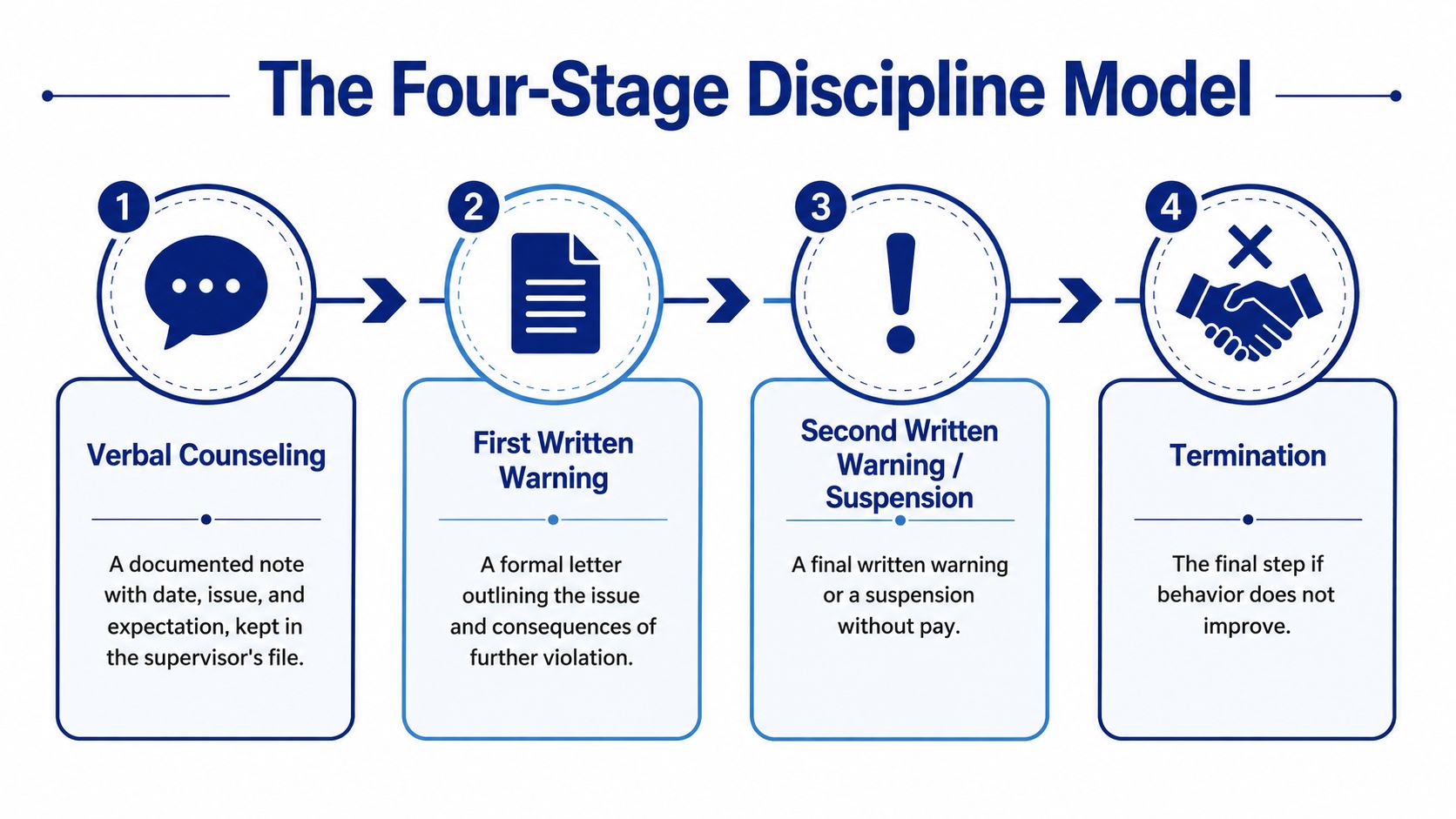
The four-stage framework described by HR Acuity is a useful policy model, not a mandatory legal formula. The controlling decision remains the relationship between the rule, the conduct, the employee's notice, and the employer's treatment of comparable cases.
A practical discipline model has four stages. It isn't a promise that every employee will pass through every stage. It is a structure for making ordinary performance and conduct decisions consistently.
The first stage should produce a written note even though the conversation is verbal. Record the date, issue, facts discussed, expected standard, employee response, and follow-up expectation. Keep the tone factual. “Employee failed to complete the assigned client report by the agreed deadline” is stronger than “employee has a bad attitude.”
The supervisor should explain what must change and by when. If the employee says a system problem, workload issue, medical concern, or unclear instruction contributed to the problem, record that response and route any accommodation or leave issue to HR.
A formal warning should refer to the earlier discussion, identify the continuing gap, state the corrective action, and explain the consequences of another incident or failure. Emory HR recommends that a written warning state the problem, reference prior discussions or actions, provide specific correction directives, identify the notice as formal discipline, and warn that continued failure can lead to further discipline up to termination. Use Emory's written-warning guidance when building your template.
Set a review date or follow-up point. A performance improvement plan may be appropriate when the issue involves measurable work expectations, but don't issue a generic plan that lacks standards, support, and a way to assess progress.
This stage tells the employee that the next failure may end employment. Restate the established expectation, summarize the prior record, identify the remaining deficiency, and specify the consequence. If suspension is used, confirm that the policy and applicable law support the action before communicating it.
The separation memo should connect the decision to the documented record. Reference prior warnings by date, summarize the expectations given, and explain the employee's failure to meet them. The file should also preserve the employee's response and the decision-maker's review.
Documents should be factual, dated, signed by the employee when possible, and stored in the appropriate disciplinary or supervisory file with controlled access.
A uniform “three write-ups” rule breaks down as soon as an employer operates across state lines. The legal baseline differs in Montana, and the risk analysis changes when an employee has requested protected leave, raised a workplace complaint, sought an accommodation, or filed a workers' compensation claim.
The sequence may need to pause while HR evaluates the underlying issue. FMLA activity, ADA interactive-process duties, workers' compensation, and state pregnancy or SAFE leave protections can affect timing and the employer's obligations. A manager must never treat a protected request as another performance failure simply because it arrived during an active discipline process.
Recent commentary on employee discipline emphasizes that a “write-up” has no fixed legal definition and that emails, notes, and informal records can become evidence. A signed form helps, but the absence of a signature doesn't decide whether the record matters. The Paradigm International Inc. HR guide can help leaders organize state-specific handbook considerations.
| Scenario | Why a Standard Write-Up Is Risky | Required Extra Step |
|---|---|---|
| Leave request or leave use | Timing may suggest interference or retaliation | Confirm the leave status and separate protected activity from performance analysis |
| Accommodation request | The issue may involve an ADA interactive-process duty | Engage HR and evaluate reasonable accommodation before escalating |
| Workers' compensation activity | Discipline may appear retaliatory | Review the claim timeline and comparable cases |
| Multi-state employment | State rules and handbook language may differ | Check the employee's work location and applicable policy |
| Harassment or serious misconduct complaint | The investigation may affect credibility and motive | Use a documented, impartial investigation before deciding |
| Different treatment by managers | Inconsistent outcomes weaken the employer's rationale | Conduct a comparator review and document the business reason |
Document the conduct, date, prior coaching, business impact, employee response, and treatment of similarly situated employees. That record matters more than a predetermined count.
A small employer needs policy language that gives managers structure without turning progressive discipline into an inflexible contract. Adapt the following excerpt with employment counsel before placing it in a handbook:
Employment is at will unless a written agreement, collective bargaining agreement, or applicable law provides otherwise. The company may use progressive discipline, which may include verbal counseling, a written warning, a final written warning or suspension, and termination. The company may skip or modify these steps based on the seriousness of the conduct, the employee's history, business needs, or other relevant circumstances. Examples of conduct that may result in immediate termination include theft, violence, serious harassment, intoxication on duty, intentional data misuse, and other serious policy violations. Before taking disciplinary action, the company may investigate the facts, interview witnesses, review records, and consider the employee's response.
That clause should match actual management practice. Don't publish discretion that no manager is trained to use, and don't promise a sequence your leaders routinely bypass.
Before approving a termination, the decision-maker should complete a disciplined review:
This checklist is operational guidance, not legal advice. State-specific language and high-risk facts should receive local legal review. The termination checklist from Paradigm provides another practical reference for organizing the process.
On the day a termination decision is made, the company should be able to give outside counsel a coherent file without reconstructing the case from scattered inboxes. The file should show the rule, the event, the response, the support offered, the escalation, and the final judgment.
Start with the policy foundation. Preserve the signed acknowledgment of the discipline policy, the offer letter, and the handbook version in effect when the employee was hired. If the policy changed, retain the relevant later acknowledgment and identify which version governed the decision.
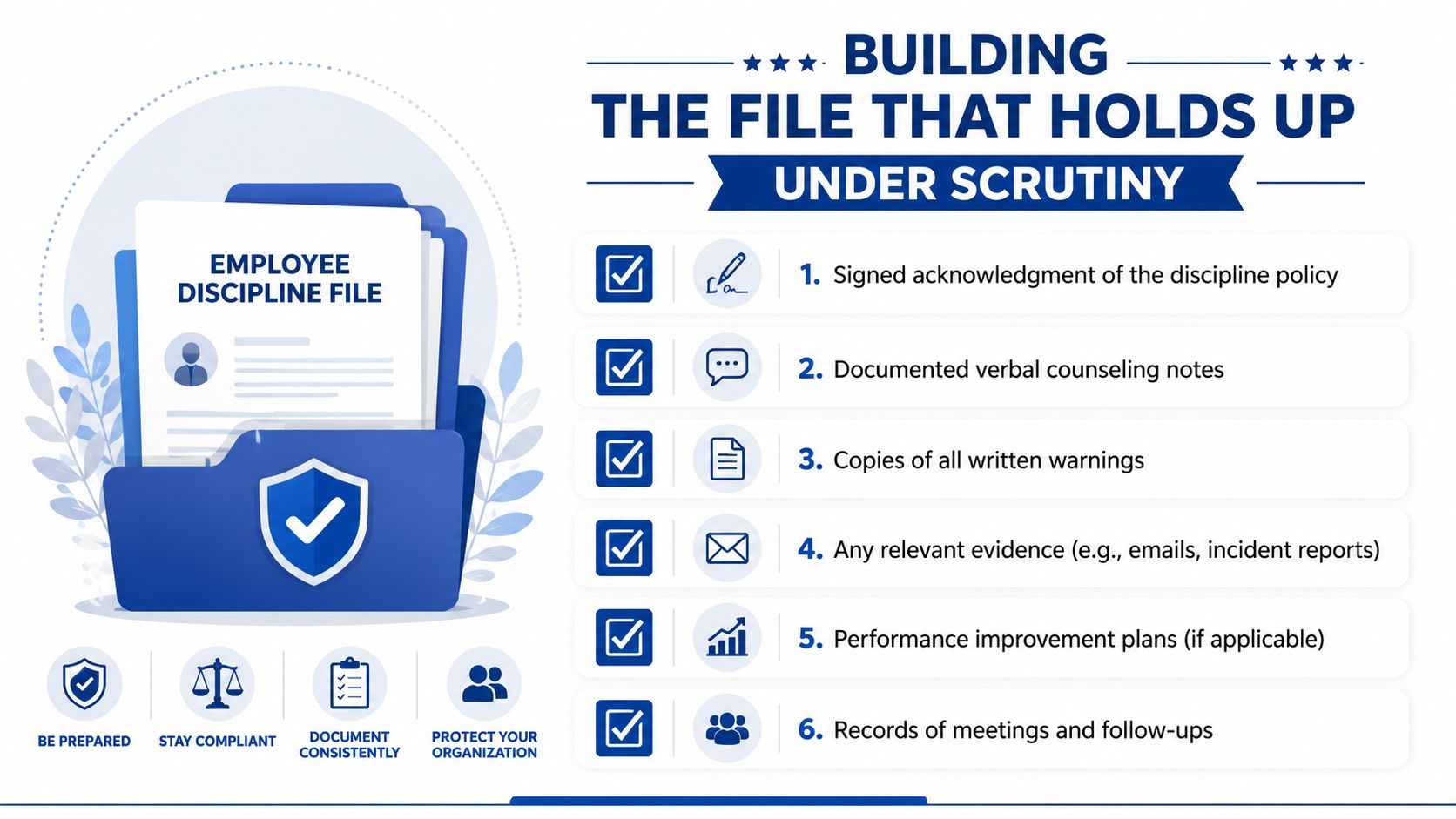
Write contemporaneously. Don't embellish notes after the decision is made to make the record look stronger. If a document was created later, label its purpose and date accurately.
Keep medical information and leave documentation separate from ordinary personnel records, with access limited to people who need the information for legitimate HR or compliance reasons. After an involuntary termination, the EEOC requires personnel records to be retained for one year from the termination date, and records relevant to an EEOC charge should be kept until the charge is resolved. See the EEOC recordkeeping requirements.
It should identify the basis for the decision clearly, but it doesn't need to reproduce the entire disciplinary history. Reference prior warnings by date and summarize the expectations and continued failure. Keep the detailed chronology in the separation memo and personnel file, not in an unnecessarily argumentative letter.
There isn't a universal legal requirement to provide a termination letter in every case. Documentation remains strongly recommended because the EEOC advises employers to document the reason for discipline or termination, and that record can help address a later discrimination charge. A county HR supervisory resource also explains that a termination letter isn't legally required in every firing. See guidance on documenting termination decisions.
Retention periods depend on the record type, jurisdiction, litigation status, and the employer's obligations. Some HR policies use a 3–7 year retention window for personnel files, depending on jurisdiction and FLSA status, but that range isn't a universal rule. Before destroying records, check applicable state and federal requirements, your retention schedule, and whether a charge, claim, audit, or investigation requires a litigation hold.
Never destroy relevant records after a dispute has become reasonably foreseeable. Preserve emails, messages, reviews, warnings, investigation materials, and decision notes in a controlled location.
They can. A verbal warning isn't weightless just because it wasn't issued on a form. The evidentiary value depends on whether the employer can show who held the conversation, when it occurred, what standard was communicated, how the employee responded, and whether the manager treated comparable employees similarly.
The practical answer is to document every material counseling conversation immediately. If an employee refuses to sign, record the refusal and have a witness acknowledge delivery. Don't convert a coaching conversation into formal discipline after the fact.
Final-pay timing varies by state and by the circumstances of separation. Don't promise a universal “immediate paycheck” rule. Have payroll confirm the employee's work location, applicable wage requirements, accrued-pay treatment, and benefit administration before the meeting.
A separation agreement can address specific post-employment terms, but it doesn't automatically cure a weak disciplinary record or eliminate statutory obligations. It may also require careful review for release language, consideration, confidentiality, and protected rights. Use employment counsel before presenting one.
Record the resignation accurately and preserve the active disciplinary file. Don't rewrite the history to make the resignation look like a termination, and don't pressure the employee into characterizing the separation a certain way. If future eligibility for employment matters, use a consistent reference and rehire process, including guidance on rehiring former employees.
The count of write-ups is a management input, not a legal answer. Before acting, identify the governing policy, test the facts, review protected activity, compare similar cases, and make sure the file tells the same story your decision-maker will tell.
Paradigm International Inc. supports owners, COOs, and HR leaders with termination decisions, investigations, manager conduct, documentation standards, and multi-state employment risk. Visit Paradigm International Inc. to discuss how your team can build a consistent discipline process that holds up under scrutiny.