


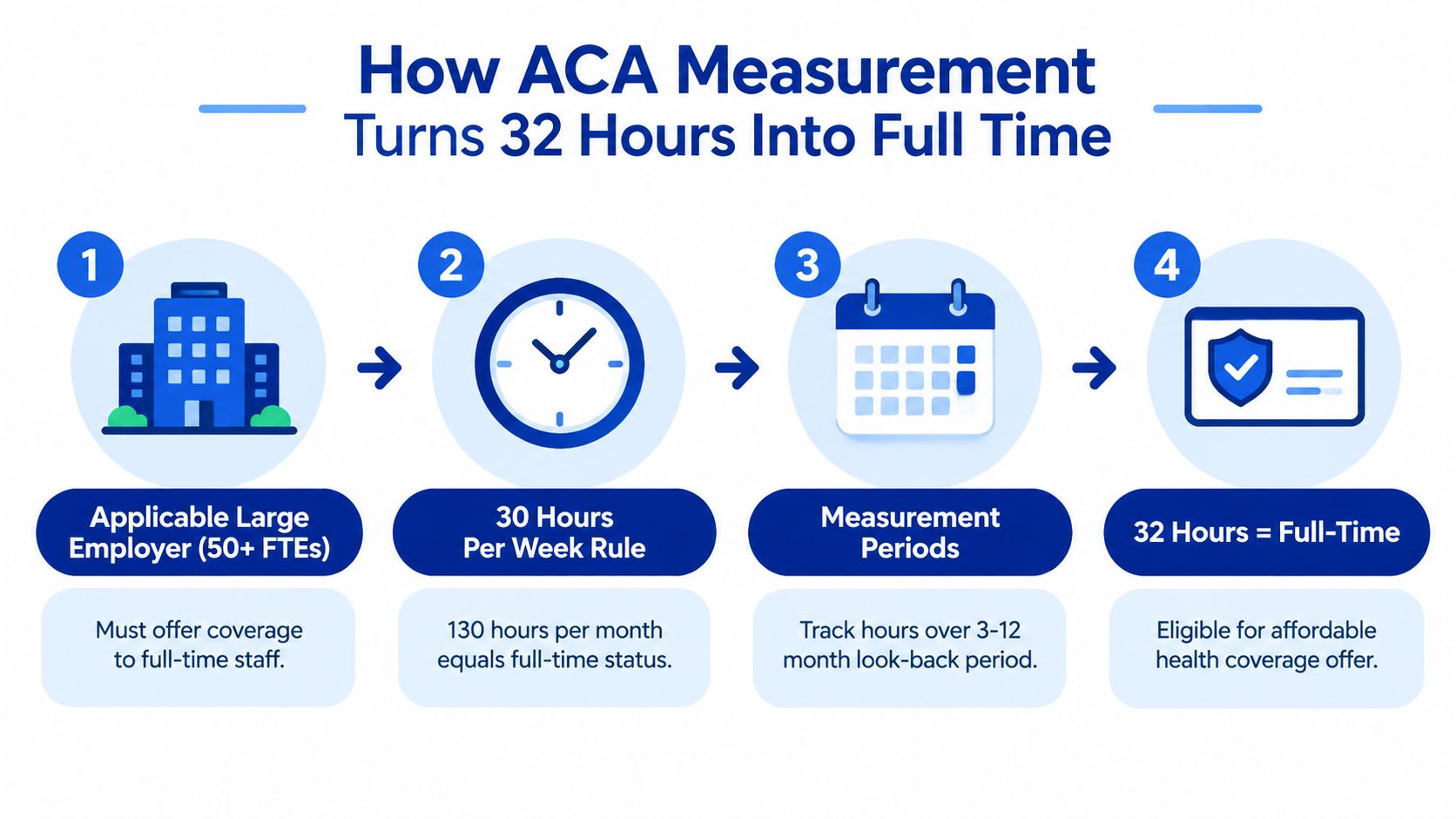
There is no single federal definition that makes 32 hours automatically full time for every purpose. Under the ACA, however, an employee averaging at least 30 hours per week or 130 hours per month is generally considered full time for health coverage if the employer is an applicable large employer.
A valued employee works a regular 32-hour schedule and asks whether they qualify for health insurance, paid time off, retirement contributions, or leave protections. The payroll system calls them part time. The benefits administrator uses different language. A manager remembers that the company's handbook mentions 40 hours.
That situation creates more than an employee-relations problem. It can create a compliance and documentation problem if leaders answer too quickly or apply one definition to every benefit. The practical question isn't, “Is a 32 hour employee full time for benefits?” It's, “Which benefit are we discussing, which rule applies, and what do our written plan terms say?”
Three lenses usually control the answer:
The sections below apply those lenses in a way that helps owners and HR leaders make decisions they can explain, administer consistently, and defend later.
Consider an employee scheduled for four eight-hour days. The employee has worked that schedule for months, performs the same core duties as colleagues, and wants to know whether the company's health plan covers them. HR checks the handbook and sees a 40-hour definition. The benefits plan summary uses different eligibility language. Payroll reports 32 hours each week.
Each source may be accurate in its own context. The problem starts when the company treats one label, such as “part time,” as the answer for every benefit. Federal wage law doesn't provide one universal full-time definition, and the ACA uses its own standard for employer health coverage. The U.S. Department of Labor's explanation of full-time and part-time employment confirms that the Fair Labor Standards Act doesn't define either term.
An employer might call the role part time for scheduling, classify the worker as full time for ACA health coverage, and limit retirement contributions according to the retirement plan's eligibility terms. Paid time off may follow a separate accrual schedule. Leave eligibility may depend on a specific statute rather than the company's general full-time label.
That isn't necessarily inconsistent. It becomes risky when the employer hasn't written the distinctions clearly or when HR staff apply them differently to similarly situated employees.
Practical rule: Don't answer a broad benefits question with a broad label. Identify the benefit first, then check the governing rule and the plan document.
A 32-hour employee generally sits above the ACA health coverage threshold, but that doesn't automatically decide eligibility for every other benefit. The defensible approach is to separate the legal standards, review the plan language, and document how the organization applies each one.
For each benefit, ask:
This framework prevents the most common error, treating 32 hours as either always full time or always part time. The correct answer depends on the benefit and the rule behind it.
A 32-hour schedule can receive three different answers, depending on the rule being applied. The FLSA, the ACA, and the employer's benefit plan do not use one universal definition of full time. HR teams should treat the schedule as a starting fact, then identify the rule that controls the decision.
The FLSA does not define full-time or part-time employment. Employers therefore set internal thresholds for scheduling, payroll, and workplace policies. A company may call 32 hours full time, while another may reserve that label for a longer schedule. The guidance on full-time employment helps establish this distinction, but it does not create one required company-wide threshold.
The ACA uses a separate test for employer shared-responsibility and health coverage purposes. An employee averaging at least 30 hours of service per week or 130 hours in a month generally meets the ACA definition of full time, subject to the applicable measurement rules. Employers should follow the IRS guidance on identifying full-time employees when setting up that process.
For ACA health coverage, 30 hours is the key threshold. A regular 32-hour schedule generally exceeds it, provided the employer is subject to the employer mandate and measures hours under the applicable ACA method.
The mandate applies to applicable large employers, businesses with 50 or more full-time equivalent employees, as summarized in this Affordable Care Act information summarized by Texas A&M University. These are separate questions: the employer-size test determines whether the mandate framework applies, while the employee-hours test helps determine full-time status for coverage.
Labels can still be useful for administration, but they are not the legal analysis. Bridge Global on Workers Grey provides context for classifications that do not fit neatly into full-time or part-time categories.
An employer may use 35 to 40 hours as its internal full-time benchmark for selected benefits or workplace policies. That approach must be written clearly and applied consistently. It also cannot override an ACA coverage obligation when the ACA standard applies.
State rules may create another answer. Employers operating in California, for example, should compare their policy with federal vs California full-time.
Use the FLSA for the employment framework, the ACA for applicable health coverage analysis, and the plan document for benefit eligibility. Align those three sources in the handbook, plan materials, payroll settings, and HR decisions.
The ACA doesn't rely only on the job title printed in an HR system. For applicable large employers, the relevant question is whether the employee has enough hours of service under the applicable measurement method. The IRS explanation of employer shared responsibility emphasizes that employers determine full-time status using hours of service.
A consistently scheduled 32-hour employee will generally meet the ACA standard because the schedule is above the 30-hour weekly threshold. But variable schedules require more careful administration. A single week may not decide the employee's status if the employer uses an averaging method.
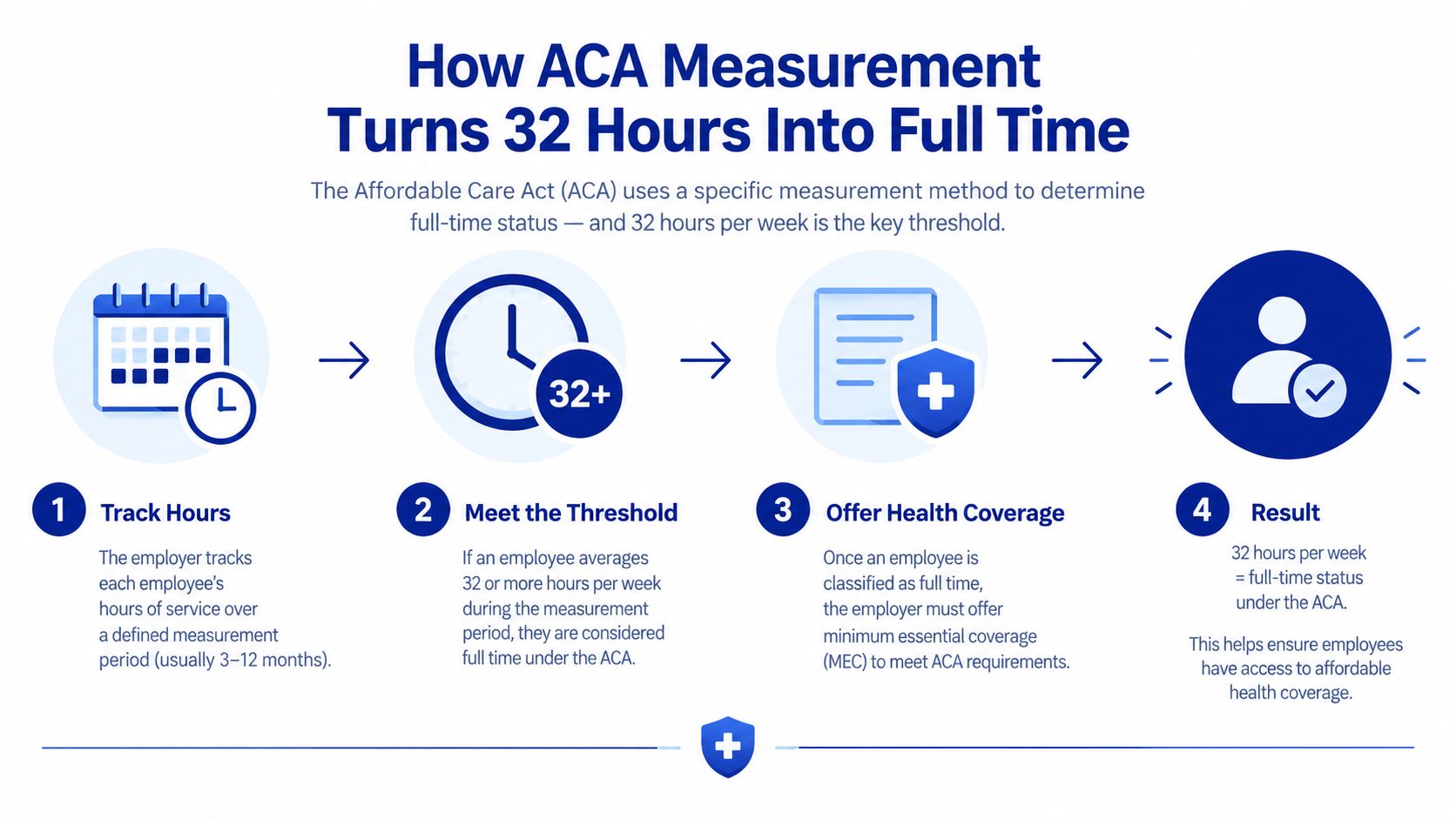
The ACA standard can be expressed in two equivalent ways:
The employer must use a reliable process for counting hours of service. Depending on the employee and the employer's method, paid time can also matter. HR leaders should coordinate payroll, timekeeping, leave records, and benefits administration so the data used for classification is complete.
A 32-hour schedule therefore presents the same basic ACA classification issue as a 40-hour schedule. If the employer is an applicable large employer, calling the worker part time doesn't remove the obligation to evaluate coverage eligibility.
For variable-hour employees, employers may use a look-back measurement approach. The employer tracks hours during a defined measurement period, determines whether the employee averaged at least 30 hours per week, and then applies the resulting status during the following stability period. Institutional HR guidance describes how this approach can cause coverage eligibility to continue even when later hours fall below 30, as summarized by Southern Oregon University's ACA benefits guidance.
That timing matters. An employee who averages 32 hours during the relevant measurement period may remain treated as full time during the following stability period, even if the schedule later changes. HR shouldn't reclassify the employee based on one slow month without checking the method and period already in use.
Administrative checkpoint: Record the measurement method, the dates covered, the hours counted, the status decision, and the coverage offer. A clear audit trail is more useful than a verbal explanation after a dispute begins.
The ACA answer applies to employer health coverage within its scope. It doesn't automatically transfer to overtime, leave, retirement, or paid time off. Each benefit has its own source of authority, and the employer's plan documents often determine the result where no federal rule supplies a universal definition.
| Benefit Type | Is 32 Hours Full Time | What Determines Eligibility |
|---|---|---|
| Employer health coverage under the ACA | Generally yes for an applicable large employer | ACA hours-of-service rules, measurement method, and plan administration |
| Overtime | Full-time status isn't the test | FLSA exemption status and hours worked above the applicable overtime threshold |
| FMLA and other leave | Not automatically | The specific statute, employee service requirements, hours worked, and employer coverage |
| Retirement plan | Not automatically | The written retirement plan, its eligibility terms, and applicable retirement law |
| Paid time off | Policy dependent | Handbook language, PTO plan terms, and applicable state or local requirements |
For an applicable large employer, an employee averaging at least 30 hours per week or 130 hours per month generally meets the ACA full-time standard. A 32-hour employee can therefore be benefits eligible for health coverage even when the company's internal scheduling label says part time.
That result doesn't decide whether the employee receives dental coverage, vision coverage, employer-paid life insurance, or another voluntary benefit. Each offering should be checked separately.
The FLSA does not define full-time or part-time status. Overtime analysis focuses on the employee's exemption status and hours worked, not whether the employer calls the employee full time. Leave laws also use their own eligibility tests, which may involve employer size, length of service, hours worked, or the type of leave.
Retirement and PTO eligibility are often controlled by the plan or policy. A company can choose to make a benefit available at 32 hours, use another threshold, or establish different classes, provided the arrangement complies with the governing law and is administered according to its written terms.
Clear enrollment administration can reduce employee confusion. A resource on streamline benefits enrollment may help HR teams think through how eligibility decisions, elections, and records fit together. For continuation coverage communications, consult the Paradigm International COBRA notification guide rather than assuming the employee's general full-time label answers the question.
Once the ACA question is answered, the employer still has to review the plan. Health insurance eligibility may depend on the ACA framework and the governing plan terms. Retirement, disability, life insurance, and paid time off may be controlled primarily by their own documents. State rules can add requirements that don't appear in a company's general handbook.
This creates three different answers for the same 32-hour employee:
For employer-sponsored welfare and retirement plans covered by ERISA, the plan document and summary plan description are central sources for eligibility and administration. HR should not rely on an informal practice that conflicts with those documents. If the handbook says one thing and the plan document says another, the employer should obtain appropriate benefits counsel and correct the inconsistency deliberately.
An eligibility definition should identify the benefit and the measurement rule. “Full-time employees receive benefits” is usually less useful than wording that explains the applicable hours standard, waiting period, measurement method, employee class, and effective date.
State and employer practices commonly treat 32 hours as full time for some benefits, while other employers use 40 hours. That variation is policy driven outside the ACA framework, as described by Tomorrow Law's discussion of full-time and part-time employee rights.
A multi-state employer shouldn't let each manager interpret “full time” independently. Use a central eligibility matrix, assign ownership for updates, and identify which rules apply by employee location and benefit plan. The objective isn't to force every benefit into one definition. It's to make every definition intentional, written, and consistently administered.
A defensible process begins before an employee asks about benefits. Start by listing every benefit the organization offers and identifying the document that controls eligibility. Then map the 32-hour schedule against each requirement instead of making one classification decision for the entire employment relationship.
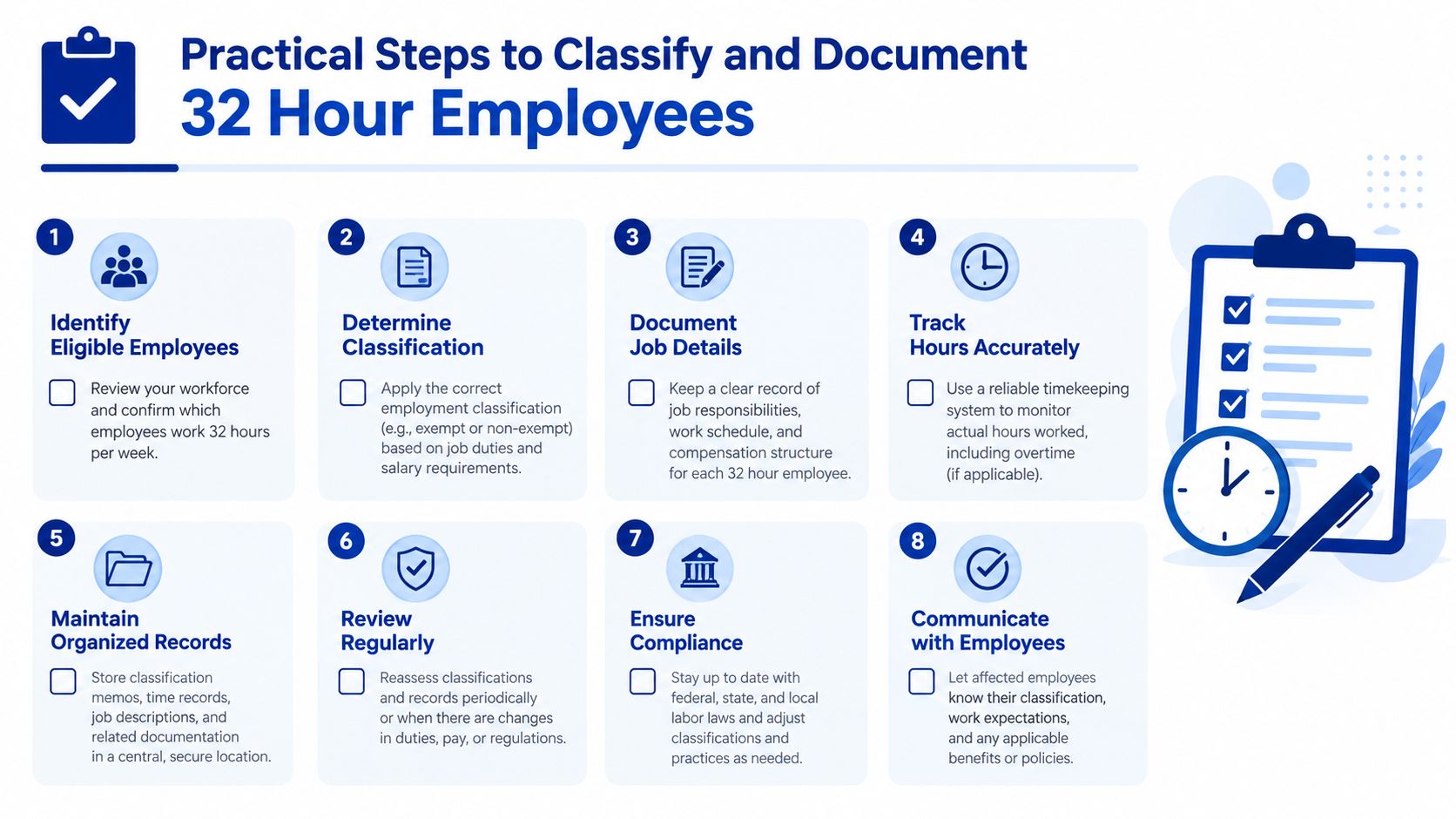
Use a written checklist for each employee or employee class:
The record should connect the decision to evidence. Keep schedules, time records, leave records, measurement-period calculations, enrollment notices, and written communications together in a controlled location.
A strong policy doesn't promise that all full-time employees receive every benefit. It defines full time separately for each program or directs employees to the controlling plan document. It should also explain that ACA health coverage eligibility may use an hours-of-service measurement process rather than the label attached to the position.
Avoid informal statements such as, “You're part time, so you don't get benefits.” A safer explanation is, “Your role is classified as part time under our scheduling policy. For medical coverage, we evaluate eligibility under the applicable ACA measurement rules and plan terms. Other benefits use their own eligibility requirements.”
For broader recordkeeping principles, review employment risk documentation strategies. Documentation should support the actual decision, not be created only after an employee challenges it.
Suppose an employee is scheduled for 32 hours every week. HR should evaluate health coverage under the ACA standard if the employer is an applicable large employer, then review each other benefit separately. Suppose another employee's schedule fluctuates around 32 hours. HR should use the established measurement method and avoid relying on a manager's estimate.
A third employee may work 32 hours in one period and fewer hours later. The team should check whether a prior measurement result controls the current stability period. These examples show why consistent records matter more than a single job title.
The answer to “is a 32 hour employee full time for benefits” is usually yes for ACA health coverage purposes when the applicable employer and measurement rules apply, but it isn't a universal answer for every benefit. The employee's schedule clears the ACA's 30-hour weekly milestone, yet retirement, PTO, leave, and other programs may use different eligibility standards.
A reliable decision has three parts. First, identify the federal rule that applies, including the ACA health coverage standard and the FLSA's lack of a universal full-time definition. Second, read the plan and policy language instead of relying on a general label. Third, check state requirements and make sure payroll, HR, benefits, and managers are using the same interpretation.
Before approving or denying benefits for a 32-hour employee, confirm that:
This process helps prevent two opposite mistakes. One is denying health coverage because the employee is called part time. The other is assuming that ACA full-time status automatically grants every benefit the company offers.
For complex plans, variable schedules, or multi-state workforces, a focused review can clarify where policy language, administration, and actual practice have drifted apart. That review can give leaders a practical path to correct the issue without creating new inconsistencies.
Paradigm International Inc. advises SMB leadership teams on benefits classifications, ACA-related HR risk, documentation, and multi-state employment decisions. Visit Paradigm International Inc. to discuss how to align plan language, hours tracking, and employee communications for a more defensible benefits process.


