A physician office manager discovers that a front-desk employee handled a leave request differently from a medical assistant's earlier request. The practice has no current handbook, the clinical procedures manual says nothing about employment decisions, and the manager can't prove which policy staff received. Florida's at-will employment rule doesn't solve that problem. It makes disciplined documentation more important.
A medical practice employee handbook in Florida should define employment expectations, reporting channels, leave administration, safety duties, and workplace conduct. It should not attempt to replace clinical protocols. The strongest structure uses a stable HR handbook, a controlled clinical policy manual, signed acknowledgments, and a process for training managers to apply both consistently.
Florida doesn't require employers to maintain a written employee handbook. That doesn't make a handbook unnecessary for a medical practice. State and federal obligations involving leave, discrimination, injury reporting, confidentiality, and retaliation create situations where the practice must show what employees were told and how supervisors acted. A handbook gives the practice a usable record instead of relying on memory.
Florida courts have generally treated employee handbooks as non-contractual by default, as reflected in Muller v. Stromberg Carlson Corp., 427 So. 2d 266, 270 (Fla. 2d DCA 1983). Poor drafting can still create implied-contract arguments, so the handbook should contain clear at-will and disclaimer language. The practical point is simple: preserve flexibility, but document the rules that govern daily decisions.
A medical practice rarely faces risk because a policy exists in isolation. Risk develops when employees receive different answers about scheduling, discipline, leave, exposure incidents, or complaints. A defensible handbook helps establish:
A practice should also connect its employment rules to patient-facing obligations. Confidentiality, records handling, access controls, and incident reporting belong in a broader compliance framework, so leaders should review practical guidance on key regulations for patient data protection when designing related policies.
Practical rule: Treat the handbook as evidence of a repeatable management process, not as a binder that sits in an onboarding folder.
The handbook becomes more important as the practice crosses legal and operational thresholds. The federal FMLA applies at 50 or more employees and provides up to 12 weeks of unpaid leave, while Florida domestic violence leave applies at 50 or more employees and allows up to 3 working days in a 12-month period. Florida also protects employees from discharge or penalties for jury service. These figures and protections should be reflected in the appropriate leave and attendance sections, with source context available in Florida handbook drafting guidance.
Florida's E-Verify framework adds another operational trigger. Employers with 25 or more employees must document participation and annual certification, which makes a formal onboarding section valuable for practices approaching or exceeding that threshold. Owners who want a focused overview can consult this guide to Florida handbook rules.
The right question isn't whether Florida forces you to publish a handbook. It's whether your practice can defend a people decision without one.
A practice can follow the wrong handbook by copying a template built for a different workforce. Start with the actual organization. Count employees across locations, identify part-time and remote personnel, and determine which rules apply to the employer as a whole. Then separate universal policies from requirements triggered by headcount, location, job role, or participation in a specific program.
Create a working matrix before drafting. Record each trigger, the policy it activates, the person responsible for administration, and the records that demonstrate compliance.
| Employee Count | Triggered Policy Requirement |
|---|---|
| 25 or more employees | Document E-Verify participation and annual certification where Florida's framework applies. See the Florida HR compliance guide. |
| 50 or more employees | Address federal FMLA administration, including eligibility, notices, and up to 12 weeks of unpaid leave. |
| 50 or more employees | Address Florida domestic violence leave, which permits up to 3 working days in a 12-month period. |
| Any applicable workforce | Include Florida jury-duty protection, anti-discrimination expectations, safety reporting, complaint channels, and at-will disclaimers. |
Use the table as a control document, not as a substitute for legal review. A practice may have further obligations based on its structure, benefits, contracts, locations, or regulated activities. Confirm each requirement before placing it in the handbook, especially where employment language could be read as a promise about clinical authority or workplace outcomes.
State plainly that the handbook is not an employment contract, does not promise employment for a specific period, and does not alter the at-will relationship. Identify who may modify employment terms and reserve the practice's right to revise policies. Do not promise a fixed disciplinary sequence or termination only for cause unless the practice intends to assume that obligation.
Keep clinical directives and employment commitments distinct. A handbook can require employees to follow the current clinical manual without incorporating every clinical procedure into the employment agreement. That separation supports Board of Medicine expectations while reducing the risk that a workflow update becomes an implied contract term.
The acknowledgment should confirm receipt, responsibility to follow the handbook, access to updates, and understanding that the acknowledgment creates no contract. Keep it separate from language that guarantees benefits or procedural steps.
A policy is defensible when a named person administers it and maintains its records:
The Paradigm International Inc. handbook guide can help leadership compare state-level considerations while building the map. The final handbook must match the practice's staffing, locations, reporting lines, and actual HR controls.
A single handbook that covers payroll, harassment, sterilization, delegation, informed consent, and patient transfers is difficult to maintain and easy to misapply. Clinical procedures can change when equipment, standards, staffing, or physician directives change. Employment policies need a different review process because they govern the relationship between the practice and its workforce.
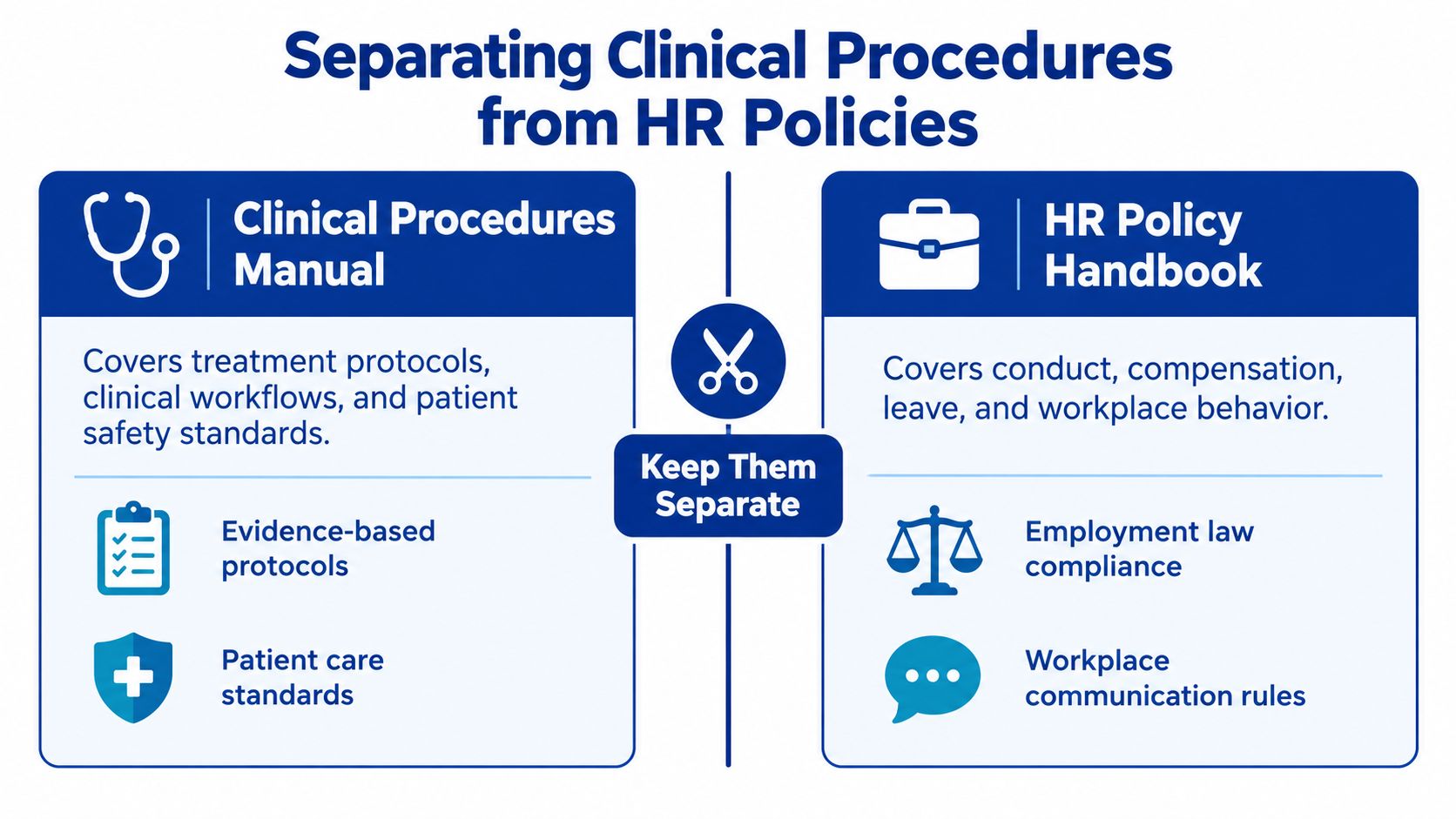
The answer is a dual-manual system. Keep the HR handbook focused on employment terms and workplace expectations. Maintain a separate clinical policy manual for patient care, delegated tasks, records, informed consent, sterilization, transfer agreements, and other clinical operations.
A combined manual creates at least three problems. First, employees may treat a clinical instruction as an employment promise, especially when the document uses mandatory language about discipline or job security. Second, an update to a clinical workflow may accidentally conflict with an HR rule on training, authority, or performance management. Third, a regulator, plaintiff's attorney, or insurer may struggle to determine which version governed a particular event.
Florida Board of Medicine materials reference policy-and-procedure manuals, delegation, records, informed consent, sterilization, and transfer agreements as elements of practice standards. That makes written clinical documentation part of the practice's compliance infrastructure, but it doesn't mean those procedures belong in the HR handbook. The Board's emphasis supports more granular operational manuals, not a longer employee handbook. The relevant material is available in the Florida Board of Medicine practice standards document.
The HR handbook should address:
The clinical manual should address:
Cross-reference the documents without merging them. For example, the HR handbook can require employees to follow the practice's clinical policies and report deviations. The clinical manual can identify the roles authorized to perform a task. Neither document should promise a particular disciplinary outcome.
Keep the documents separate, but make the cross-references precise.
A practical control is to place document owners, approval authorities, effective dates, and revision histories on both manuals. New hires should acknowledge the HR handbook and confirm access to the clinical manual. Clinical staff should receive role-specific training rather than a general instruction to read a large document.
A needlestick occurs during a busy clinic session. The medical assistant needs immediate instructions, the supervisor needs a documented reporting path, and the practice must protect the employee without disrupting patient care. A defensible handbook sets the expectation to report. Separate safety and clinical materials should define the operational response.
Florida's drug-free workplace program can reduce workers' compensation premiums for participating employers under Florida law. That financial benefit matters to medical practices, but it should not control policy design. A testing rule that does not match actual procedures can produce inconsistent treatment, confidentiality problems, and disputes with employees or applicants.
A drug-free workplace policy should state the practice's rules on prohibited conduct, testing circumstances, reporting, confidentiality, and consequences. It should explain how employees ask questions and where they can seek assistance if the practice offers an employee assistance process.
Avoid vague language such as “management may test anyone at any time.” Use specific triggers that match the practice's procedures and applicable law. Identify who receives testing information, how records are protected, what happens after a disputed result, and which decision-makers may act.
The substance abuse policy guide can help owners organize the policy architecture. The practice must still align the final wording with its insurer, testing provider, workforce, and daily operations. Do not promise a particular disciplinary outcome if the facts, law, or investigation may require a different response.
Healthcare safety policies must address the hazards employees encounter during clinical work. Give staff an accessible process for reporting:
The handbook should separate event reporting from investigation. Employees need immediate instructions. Managers need a distinct protocol for preserving records, notifying the appropriate leaders, protecting confidentiality, and avoiding unsupported conclusions. The clinical manual should define the clinical response, while the HR handbook should govern reporting duties, workplace conduct, and employment administration.
A safety policy earns its value when an employee can follow it during a stressful event without asking which manager has authority.
Review the program after an injury, exposure, complaint, or failed training exercise. Each event can expose a gap between written policy and actual workflow. Correct the relevant document, retrain the affected team, and preserve the approval and revision record. That process supports both employment-law compliance and the Board of Medicine's expectations without turning clinical instructions into implied employment promises.
The most dangerous handbook is often a well-written one that managers ignore. A supervisor who excuses one employee's attendance issue, denies another employee's leave request without review, or handles similar complaints through different channels weakens the practice's defense. The problem isn't only unfairness. It's the absence of a reliable decision process.
Florida-focused guidance identifies supervisor deviation from written procedure as an operational pitfall because inconsistent treatment erodes the handbook's value as evidence of disciplined, non-discriminatory HR administration. Read the supporting discussion in this Florida handbook compliance overview.

A signed acknowledgment has limited value if nobody can find it. Store it with the employee's personnel records, protect access, and connect it to the exact handbook version the employee received. Electronic systems can work well if they preserve the date, employee identity, document version, and completion record.
Maintain a simple version register containing:
When a policy changes, don't silently replace the old file. Preserve the historical version and the acknowledgment tied to it. A later dispute may concern conduct that occurred before the current handbook took effect.
Managers need scenario-based instruction. Use examples from the practice's actual work:
For each scenario, managers should know what they can decide, what they must escalate, what they must document, and what they must not promise. Physicians who supervise staff need the same training as office managers. Clinical authority doesn't automatically confer HR expertise.
Generic templates also create risk when they omit Florida-specific references, notice obligations, or procedures that match the practice's actual structure. The handbook should reflect real reporting lines and real manager behavior. If leaders won't follow a rule, revise the rule or change the behavior. Don't keep a polished policy that nobody applies.
A multi-state practice should use a core handbook plus state-specific addenda. The core can address common employment standards, while each addendum handles location-specific leave, wage, notice, and other requirements. This structure is easier to audit than forcing every employee to read a single document filled with rules that don't apply to their workplace.
Review the handbook at least annually and whenever the practice changes materially. Florida minimum wage and leave rules can change, so the owner should assign responsibility for reviewing legal developments, updating affected language, obtaining approval, and redistributing the revised document. Event-driven reviews should follow new locations, acquisitions, major staffing changes, benefit changes, or a significant complaint.
For each state, maintain a compliance file containing the addendum, effective date, acknowledgment records, and a short explanation of which employees receive it. Multi-location operators should also compare manager practices across offices. A consistent policy with inconsistent local execution remains a risk.
Expansion often brings new billing vendors, staffing partners, and outsourced administrators. Before changing a workflow, confirm which responsibilities remain with the practice and which belong to the vendor. A Florida medical billing companies list can help leaders identify external billing resources, but vendor selection doesn't replace the practice's responsibility to define confidentiality, reporting, supervision, and escalation expectations.
Practice owners and COOs should review the handbook and clinical manual together, but approve them through separate controls. That prevents a clinical update from changing employment terms without notice and gives managers a clear source for each decision.
Paradigm International Inc. helps owners, COOs, and leadership teams build or audit employee handbooks, align state addenda, and maintain defensible documentation for regulated and multi-state operations. If your Florida practice needs a structured review of its HR and clinical policy boundaries, visit Paradigm International Inc. to discuss the right advisory support.