
Most advice on onboarding vs orientation gets one thing wrong. It treats the terms as interchangeable, as if the difference is mostly HR vocabulary. It isn't. For SMB leaders, especially those operating across state lines, confusing a brief orientation event with a true onboarding process creates avoidable turnover, inconsistent management practices, and weak documentation when decisions are later challenged.
That distinction has measurable business impact. Organizations with a strong onboarding process, separate from short-term orientation, see an 82% improvement in new hire retention and over 70% higher productivity, according to Paycor’s summary of onboarding vs. orientation research. The stakes are even higher for smaller businesses because poor onboarding contributes to 20% of employees quitting within the first 45 days, which can magnify disruption, hiring costs, and legal exposure in growing organizations.
Leaders don't need more theory here. They need a practical standard that answers a simple question. What belongs in orientation, what belongs in onboarding, and how do you build both in a way that's consistent, documented, and defensible?
Confusing orientation with onboarding is not a terminology problem. It is a control failure.
For a multi-state SMB, that failure rarely shows up on day one. It shows up later, when one location gives a new hire policy training that another location skips, when a manager assumes expectations were clear because they were discussed informally, or when the company needs proof that an employee received required notices, role instruction, and a fair opportunity to succeed.
Orientation handles immediate employment setup. Onboarding handles consistency, accountability, and follow-through over time. If leaders collapse both into a single first-day event, they usually create three avoidable problems at once: uneven manager practices, weak documentation, and preventable disputes over what the employee was told, trained on, or asked to do.
That matters financially as much as it matters operationally.
Early attrition is expensive, but the larger risk is often hidden in rework, missed training, payroll errors, policy disputes, and messy employee relations issues that become harder to defend because the process was informal. I see this most often in growing companies that moved fast, hired across state lines, and assumed a handbook acknowledgment was enough to prove a sound start.
A better standard is simple. Treat orientation as one documented event inside a broader onboarding process, then assign ownership for each part. HR can manage forms, notices, and policy acknowledgments. Managers must own role clarity, training cadence, performance checkpoints, and written follow-up. Without that division, accountability blurs quickly.
The distinction is not academic. It affects what gets recorded, who is responsible, and how well the business can defend its decisions later if a wage issue, discrimination claim, leave dispute, or wrongful termination allegation surfaces.
The simplest way to separate these terms is this. Orientation is the event. Onboarding is the process.
Orientation is usually short. It happens at the beginning of employment and focuses on immediate readiness. The goal is to make sure a new hire can start work with the basic information and administrative setup they need.
Onboarding lasts much longer. It connects the employee to the role, the team, the manager, and the standards for performance. It’s where expectations become clear and support becomes structured.
| Criterion | Orientation | Onboarding |
|---|---|---|
| Timeline | Hours to days | Months to a year |
| Primary purpose | Administrative readiness and compliance | Integration, performance, and retention |
| Content | Paperwork, policies, benefits, basic company information | Role expectations, training, feedback, milestones, team integration |
| Main owner | HR or operations | Shared ownership across HR, managers, and team leaders |
| Main outcome | Day 1 functionality | Sustainable contribution and documented development |
Orientation is transactional by design. That isn't a criticism. It serves an important purpose when it's done well.
It typically includes items such as:
A good orientation reduces confusion and creates a cleaner start. For a more focused look at what belongs in that early event, this guide on new employee orientation is a useful reference.
Onboarding is broader and far more strategic. It addresses whether the employee understands the job, knows how success will be measured, and receives consistent guidance during the early months of employment.
That means onboarding should include:
Orientation answers, “How do I start here?” Onboarding answers, “How do I succeed here?”
When companies collapse both into a single first-day session, they create a false sense of completion. The employee may be employed. They are not yet integrated.
The practical difference between onboarding vs orientation becomes clearer when you compare what each one is built to do. One is mostly about immediate readiness. The other is about sustained contribution, consistency, and retention.
Leaders often assume the distinction is obvious until they examine their own process. That's when the gap appears. If everything happens in the first few days and almost nothing is scheduled after that, the business probably has orientation, not onboarding.
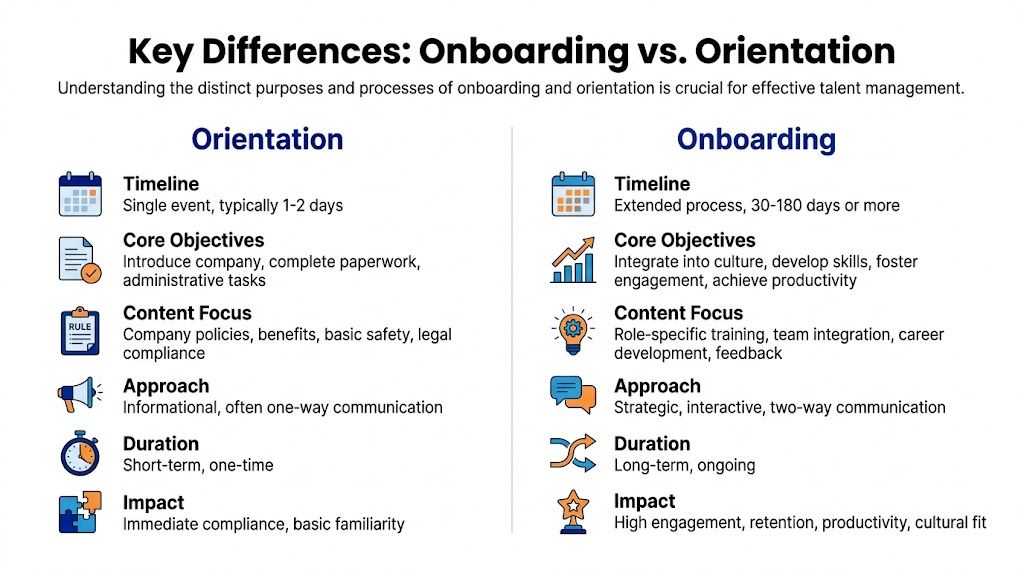
| Criterion | Orientation | Onboarding |
|---|---|---|
| Timeline | Short-term, usually at the start of employment | Extended, often over months |
| Core objective | Complete required setup and provide baseline information | Build role clarity, engagement, and proficiency |
| Content focus | Policies, paperwork, benefits, compliance items | Skills, expectations, relationships, milestones |
| Communication style | Often one-way and standardized | Two-way, role-based, and adaptive |
| Ownership | Mostly HR-led | Shared by HR, managers, and operational leaders |
| Documentation value | Confirms receipt of key information | Creates a record of support, expectations, and performance development |
| Business impact | Helps reduce early confusion | Influences retention, engagement, and productivity |
Orientation is short because its purpose is narrow. It covers what a new hire needs to know immediately. That usually means forms, policies, benefits, systems access, and practical basics.
Onboarding is longer because performance doesn't happen in one meeting. Employees need time, reinforcement, and manager involvement. They need feedback after they've started doing the work, not just before.
When a company says it completed onboarding on day one, it usually means the process ended before any meaningful performance support began.
Orientation is built for immediate compliance and familiarity. Onboarding is built for confidence, capability, and connection.
That difference matters because the long-term business return comes from what happens after the first day. According to Axonify’s analysis of onboarding vs. orientation, companies with exceptional onboarding report 2.6x higher job satisfaction and 54% boosted engagement. Those results come from the parts many employers skip, such as performance milestones, regular reinforcement, and social integration.
Orientation is about compliance. Onboarding is about connection and contribution.
A company can complete every required first-day form and still lose the employee because the job was unclear, the manager was absent, or training was inconsistent. That isn't a recruiting problem. It's an onboarding failure.
The fastest way to audit your current process is to review your content.
If your checklist is dominated by handbook signoffs, payroll setup, confidentiality forms, and a company overview, you're looking at orientation content. If you can also point to role training plans, check-in notes, goal setting, feedback records, and mentorship touchpoints, you're seeing onboarding content.
A defensible process usually includes both. It doesn't force one to carry the weight of the other.
HR can run orientation. HR alone cannot carry onboarding.
Managers own a large part of the onboarding outcome because they control priorities, coaching, feedback, and job clarity. Operations leaders often own the environment where standards are learned. Team peers influence whether the employee feels included and supported.
When nobody is explicitly accountable beyond day one, three things happen:
That last point becomes particularly serious in multi-state businesses, where inconsistent treatment can trigger both employee relations issues and compliance concerns.
When companies confuse onboarding vs orientation, they don't just weaken the employee experience. They also weaken the business's ability to show that expectations were clear, training was provided, and employees were treated consistently.
That matters in any organization. It matters more in multi-state SMBs because employment obligations, notice requirements, and training expectations can vary by jurisdiction. A loose process that feels manageable in one location can become a pattern of exposure across several.

Most leaders think risk appears at termination. In practice, it often starts much earlier, during hiring and early employment.
If one manager gives detailed expectations and another gives none, the business creates inconsistent records. If one site documents training and another relies on verbal coaching, the business creates defensibility gaps. If “cultural fit” becomes a vague screen during the early weeks, the company can drift into inconsistent and potentially discriminatory treatment.
That concern isn't theoretical. For multi-state SMBs, inadequate onboarding creates legal exposure because orientation often handles the initial paperwork while missing the ongoing documentation needed for defensibility. TechTarget’s coverage of onboarding vs. orientation notes that EEOC filings for hiring and onboarding bias rose 12% in 2025, and it highlights the risk of over-emphasizing “cultural fit” without a uniform, documented process.
A practical way to train managers on this issue is to ground them in real-world examples of discrimination in the workplace. It helps leaders see how subjective language and uneven treatment can become evidence, not just opinion.
Weak onboarding creates visible costs and hidden ones.
Visible costs include:
The hidden costs often matter more:
If early exits are already a problem, this resource on how to prevent employee turnover can help leadership teams connect onboarding structure to broader retention strategy.
A sound approach doesn't need to be elaborate. It does need to be deliberate. For most SMBs, that means dividing responsibilities by phase and documenting what happens in each one.
Pre-boarding
Week 1
Days 30, 60, and 90
The strongest onboarding systems don't just support employees. They create evidence that the organization acted consistently and reasonably.
A defensible onboarding program does more than welcome a new hire. It creates a repeatable record that the company gave clear expectations, delivered required information, and responded consistently if problems appeared. For multi-state SMBs, that distinction matters because the cost of a weak process usually shows up later, during an unemployment claim, a wage dispute, a discrimination complaint, or a wrongful termination allegation.

Many companies organize onboarding by timeline alone. That helps with scheduling, but it does not always help with accountability. A better approach is to build around control points, the moments where missed steps create legal exposure, manager inconsistency, or preventable turnover.
Each control point should answer three questions: what must happen, who owns it, and what proof should exist if someone asks six months later.
Pre-boarding is where preventable errors start. In my experience, SMBs often treat this stage as an admin task. It is really a risk stage.
Before day one, the company should confirm that the employee is tied to the right work state, tax setup, pay practice, policy set, and notice package. Remote and hybrid hires make this harder because the work location on paper does not always match where the work is performed. If that point is wrong, the company can issue the wrong documents, apply the wrong leave rules, or miss state-specific acknowledgments.
Useful pre-boarding records include:
Week one often collapses too many goals into one meeting. That creates confusion for the employee and weakens the record for the employer.
Orientation tasks should be completed accurately and documented cleanly. Onboarding tasks should then continue through manager-led training, role clarification, and observed performance support. Keeping those functions distinct helps in two ways. Employees get clearer information, and the company can later show which issues were covered as compliance requirements versus which issues were coached as part of performance development.
A sound first-week structure usually includes:
Many onboarding programs fail at the point where paperwork ends. That is also where legal defensibility starts to matter more.
If a manager later claims a new hire was not meeting expectations, there should be dated check-ins showing what was expected, what support was provided, and when concerns were first raised. Without that record, the company is left defending conclusions instead of facts. That is a weak position in any dispute, especially when employees in different states or locations are treated differently by different managers.
A practical 30, 60, and 90 day structure should do the following:
Confirm that the employee received the planned training, understands the role, and knows the immediate performance standards. Document open questions, missed training, or barriers to productivity.
Test consistency. Are expectations being applied the same way this manager applies them to others in the same role? If coaching is needed, record the issue in job-related terms such as attendance, quality, timeliness, or policy compliance.
Create a clear status point. The company should be able to show whether the employee met early milestones, what support was provided, and what next steps were communicated if gaps remained.
A 90-day file often includes:
Technology is useful for document delivery, reminders, workflow triggers, and completion tracking. It is less useful where judgment, context, or legal nuance matters.
According to TEKsystems’ discussion of orientation and onboarding practices, many employers are increasing their use of AI in onboarding. For SMBs, the safe rule is straightforward. Use technology to support orientation administration and recordkeeping. Keep performance decisions, accommodation-related discussions, conduct issues, and corrective coaching with trained humans.
That trade-off matters. Automation can help HR teams stay organized across locations. It can also create risk if managers rely on generic prompts or AI-generated summaries to characterize employee performance, especially when those summaries are later used in disciplinary decisions.
Onboarding usually breaks down because ownership is assumed rather than assigned. Multi-state employers feel that problem faster because one missed step can affect payroll, leave compliance, safety training, or policy enforcement across locations.
Use a written ownership map:
This structure gives SMB leaders something they can defend. If a claim arises, the company can show who was responsible, what was completed, and where the record lives. That is the difference between an onboarding program that feels organized and one that holds up under scrutiny.
Most SMBs don't need a more complicated onboarding program. They need one that people can follow. Checklists help because they reduce variation across managers and locations. Documentation matters because memory is weak, turnover happens, and legal questions often arise long after the first month.

A manager's checklist should focus on preparation, clarity, and record creation. It shouldn't read like a duplicate of HR's paperwork file.
Use items such as these:
A ready-made sample new hire checklist can help teams standardize this without starting from scratch.
The employee's checklist should make expectations visible and reduce confusion. It should also help the company show that required information was delivered and received.
A practical new hire checklist often includes:
The best onboarding records aren't excessive. They're complete, organized, and tied to actual decisions.
For multi-state operators, a centralized but flexible documentation system is usually the safest model. Centralized means every location follows the same core process and recordkeeping standards. Flexible means state-specific notices, training requirements, and policy versions can be added without changing the entire structure.
Keep the following records in an orderly file system:
If a manager says, “We told them,” but nothing was recorded, the business may have a communication story but not a defensible record.
The goal isn't bureaucracy. It's consistency. A clean file often decides whether a later dispute is manageable or expensive.
Multi-state businesses can't rely on a single generic onboarding packet and assume they're covered. The closer a company gets to growth across jurisdictions, the more important it becomes to distinguish between a standard core process and state-specific obligations layered onto that process.
A sound model starts with one consistent framework for every employee. That framework should define the timing of orientation, manager check-ins, training expectations, and documentation standards. Then the company adds localized requirements based on where the employee works, not where headquarters happens to sit.
The safest structure is centralized in design and localized in execution.
Your core process should cover items such as role expectations, orientation sequence, acknowledgment standards, manager check-in timing, and file retention practices. Local modules should handle state-specific notices, training mandates, leave-related communications, wage and hour acknowledgments where required, and any jurisdiction-specific policy supplements.
This approach matters because inconsistency creates two risks at once. First, the company may miss a legal requirement in one state. Second, it may treat employees differently without a business reason for doing so.
The most common problems aren't usually dramatic. They're administrative gaps that spread gradually as the business expands.
Examples include:
These issues become even more relevant when employers hire across borders or build distributed teams. If your organization is exploring international expansion or wants to Hire LATAM talent, it helps to evaluate onboarding structure before hiring begins, not after compliance questions appear.
The strongest multi-state onboarding programs are practical. They don't bury leaders in legal language. They translate compliance into operational steps that HR, managers, and site leaders can follow consistently.
That means maintaining current state addenda, assigning responsibility for updates, training managers not to rely on subjective “fit” language, and reviewing whether documentation standards are being used across locations. A process is only defensible if people follow it the same way under routine pressure.
Orientation and onboarding serve different functions, and businesses pay for it when they blur the two. Orientation is the short, front-end event that handles logistics, paperwork, and immediate compliance. Onboarding is the longer process that builds clarity, capability, consistency, and a documented record of support.
For SMBs, especially those managing employees across multiple states, this distinction isn't academic. It affects retention, productivity, manager accountability, and legal defensibility. A business that treats onboarding as a one-day event often ends up reacting later to turnover, performance confusion, or preventable employee relations issues.
The fix isn't to make the process bigger. It's to make it clearer. Define what belongs in orientation, define what continues through onboarding, and assign ownership for both. When that structure is in place, new hires integrate faster, managers lead more consistently, and the organization is in a stronger position if decisions are ever questioned.
If your leadership team needs help building a clearer, more defensible approach to onboarding across complex employment environments, Paradigm International Inc. can help you strengthen the process before small gaps become larger legal and operational problems.