
Most advice on peer to peer recognition gets one thing wrong. It treats recognition like a morale campaign when it should be treated like a controlled people process.
If you're a small or mid-sized employer, especially across multiple states or in a regulated environment, a recognition program can help or hurt you. Done well, it supports retention, visibility, and consistency. Done poorly, it creates fairness complaints, uneven participation, and a record of who gets celebrated while others get ignored.
Peer to peer recognition matters because employees don't just want feedback from the chain of command. They want acknowledgment from the people who see their work.
One employee recognition statistics roundup cites a Globoforce/Workhuman survey showing that 41% of employees want to be recognized by a peer, compared with 37% who want manager recognition. The same source reports that organizations with recognition programs can see 31% lower voluntary turnover, 92% engagement, and that Gallup-linked figures cited there show 21% higher profitability for engaged workforces.
That changes the business case. Recognition isn't just about making people feel good. It's a practical operating tool for employers that need more consistent employee experience across locations, departments, and shifts.
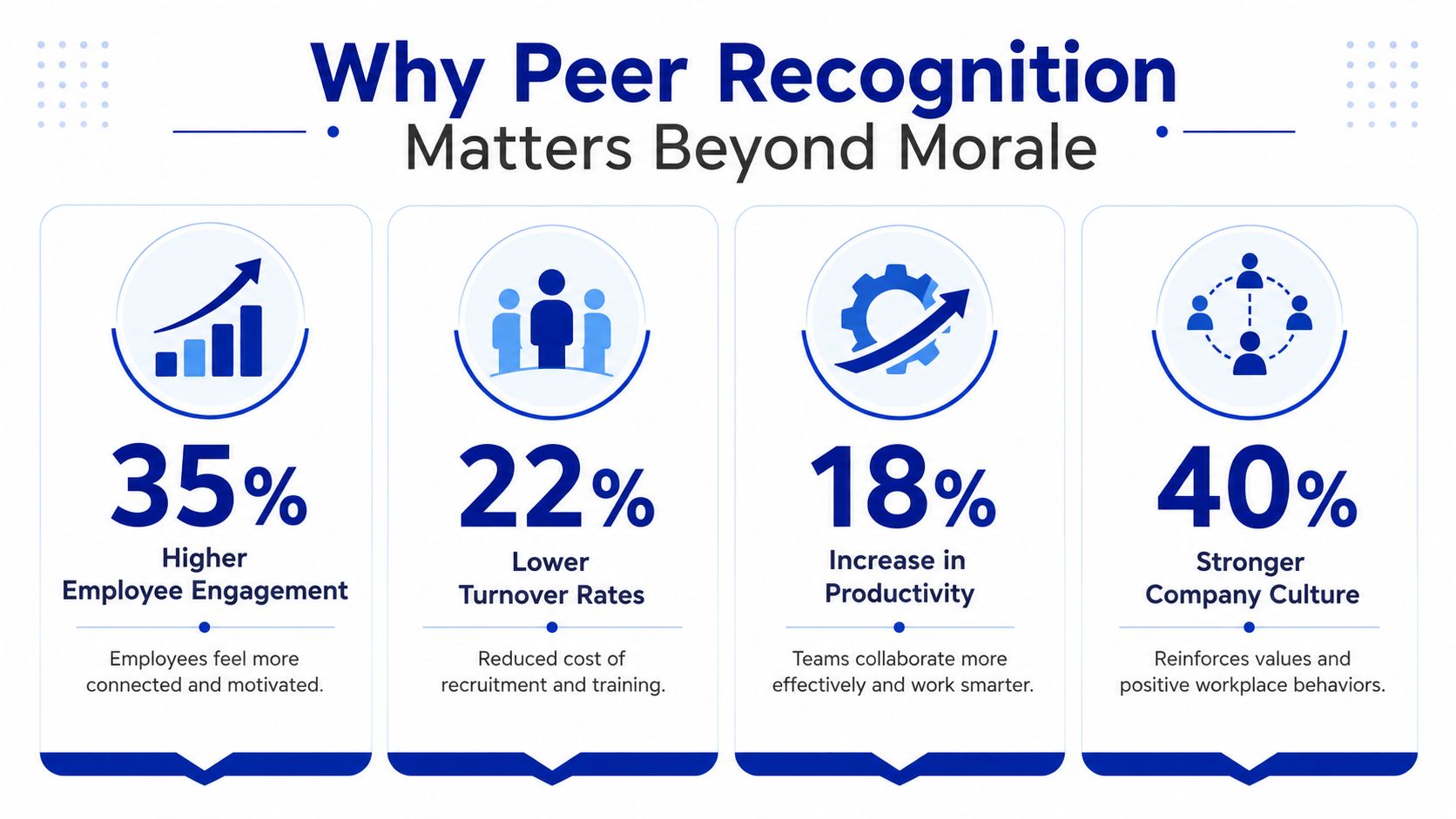
A manager can't observe every contribution. Peers often can. In distributed teams, clinical settings, field operations, and multi-site businesses, the people closest to the work often have the clearest view of who solved a problem, stepped in under pressure, or reinforced standards.
That visibility makes peer recognition operationally useful. It fills the gap between annual reviews, formal check-ins, and compliance-focused supervision.
Practical rule: If your managers can't reliably see day-to-day behavior, your recognition model can't depend on managers alone.
Recognition also helps leaders spot whether values are showing up in practice. If employees consistently recognize behaviors tied to service, safety, teamwork, responsiveness, or accountability, you have a live signal that culture isn't just printed on a wall. If you want a stronger baseline for tracking impact, pair recognition with a disciplined approach to measuring employee engagement.
Smaller employers often assume formal recognition is for enterprise companies with large budgets and dedicated HR teams. That's backward. SMBs usually feel turnover, disengagement, and manager inconsistency faster and more painfully than larger organizations.
Peer recognition gives you a relatively low-friction way to create repeatable acknowledgment across the business. It can reinforce standards when leadership isn't physically present, and it can do that without waiting for the next review cycle.
The key point is simple:
The mistake is assuming those benefits happen automatically. They don't. Benefits show up when the program is designed with discipline.
A popular recognition program can still be a bad program.
The biggest risk isn't that people won't like it. The biggest risk is that leadership launches something highly visible, loosely governed, and subjective, then acts surprised when employees start questioning fairness. Once that happens, the issue stops being cultural and becomes operational, legal, and reputational.

SHRM's warning on peer recognition red flags is worth taking seriously. It notes that peer recognition can become counterproductive if it's designed like a popularity contest, creating comparisons, feelings of unequal treatment, and other toxic dynamics. It also states that peer recognition should supplement, not replace, manager recognition and feedback.
That point is fundamental. If employees believe recognition flows to the most social employees, the most visible departments, or the people with the strongest personal relationships, your program starts undermining trust instead of building it.
Watch for these warning signs:
If you're looking at powerful recognition examples for HR, use them as inspiration for format, not as a substitute for governance. The design choices behind the example matter more than the surface mechanics.
Recognition turns risky fast when rewards are attached and no one has thought through administration. Cash, gift cards, points with cash-like value, and award structures tied to measurable output can create tax, wage, and documentation questions that leaders shouldn't improvise.
That doesn't mean you should avoid rewards. It means you need controls before launch.
A defensible program doesn't ask, "Will employees enjoy this?" It asks, "Can we explain how this works, who qualifies, how it's tracked, and how we prevent bias?"
In regulated or multi-state settings, subjective recognition can also create discovery problems later. If complaints arise about discrimination, retaliation, favoritism, or inconsistent treatment, your recognition records may be reviewed alongside performance files, complaint histories, and manager notes. Vague praise for some employees and silence around others can become part of a larger narrative.
Recognition should never become an uncontrolled side channel for compensation, status, or managerial avoidance. If it does, you're not running a culture initiative. You're creating evidence without standards.
A peer to peer recognition program fails when it is built for enthusiasm instead of control. Build it like an employment practice. That means clear criteria, documented workflows, review points, and records you can defend.
You do not need a complex platform. You need a system employees can use without confusion and leaders can audit without guesswork.
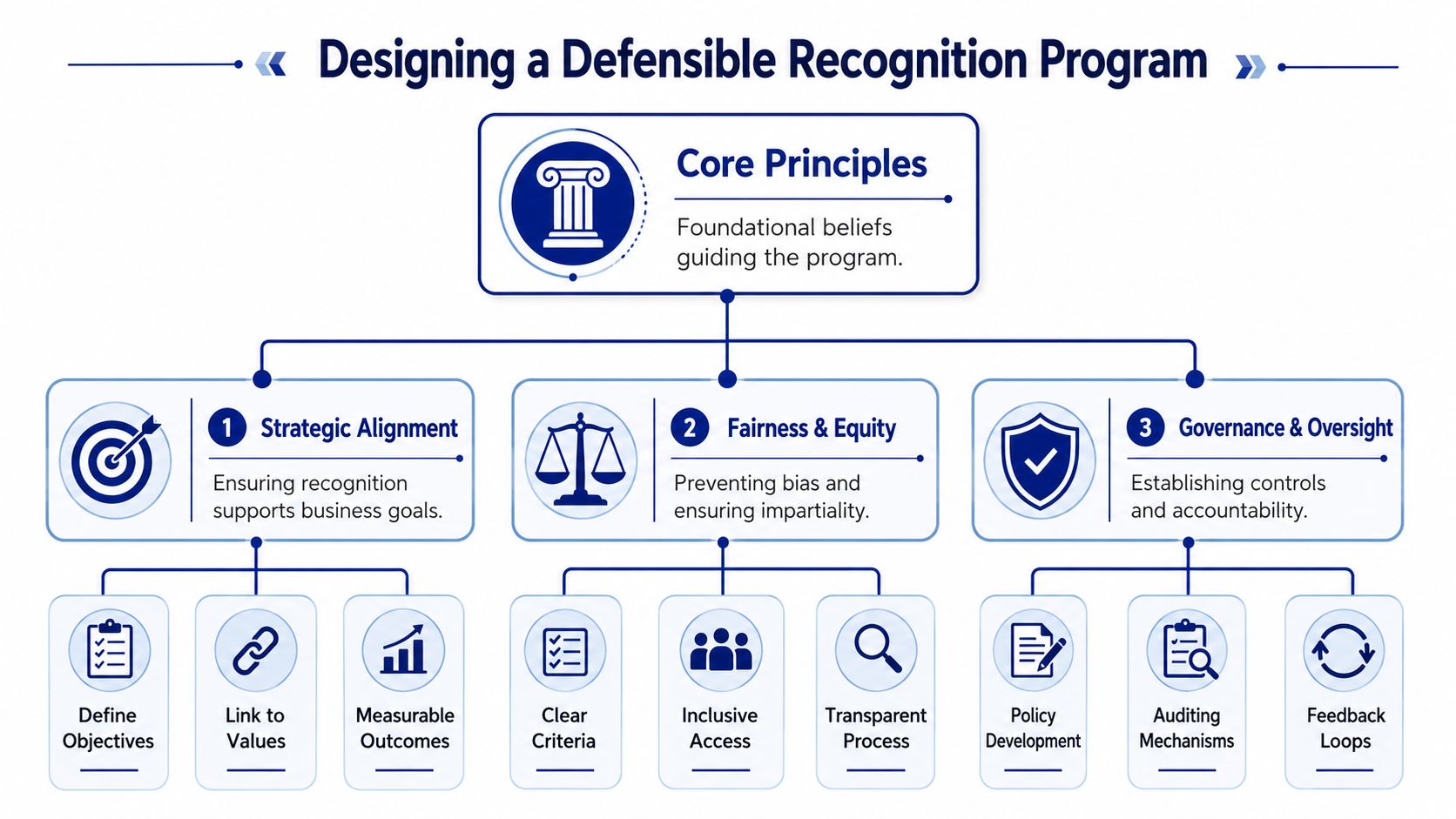
Define what qualifies before you invite anyone to post praise. Loose standards create inconsistent recognition, weak records, and avoidable bias concerns.
Tie recognition to observable actions tied to business needs. Recognize behavior such as following patient safety procedures, documenting work correctly, training a new hire thoroughly, resolving a client issue within policy, or covering a shift transition without creating service risk. If your values are too broad to guide decisions, tighten them first. This guide to company core values can help you turn vague ideals into usable standards.
Your policy should answer four questions with precision:
A program is not defensible if one group can participate easily and another cannot.
Deskless and frontline employees need the same practical access as office staff. If corporate teams can post recognition instantly in collaboration tools, while field employees need a manager to relay it later, participation data will reflect convenience instead of contribution. That weakens adoption and undermines fairness.
Use a simple standard: every employee should have a realistic way to submit and receive recognition during the normal workday.
| Program choice | Defensible standard |
|---|---|
| Submission method | Employees can participate without a desk, company laptop, or manager acting as gatekeeper |
| Visibility | Recognition appears in a channel that can be reviewed consistently, not only in private messages |
| Approval rules | Rewards, exceptions, and escalations follow written criteria |
| Access support | Frontline and mobile workers have a clear participation method and basic instructions |
Recognition should be easy to submit and hard to misuse. That balance decides whether the program holds up under scrutiny.
Embedding recognition in tools employees already use is usually the right call. It increases participation and reduces training friction. It also works only if submissions follow a standard format and someone owns oversight. Convenience without governance creates noise, duplicate entries, vague praise, and public comments you may later need to explain.
Set these rules at launch:
One test matters more than the rest. If an employee asks why a coworker was recognized and they were not, your leaders should be able to point to standards, records, and process. Opinion is not enough.
A single recognition idea can create different administrative problems across states. That's why multi-state employers shouldn't copy a vendor template and assume it's enough.
The first priority is consistency of policy. The second is flexibility in administration. You need one core standard that defines eligibility, approval, documentation, and reward handling, but you also need room to account for local payroll practices, notice requirements, and operational realities.
A unified program should answer the same basic questions everywhere. What behavior qualifies. Who can nominate. Who reviews submissions. What rewards are allowed. How records are retained. Those decisions shouldn't change from location to location based on local manager preference.
What can vary is execution. A manufacturing site may rely on printed recognition cards and mobile access. A healthcare operation may need tighter review for public praise involving patient-facing work. A professional services team may use collaboration tools and meeting-based recognition.
That distinction matters. If standards vary by manager or site, employees may see the program as arbitrary. If process varies thoughtfully while criteria stay stable, you preserve both fairness and operational fit.
The moment recognition carries financial value, leadership should stop treating it like a culture project and start treating it like an employment process. Finance, payroll, HR, and operations should align on how rewards are issued, recorded, and approved.
Use a review checklist before launch:
Multi-state employers often create accidental exclusion. One site has a highly engaged leader and active participation. Another has weak adoption, no local champion, and little visibility. The result looks like culture inconsistency, but it can become a fairness problem if access and recognition are uneven over time.
A defensible program requires regular cross-location review. If one population rarely gives or receives recognition, fix the process. Don't assume silence means satisfaction.
A peer-led recognition program does not reduce managerial responsibility. It raises the standard for it.
If managers step back too far, recognition turns into a popularity contest. If they take over, the program stops being peer-led and employees treat it like another top-down approval channel. The manager's job is to keep the system credible, consistent, and usable under real operating conditions.
Managers set the tone for what counts as acceptable recognition. They should teach employees to name the specific behavior, explain why it mattered, and connect it to team standards or business expectations. That discipline matters because vague praise creates noise, while clear recognition creates a record of conduct the organization can evaluate.
Managers also need to correct misuse fast. Inside jokes, reciprocal shout-outs, repeated praise for the same visible employees, or recognition that hints at protected traits should not sit unaddressed. Left alone, those patterns create fairness and employee-relations problems.
A manager's operating role should be clear:
Peer recognition happens across teams, but risk shows up locally first. Managers are usually the first to see that one crew never participates, one employee is consistently overlooked, or one high-profile contributor attracts disproportionate praise because their work is more visible.
That does not mean managers should manually approve every message. It means they should review patterns, ask hard questions, and fix breakdowns in access, understanding, or team norms. A peer-led system still needs supervision.
For leaders who want stronger day-to-day management habits, these attributes of a good boss fit the oversight this kind of program requires.
Good managers protect the integrity of peer recognition. They do not compete with it.
If you measure success by counting how many recognitions were sent, you're measuring activity, not value.
A defensible program tracks whether recognition is distributed fairly, tied to meaningful behavior, and associated with business outcomes that matter. The data should help leadership answer two questions. Is the program being used consistently, and is it reinforcing the right conduct?
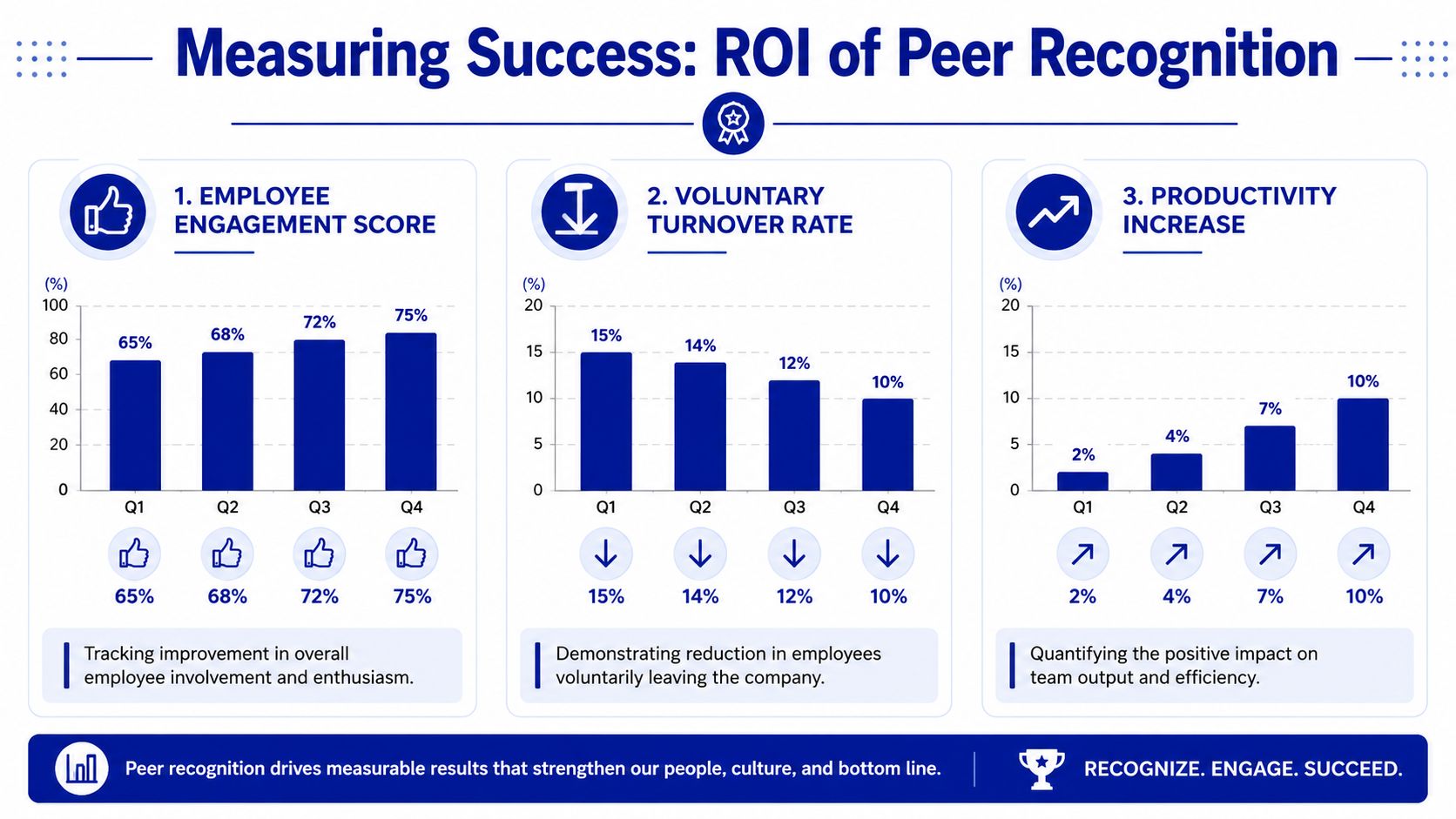
Start with participation patterns. Review who gives recognition, who receives it, and where activity clusters. Look across departments, supervisors, work locations, and employee groups. If participation is concentrated among a few teams or personalities, the program may be socially active but structurally weak.
Review the content too. Recognition should reflect real work, not vague approval. If most entries say some version of "great job" without naming the behavior, your system isn't generating useful data or reinforcing standards.
Use a review grid like this:
| What to review | What it tells you |
|---|---|
| Participation by team | Whether the program is actually reaching the organization |
| Recognition by role or location | Whether access or adoption is uneven |
| Content quality | Whether employees understand what qualifies |
| Manager follow-through | Whether supervisors are supporting or ignoring the program |
You should also connect recognition data to broader people indicators. Compare participation trends with turnover, engagement, absenteeism, and performance patterns. The point isn't to force simple cause-and-effect claims. The point is to determine whether the program is contributing to a healthier, more stable work environment.
A peer recognition outcomes summary reports that strong recognition programs can reduce voluntary turnover by up to 43% and increase employee engagement by 40%. Those numbers are useful, but only if your own program is disciplined enough to produce reliable internal evidence.
What should trigger leadership review?
Fairness is not a side benefit of measurement. It's one of the main reasons to measure at all.
If you're going to build peer to peer recognition, build it like a business process.
Start by defining what the program is for. Retention. Engagement. Reinforcing values. Supporting consistency across sites. If the objective is fuzzy, the program will drift toward popularity and noise.
Then put guardrails around it. Set clear criteria. Decide who can participate. Build access for deskless and frontline employees. Clarify what managers must do. Align payroll, finance, and HR before any reward is issued. Track use across teams and review patterns for inequity, bias, or weak adoption.
Use this checklist before launch:
The best recognition programs aren't the loudest. They're the clearest, most consistent, and easiest to defend.
A structured recognition program can strengthen retention, reinforce standards, and improve the employee experience, but only if it's designed with real discipline. If your organization operates across states, manages frontline or regulated teams, or needs a more defensible approach to people practices, contact Paradigm International Inc. to discuss how to build a recognition program that works in practice and holds up under scrutiny.