
The P&L no longer supports the current org chart. Open requisitions have already been frozen, contracts are being reviewed, and the COO is now weighing whether to eliminate a function, close a site, or reduce several teams. That decision can't be handled as a single announcement. It requires a documented operational process that accounts for selection logic, notice obligations, employee communications, payroll, benefits, and post-RIF records.
A reduction in force can be necessary for business continuity. It can also create discrimination claims, WARN exposure, severance disputes, and lasting damage to employee trust if leaders move too quickly. The right approach is to treat reduction in force procedures as a rules-driven playbook, not as a personnel decision made behind closed doors.
A true reduction in force, or RIF, is a permanent elimination of positions for business reasons rather than a response to individual performance or misconduct. The affected roles may disappear because the company is restructuring, a contract has ended, a budget has been rescinded, or a facility is closing. The defining question is whether the organization is removing work or positions, not merely removing particular people.
That distinction matters because ordinary termination procedures aren't enough. A performance-based termination should rely on performance records and prior corrective action. A RIF should begin with a documented business justification, a defined organizational scope, neutral selection criteria, and a review of legal and operational consequences. Mixing those two rationales creates avoidable confusion. If leaders say the business is eliminating a role but managers describe the decision as an employee's performance failure, the company's records may undermine its stated reason.
Practical rule: Decide what work the future organization needs before deciding which employees will leave.
Several events commonly push a cost reduction into formal RIF territory:
Federal agencies operate under an especially formal framework. Under Title 5 of the Code of Federal Regulations, Part 351, RIF procedures apply when employees face separation or demotion because of reorganization, lack of work, shortage of funds, insufficient personnel ceiling, certain reemployment or restoration rights, or a furlough exceeding 30 calendar days or 22 discontinuous workdays. That framework shows why a RIF is a structured legal mechanism, not just a label for a difficult layoff.
The human impact still deserves disciplined attention. Leaders should review how to handle layoffs with empathy, particularly when preparing managers to deliver difficult news without blaming affected employees. Respectful communication doesn't replace compliance, but it reduces improvisation and helps preserve dignity.
Federal WARN analysis starts with the employer, the worksite, the number of affected workers, and the timing of the separations. Covered employers generally include those with 100 or more employees, subject to statutory coverage rules. The federal law generally requires 60 calendar days of written notice for a covered plant closing or mass layoff. The notice goes to affected employees or their representative, the state dislocated worker unit, and the chief elected official of the relevant local government, as described in the U.S. Department of Labor WARN employer guide.
A WARN-covered mass layoff occurs at a single site during a 30-day period when the employer lays off 500 or more employees, or 50 to 499 employees when that group equals at least 33% of the site's active full-time workforce. Separate rules can apply to plant closings and relocations. Don't rely on a headcount pulled from the corporate payroll alone. The site, employment status, separation date, and statutory exclusions all affect the analysis.
| Triggering Event | Employee Threshold | Notice Window |
|---|---|---|
| Plant closing at a covered site | 50 or more workers displaced | 60 calendar days |
| Mass layoff at a single site | 500 or more employees | 60 calendar days |
| Mass layoff at a single site | 50 to 499 employees and at least 33% of active full-time workforce | 60 calendar days |
| Covered relocation | Review the applicable statutory coverage and site facts | Generally 60 calendar days |
WARN timing follows the employee's separation date. In a phased RIF, each group may have its own notice deadline. If separations occur on different days, employers should calculate the required notice separately for each separation rather than assuming one announcement date covers every employee, as explained in this state WARN Act compliance overview.
The law includes limited exceptions, including certain faltering-company and unforeseeable-business-circumstance situations. Those exceptions aren't a shortcut. The employer should preserve contemporaneous evidence showing why the exception applied, when the triggering facts became known, what notice was provided, and why full notice wasn't possible. Missing notice can expose the employer to statutory liability for affected employees' pay and benefits, so counsel should review the exception before the company relies on it.
State mini-WARN laws can impose broader coverage, different thresholds, or additional requirements. Federal compliance is the floor for covered actions, not a complete multi-state answer. Build the state analysis before approving the announcement date.
The selection matrix should exist before any employee names appear on the list. That sequence is critical. If managers identify people first and create criteria afterward, the criteria can look like a justification rather than a genuine business tool.
Start with the future-state organization. Identify the work that must remain, the capabilities required to perform it, and the roles that will be eliminated or consolidated. Then translate that analysis into criteria that are objective, job-related, consistently applied, and documented.
Useful factors may include:
Salary deserves particular caution. Compensation may be relevant to the financial model, but using salary as a proxy for who should leave can concentrate the impact on older workers with greater tenure. If cost is a business constraint, document the financial objective separately and show why the selected role structure meets that objective. Don't turn a compensation spreadsheet into a disguised age screen.
HR should test the proposed criteria against available workforce data before final approval. Review whether the proposed outcome disproportionately affects protected groups, including employees aged 40 and over, race groups, sex, disability, national origin, and pregnancy status. The purpose isn't to guarantee identical outcomes. It is to identify whether a neutral-looking process is concentrating the burden on a protected group and whether a less harmful, equally effective alternative exists.
The EEOC reported 88,531 new discrimination charges in FY 2024 and $700 million in monetary benefits for workers and job seekers, making termination decisions a continuing enforcement pressure point, according to the EEOC's FY 2024 enforcement and litigation data. The figures don't prove that a particular RIF is unlawful. They do show why selection documentation should be treated as evidence, not administration.
Keep the final record disciplined:
A strong matrix won't eliminate risk. It gives the company a coherent explanation that can withstand scrutiny.
Treat every state as a separate legal layer. Before naming employees, plot each affected site, assigned employee, headcount, separation date, and rolling measurement window on one compliance calendar. A plan that works at a headquarters in one state can fail when remote employees, satellite offices, or shared service teams are assigned to another location.
Federal WARN generally uses a 60-day notice period for covered plant closings and mass layoffs. State mini-WARN laws may cover smaller employers, use lower thresholds, require different delivery methods, impose longer notice, or add severance and final-pay obligations. California, for example, can apply to employers with 75 or more employees and can be triggered by layoffs of 50 or more employees within 30 days, according to the Department of Labor's plant-closing and mass-layoff guidance.
Your legal and HR teams should create a site-by-site matrix with these columns:
| State | Mass Layoff Threshold | Notice Period | Final Pay Trigger | Key Carve-outs |
|---|---|---|---|---|
| Federal baseline | 500 employees, or 50 to 499 employees and at least 33% of the active full-time workforce at one site during 30 days | 60 calendar days when covered | Apply the governing state rule | Federal exemptions and exceptions require fact-specific review |
| California | Review the state threshold and site facts, including the 50-employee and 75-employee coverage points | Confirm current state requirements before announcement | Check California timing for wages and accrued amounts | State-specific notice, coverage, and delivery rules |
| New York | Review site headcount, event type, and applicable state coverage | Confirm current state requirements | Check state final-pay requirements | State-specific coverage and notice rules |
| Illinois | Review the state threshold and covered event | Confirm current state requirements | Check state final-pay requirements | State-specific coverage and notice rules |
| New Jersey | Review the state threshold and covered event | Confirm current state requirements | Check state final-pay requirements | State-specific coverage and notice rules |
| Massachusetts | Review the state threshold and covered event | Confirm current state requirements | Check state final-pay requirements | State-specific coverage and notice rules |
This table is a planning framework, not a substitute for current state-law review. Use the Paradigm International Inc. handbook guide to identify state-specific employment requirements, then have counsel validate the RIF facts.
Remote work complicates site analysis. An employee's home may not be the only relevant location if the person is assigned to, reports into, or works for a covered site. Review personnel records, work assignments, payroll registrations, and organizational reporting lines. Also examine rolling 30-day and 90-day look-back periods where applicable, because staggered decisions can combine into one covered event.
Add the earliest notice date, final-pay deadline, severance approval date, benefits handoff, and communication owner to the calendar. Include collective bargaining obligations where applicable, and do not assume managers are outside every obligation merely because they aren't represented. The calendar must be complete before leaders schedule separation meetings.
The script determines whether the RIF feels controlled and respectful or improvised and hostile. Managers need language that matches the written notice, the selection record, and the approved severance terms. If the spoken explanation changes from one employee to another, the company creates inconsistency that can become evidence.
Use three communication layers. First, brief managers and remaining employees on the business rationale and immediate operating changes. Second, conduct the separation meeting with the affected employee. Third, deliver a written notice that accurately reflects what was said and identifies the next administrative steps.
A practical meeting should move in this order:
Keep the meeting short enough to stay controlled, but don't rush the employee through documents. HR should attend, and the company should determine in advance whether a second company representative or witness is appropriate. Every participant should understand that meeting notes, calendar entries, emails, and chat messages may later be discoverable.
Managers shouldn't promise rehire, describe the employee as “too expensive,” suggest that an employee's age or leave status influenced the decision, or offer an off-the-record settlement. They also shouldn't introduce undocumented criticism during a RIF meeting. If a manager can't support a statement with the approved record, the manager shouldn't make it.
Prepare a written FAQ that answers common questions about selection methodology, severance, COBRA, unemployment claims, return of property, and remaining work. Use neutral unemployment language. The company should provide accurate factual information and avoid coaching employees about how to characterize the separation.
Remaining employees need a separate message. Explain what work remains, who owns it, what priorities changed, and where employees can ask questions. Don't disclose confidential details about departing colleagues. Consistent communication protects dignity and gives the surviving team enough information to operate.
Severance isn't merely a goodwill gesture. In most RIF settings, it is part of a negotiated exchange in which the employer offers compensation or other value in return for a release of specified claims. The agreement must be drafted for the employee's age, employment status, jurisdiction, and circumstances. Have employment counsel review the final form before managers distribute it.
For employees aged 40 and over, an ADEA waiver requires careful compliance with federal requirements, including a 21-day consideration period and 7-day revocation period in the applicable individual separation context. Group termination programs can require additional disclosure about the decisional group and selected and non-selected employees under the Older Workers Benefit Protection Act. Don't reuse a separation agreement from another state or another RIF without reviewing the facts.
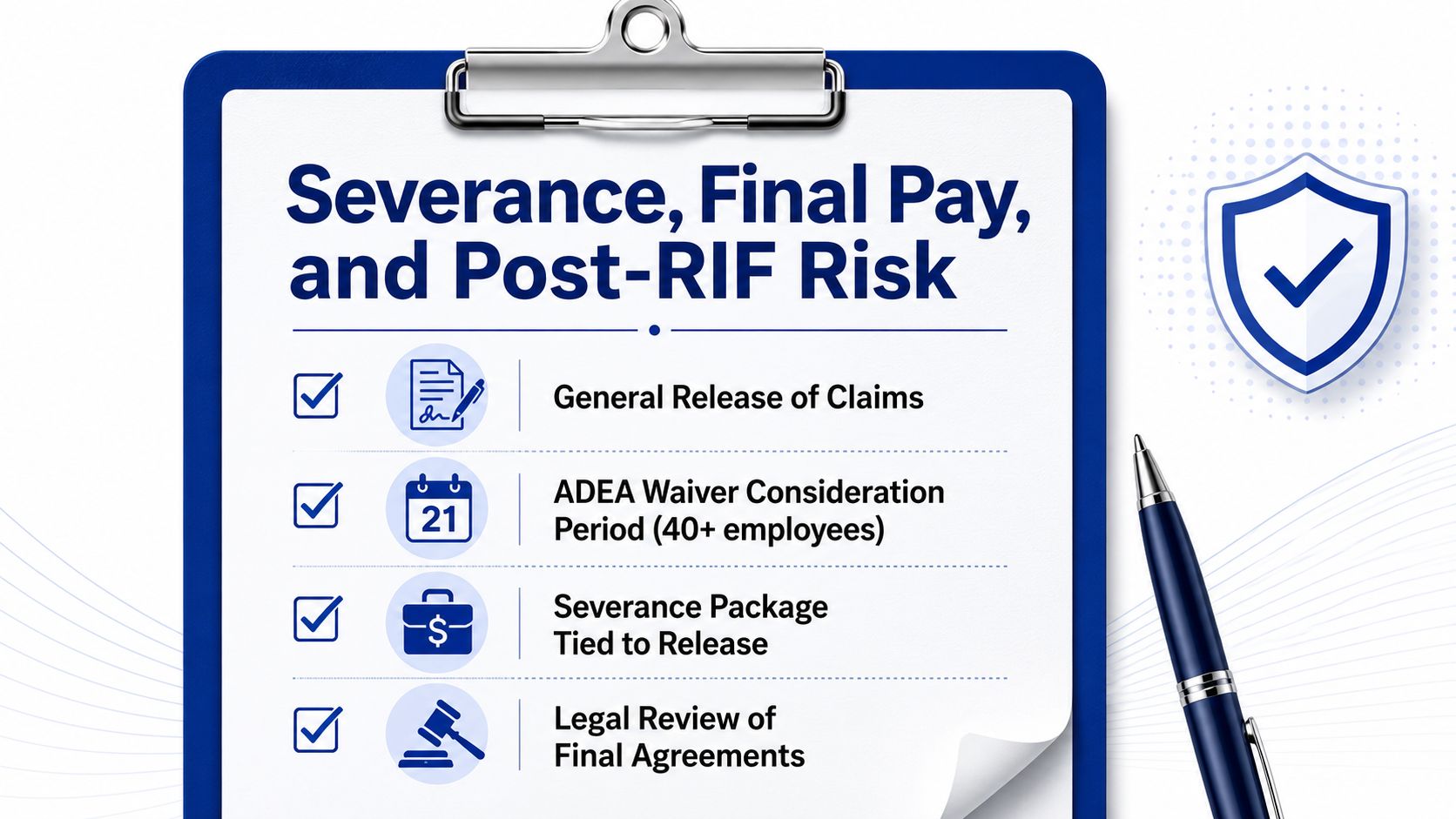
Payroll should create a state-by-state final-pay schedule before notices go out. The last paycheck should separately identify wages, accrued paid time off where required, commissions, deductions, and any other amounts due. California, Massachusetts, and New York can impose accelerated final-pay timing in particular circumstances, so payroll should validate the rule for each employee rather than applying one company-wide date. Leaders handling a Texas workforce should also review the final paycheck penalty rules in Texas.
Benefits administration needs its own owner. Coordinate COBRA election materials, applicable state continuation coverage, conversion rights for group life and supplemental policies, and the employee's final date of active coverage. The federal COBRA election notice process generally requires the plan administrator to send the election notice within 14 days after receiving notice of the qualifying event, so HR should confirm who sends the notice and when the clock starts.
Post-RIF records should include:
Set a retention schedule with counsel that addresses the applicable federal limitation period and any longer state requirement. Don't let managers keep unofficial copies in personal email or local folders. Centralized, access-controlled records are easier to audit and less likely to contradict the official file.
The next 30 days should produce a documented decision, not just an announcement date. Assign one owner to every workstream. The CEO or COO owns the business rationale, the HR lead owns process control, employment counsel owns legal review, and payroll owns final-pay and benefits execution.
Day 1, convene counsel and HR. Confirm the business problem, decision authority, confidentiality rules, and project workspace. Counsel should identify the federal, state, contractual, leave, accommodation, and retaliation issues that require immediate review.
Day 3, lock the organizational scope. Define the future-state structure, affected functions, sites, roles, reporting lines, and work that will remain. Don't identify individuals until the role map is stable.
Day 5, finalize objective selection criteria. HR and business leaders should document the rubric, data sources, comparison groups, and approval process. The criteria must connect to post-RIF operations, not to a manager's unrecorded preference.
Day 7, run the disparate-impact review. Compare the proposed outcome across protected groups and investigate any concentration that needs a business explanation or alternative analysis.
Day 10, audit WARN exposure. Counsel and HR should map federal and state thresholds by site, calendar window, remote assignment, and separation date. Calculate the earliest permissible notice date for every affected group.
Day 12, approve severance and benefits terms. Counsel should review releases, ADEA and OWBPA requirements, state restrictions, COBRA materials, final-pay rules, and any commission or PTO issues.
Day 15, finalize the communication plan. HR should prepare manager scripts, employee notices, remaining-employee messages, FAQs, meeting schedules, witnesses, and escalation instructions.
Day 20, rehearse the meetings. Managers should practice the approved script and difficult questions. Correct language that sounds personal, speculative, retaliatory, or inconsistent with the selection file.
Day 23, confirm operational controls. Payroll, benefits, IT, facilities, and security should verify payment dates, coverage notices, property recovery, access changes, records, and employee contacts.
Day 30, complete final review and communication. The CEO or COO approves the business decision only after HR and counsel confirm that the selection record, notice calendar, agreements, scripts, and operational checklist match.
The rationale matters as much as the task. Counsel review controls legal exposure. A locked scope prevents post hoc selection. A disparate-impact check tests neutral criteria. A multi-state audit protects against missed notice obligations. Rehearsed communications reduce inconsistent statements. The final records show that leaders made the decision through a repeatable process.
A RIF survives scrutiny when it is documented before it is announced. If your company doesn't have in-house employment counsel, outside advisory support can serve as a control point, particularly for multi-state headcount mapping, selection documentation, manager preparation, and final agreement review.
Paradigm International Inc. helps owners, COOs, and HR leaders structure high-stakes workforce decisions with defensible documentation, multi-state compliance review, and practical manager guidance. Visit Paradigm International Inc. to discuss the RIF process before notices are drafted and communications begin.