Your warehouse supervisor got terminated for attendance six months ago, and now a different hiring manager wants to bring him back. That sounds simple until someone asks why a nearly identical applicant was denied rehire, and nobody can point to a policy, a category, or a written rationale. That's where a rehire policy after termination stops being an HR formality and starts becoming a document you may have to defend under oath.
A strong policy does one thing well: it takes the judgment call out of the hallway and puts it into a record that can survive scrutiny. If you're the COO or owner, that means the question isn't whether former employees can ever come back. The question is whether your company can explain, consistently and in writing, why one person was eligible, another was conditional, and a third was out.
A terminated employee reapplies months later, and the hiring manager says, “He was fine enough last time, let's move fast.” Then a different manager rejects a similar applicant, and the second person files an EEOC charge. At that point, the issue isn't the hire itself, it's the fact that leadership has no rehire-after-termination record, no eligibility category, and no written reason that explains the difference.
That absence is what gets exposed in discovery. Rehire decisions are not private feelings once they're tied to protected activity, a charge, a complaint, or a later lawsuit. They become documents, emails, manager notes, and testimony, which means inconsistency is dangerous even when the original termination seemed routine.
Practical rule: if the company can't explain the rehire call in one clean paragraph, it probably can't defend it in deposition.
The risk is bigger than one rejected applicant. A rehire refusal can become a cross-claim in a wrongful termination dispute, especially when the former employee argues that the company's story changed after the fact. That's why undocumented discretion is the worst possible system, because it invites comparison between two people who were supposedly treated differently for the same reason.
A major workforce analysis found that organizations rehired about 5.3% of laid-off employees within 15 months, and that the rate stayed in the 4% to 6% range over seven years (Visier layoff boomerang report). That matters because rehiring former employees is not rare. It's a recurring talent decision, which means your policy needs to act like a system, not a mood.
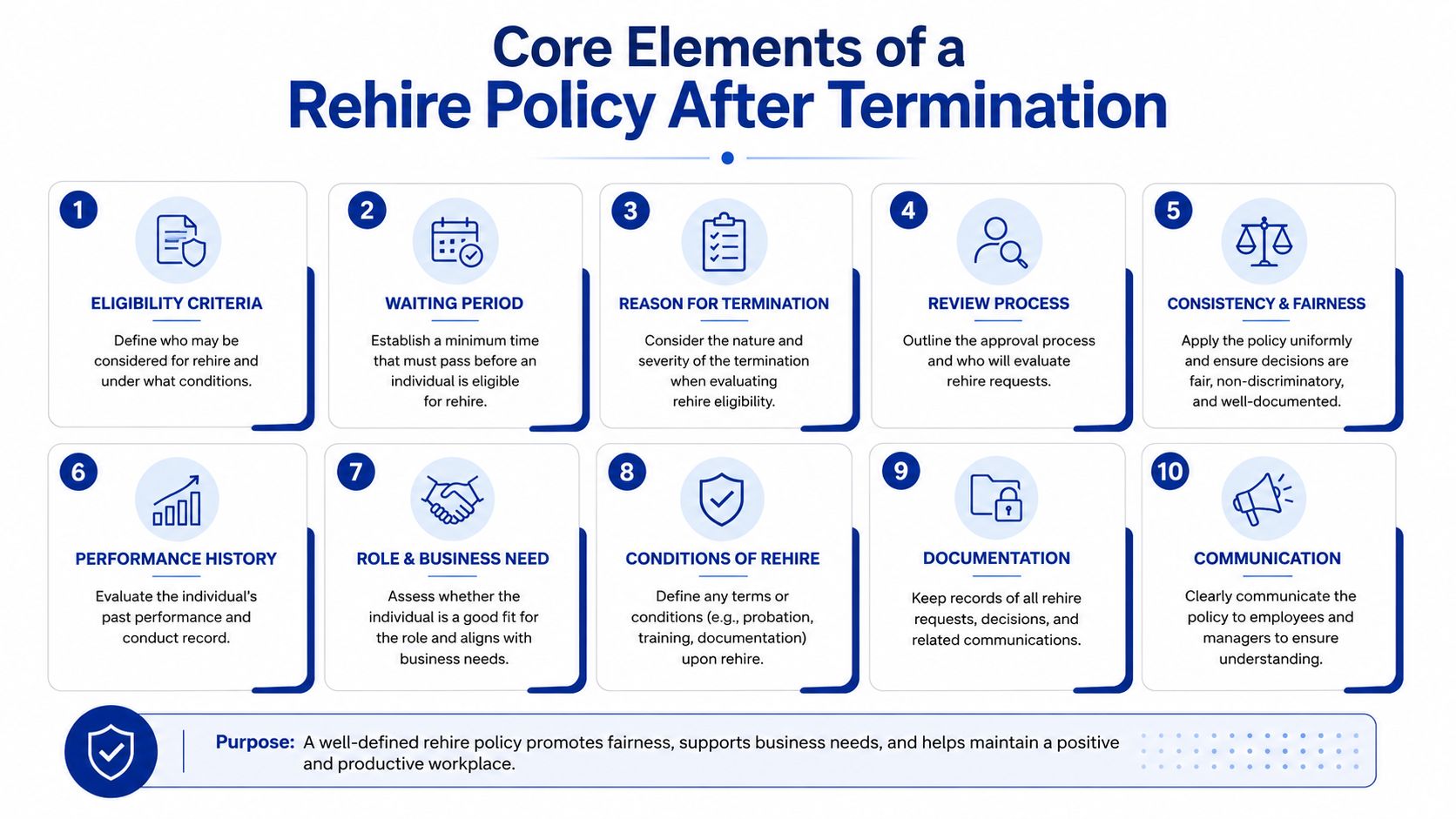
A defensible rehire policy after termination needs four things, and each one has a different job. First, it needs eligibility categories. Second, it needs a waiting period or cooling-off rule. Third, it needs a single approval authority. Fourth, it needs documentation that proves the decision wasn't ad hoc.
That structure belongs in two places. The broad rule should live in the handbook, where employees and managers can see it. The operational details, meaning how HR verifies the separation reason, who signs off, and how exceptions are tracked, belong in an HR procedure. The actual decision record belongs in the personnel file, linked to the original termination file.
The drafting mistakes are predictable. Vague language like “may be considered” sounds flexible, but it's weak if two managers use it differently. Blanket bans are cleaner on paper, but they can be indefensible when the termination reason was ambiguous or later corrected. Silence on conditional rehires is worse, because it leaves managers to improvise.
One sample policy allows a former employee terminated for reasons other than illegal or unethical behavior to reapply after 4 months, while employees terminated for cause or job abandonment are not eligible, and a no-show after accepting an offer triggers a 6-month no-rehire period (Workable former employee rehire policy). Another institutional policy uses a 12-month bar for some cause-based separations, which shows that timing varies by reason and can be formally time-bound (Workable former employee rehire policy). That's the model worth copying, because time-bound rules are easier to explain than vague exceptions.
The fastest way to make a rehire policy sloppy is to treat every termination the same. You don't want a single yes-or-no rule. You want a separation category, a default outcome, and a record that explains any deviation.
A voluntary resignation with notice should usually stay in the eligible bucket, unless there was a related conduct issue or a documented trust problem. A resignation without notice can be treated more cautiously, because the departure itself may have created operational harm. Performance-based terminations should be conditional at best, because the company needs proof that the underlying issue is gone and that the old record wasn't just renamed.
Misconduct or policy violation terminations deserve the tightest treatment. If the conduct involved theft, harassment, fraud, or another serious breach, the default should be ineligible unless legal counsel signs off on a documented exception. Position elimination or RIF cases are different again, because the business ended the role, not the person, so the policy should focus on recall rights, reapplication rules, and whether the company owes the former employee a fair shot at a comparable opening.
Here's the rule I'd use: if the termination reason is unclear, treat the employee as “pending review” until HR establishes the facts. Do not force a manager to guess. That's how a routine rehire turns into a discrimination exhibit.
A good practice is to gather exit information before the file closes. If you need a structured way to understand why people leave in the first place, a tool like questions to reduce turnover can help the organization collect cleaner separation data. Better exit documentation makes later rehire decisions more defensible.
Ambiguous separations should never be turned into confident answers without facts. If the file is thin, the answer should be careful, not convenient.
For contractors and mixed workforces, the separation paper trail matters just as much. See the internal guidance on contractor termination letter if your company uses nonemployee relationships alongside standard employment.
A generic rehire policy falls apart as soon as it crosses a state line or touches a protected category. One office may treat it as routine. Another may treat the same language as retaliation, discrimination, or a benefits problem. A policy that looks fine in one office fails in another because applying the same standard in a legally aware way is what separates defensible practice from exposure.
| Trigger | What generic language gets wrong | What a defensible policy does |
|---|---|---|
| RIF or layoff | Treats all former employees the same | Separates recall rights from ordinary rehire rules |
| Protected activity | Assumes a refusal to rehire is always neutral | Requires a legitimate, non-retaliatory reason |
| ACA eligibility | Treats every return as a brand-new start | Checks whether the prior termination and rehire are reasonable |
| Background checks | Reuses old timing assumptions | Reapplies timing rules only when permitted |
| Nepotism conflicts | Focuses only on the candidate | Looks at who supervises, approves, or influences pay |
A refusal to rehire can create retaliation exposure under Title VII when the former employee previously filed an EEOC charge or participated in an investigation. Those are protected activities, so the company needs a legitimate reason, and that reason needs to be documented before the dispute starts (The Employer Handbook on refusing to rehire after an EEOC charge). In the age-discrimination context, a rehire bar tied to a reduction in force can also create disparate-impact risk, as shown in EEOC v. Allstate, where a one-year bar after termination or until severance ended was challenged because it affected older workers more heavily (EEOC v. Allstate).
ACA treatment matters too. A rehired employee can be treated as newly eligible for benefits and made to satisfy the plan's eligibility rules again, but only if the termination and rehire are reasonable and not a subterfuge to evade the 90-day waiting-period limit. There is no minimum waiting period, and employers may waive the waiting period entirely (ACA rehire waiting period guidance). HR cannot improvise benefit timing just because the person used to work there.
For handbook alignment across states, use a state-specific review process rather than a one-size-fits-all policy. If you need a checklist for that, use the internal guide to find your state's handbook rules. I also flag nepotism-style conflicts here because the operational issue is who can supervise, approve, or influence pay, not just whether two people are related (CalHFA nepotism policy).
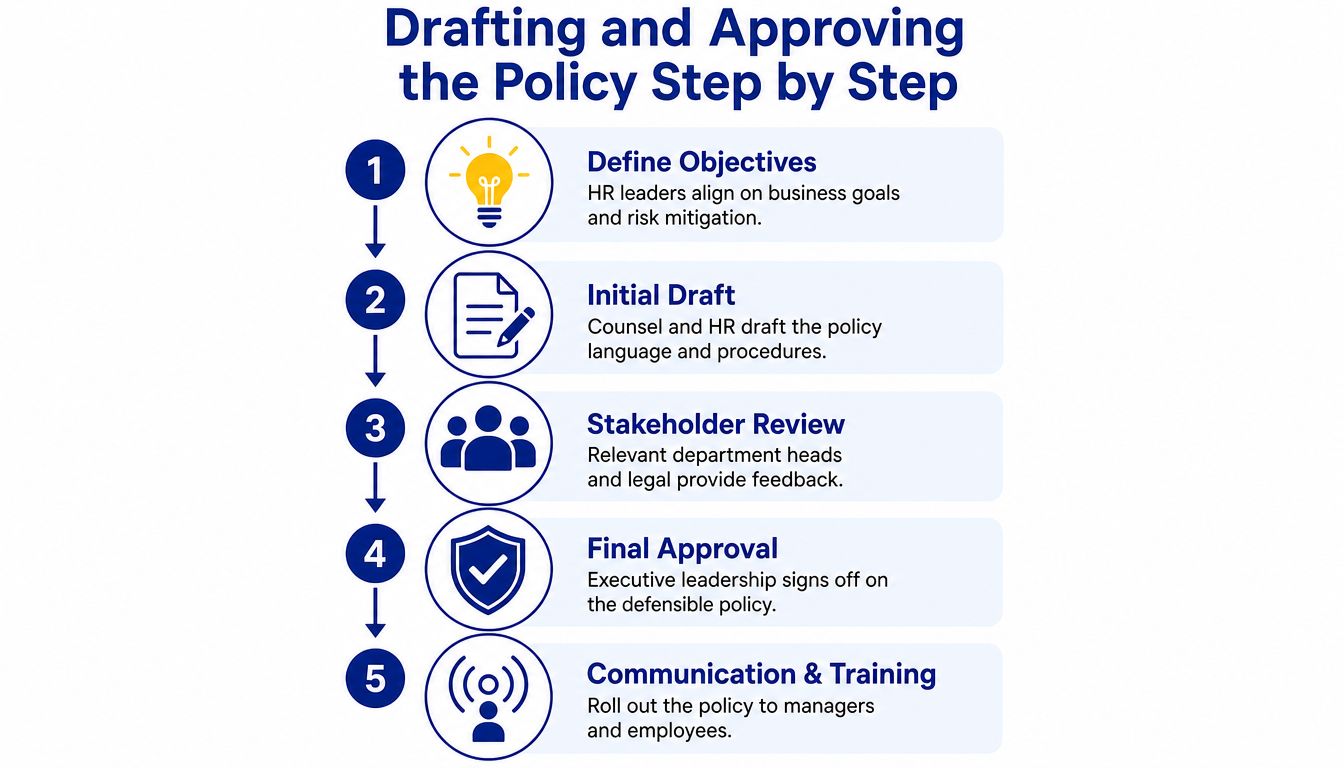
A rehire policy is only as defensible as the workflow that produced it. If leadership can't show how the policy was drafted, reviewed, and approved, the policy reads like a reaction, not a deliberate business rule.
Start with business objectives and risk tolerance. Do you want to allow broad rehire flexibility, or do you want tight control after terminations for cause? Write that down before you draft a single clause, because the policy language should reflect the company's actual appetite for risk, not a generic template.
The key artifact is the decision matrix. It shows who decides, which clause applies, and what evidence must exist before a former employee comes back. A redline log matters too, because it shows the company didn't adopt vague language without debate. A training deck matters because managers are usually the ones who create inconsistency if they don't understand the categories.
Good policy work leaves a trail. If the approval path is invisible, the policy won't hold up well when someone challenges the decision later.
This is also where a document discipline mindset helps. If your company already needs a system to turn archives into a revenue engine, the same discipline applies here, because the rehire file is only useful if it's easy to find, consistent, and complete. The policy file should show the effective date, signature trail, and the exact version managers were trained on.
A usable template should be simple enough for HR to apply and precise enough for counsel to defend. Keep the policy clauses variable, so leadership can set different rules by separation reason without creating a new document every time the law changes.
Template language
A former employee resigned with notice and reapplies 8 months later. If the file supports a clean separation and the policy sets an eligibility window shorter than that, HR can document regular eligibility and restore tenure only if the policy allows a bridge. The important thing is consistency, not sentiment.
A former employee was terminated for a policy violation and reapplies two years later. The waiting period, the written approver, and the reference-check step all matter here, because the company should be able to show that the reason for separation was reviewed again before the decision changed. If the policy allows conditional rehire, the decision should say what condition was satisfied.
A former employee separated in a RIF is recalled to a different role. That call may implicate recall rights and benefit eligibility, and if USERRA applies, the original hire date and reemployment protections may have to be preserved. The ACA treatment still needs separate attention, because benefit timing has its own rules and shouldn't be guessed at.
For retention and recordkeeping on the rehire file, see how long to keep employee records. Keep the original termination record, the rehire request, the approval note, and any exception memo together.
The policy on paper doesn't matter if managers handle rehire requests by memory. Every request should enter through one intake form, and that form should capture the separation reason, exit interview notes, prior manager input, and the new manager's recommendation before any offer language is drafted. If those facts aren't gathered early, HR ends up reconstructing them later from email threads, which is exactly the kind of mess that makes a record look unreliable.
I'd require a written eligibility determination signed by HR and the hiring VP. That document should sit in a dedicated rehire file linked to the original termination record, not buried in a generic hiring packet. The logic should be visible, because if the decision is challenged, the company needs to show what it knew at the time and why the call was made.
Retention matters too. A company should set record horizons that match its legal footprint, because some states require longer retention than others. California personnel files are commonly kept for 7 years, while many other jurisdictions require at least 4 years, and records tied to harassment, discrimination, or wage claims should be held longer when litigation hold rules apply. If you need a broader filing standard, align it with your internal record policy and legal counsel's retention map.
Train managers every year on the rehire matrix. The same separation reason should produce the same eligibility call across regions unless the law or a documented exception says otherwise. Then run an internal audit at the 12-month mark to confirm every decision cites the policy clause and matches the separation category in the file.
There are three questions leaders always ask after they hear this framework. First, can a terminated employee be rehired at all? Yes, unless the separation involved egregious misconduct, an unrevoked gross-misconduct finding, or a regulatory bar. Second, can the company change rehire eligibility if new evidence surfaces? Yes, but the change has to be documented when it's made, tied to the clause that allows reassessment, and handled without retroactive games on unemployment or benefit claims. Third, what should happen when a former employee asks for a reference after a rehire denial? Keep it narrow, job title and dates of employment, and route anything beyond that through HR.
Never answer a rehire question before checking the policy. If the file and the policy disagree, the file needs to be fixed, not the story.
Paradigm International Inc. helps leadership teams build HR decisions that can stand up in a charge, an audit, or a lawsuit. If you need a rehire policy that fits your separation records, approval chain, and multi-state risk, visit Paradigm International Inc. and talk through the specific facts before the next request lands on your desk.