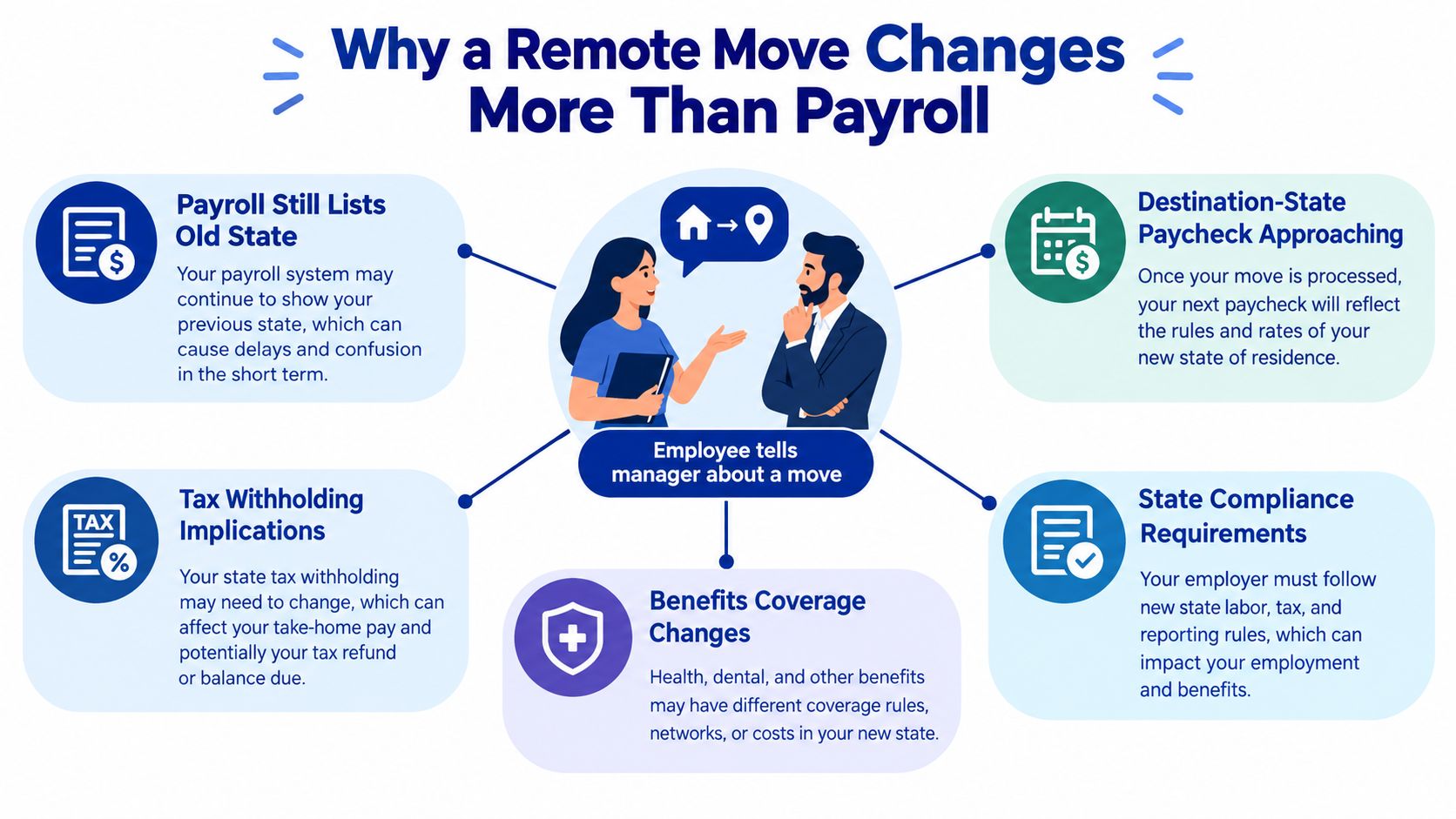
An employee tells a manager that the move is complete. Payroll still lists the old state, and the next paycheck is approaching. When a remote employee moved to another state without a coordinated review, the owner needs more than an address correction. The immediate priority is establishing where work occurred, when it started, and which decisions need specialist review.
A manager may hear about a relocation during a routine check-in and assume the employee has already notified payroll. The employee may assume that updating a mailing address completes the process. Neither assumption establishes the first day worked in the destination state or confirms that anyone reviewed the arrangement.
The employer should treat the move as a dated work-location event. That means collecting evidence before deciding which registrations, payroll settings, employment policies, and coverage arrangements need attention. A permanent move, temporary stay, and recurring split between homes shouldn't automatically receive identical treatment.
Remote work is common enough to justify a standard process. The Bureau of Labor Statistics reported that 22.8% of people at work teleworked or worked at home for pay in 2024, although that figure measures telework, not interstate relocation or legal obligations (BLS annual state telework data).
For a growing company without a senior HR leader, the practical challenge is coordination. Payroll, benefits, the insurance broker, and the manager may each hold different information. Someone with decision authority needs to bring those records together.
The initial review should assign an owner to each affected area:
Practical rule: An updated mailing address isn't evidence that the employer approved a new work location.
The owner doesn't need every answer immediately. The owner does need a reliable record, assigned responsibilities, and a clear escalation path before routine processing substitutes for a considered decision.
Separate the move date from the first workday. An employee might relocate over a weekend, take leave, and begin working from the new home later. Alternatively, the employee might work from the destination before formally changing residence.
The evidence file should preserve those distinctions. Its purpose is to support a reasoned effective-date decision, not to collect unnecessary personal information. A dated employee statement is a sensible starting point, with additional evidence requested when the facts conflict.
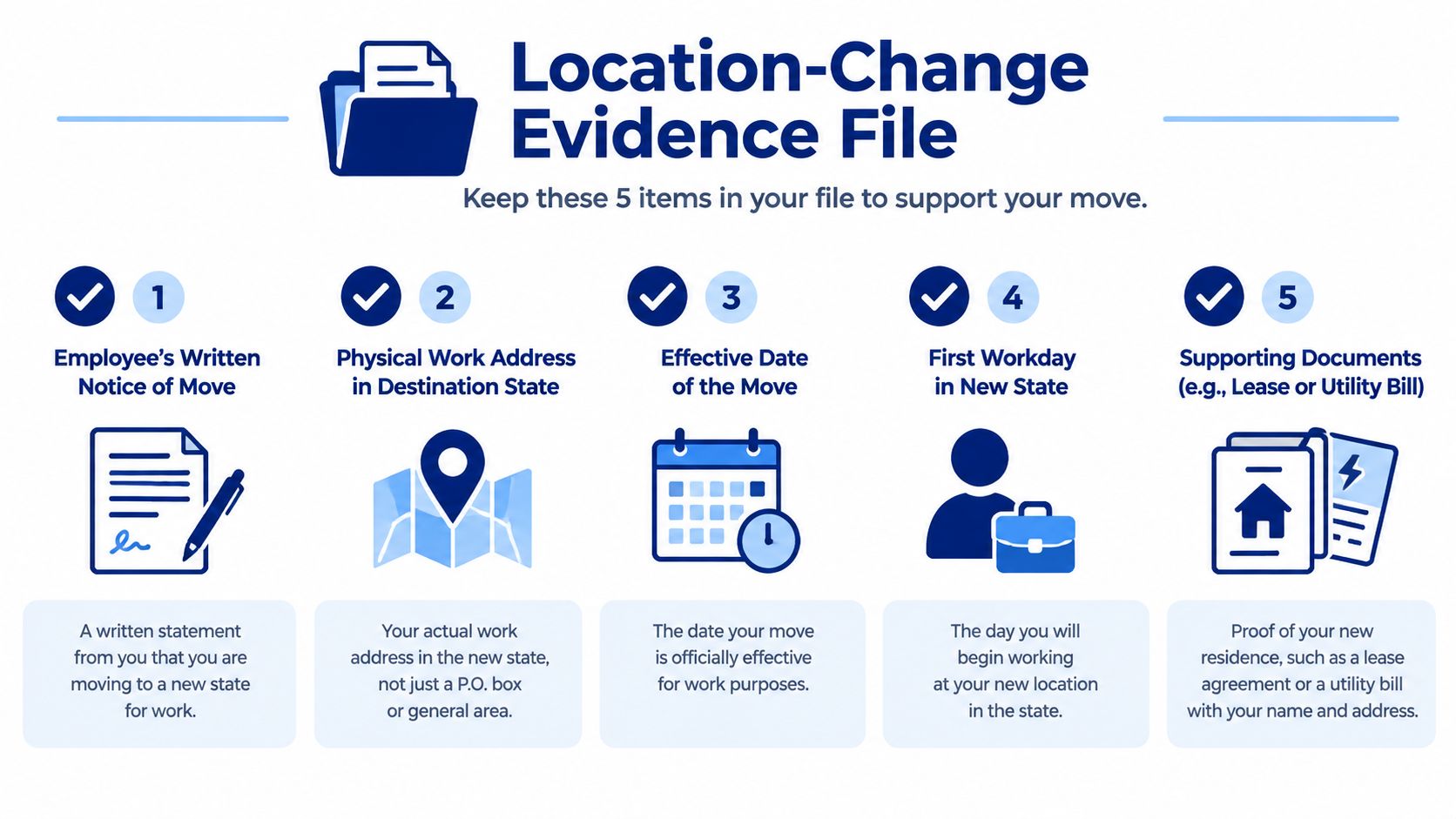
The assigned coordinator should assemble the following:
For temporary arrangements or work from a second home, add a dated workday log. Each entry should distinguish actual work from vacation or other nonworking time. Travel records and timekeeping can help resolve inconsistencies, but neither should replace an employee's explanation without review.
A lease or utility bill may support residence information when necessary. It doesn't, by itself, establish when the employee first performed work there. Collect only relevant supporting material and restrict access to the file.
The file needs a short decision note explaining the accepted timeline, supporting evidence, reviewer, and outstanding questions. If the employee notified a manager before payroll learned about the move, preserve both dates. Don't rewrite the record to make the approval appear earlier than it was.
The employer can use templates for safer HR decisions to standardize intake, approvals, and exception records. A consistent format makes missing facts easier to identify. It also helps the next reviewer understand why an effective date was selected.
For a late-discovered move, the note should distinguish historical facts from corrective actions. The employee's first workday belongs in the historical timeline. The date payroll changes a setting belongs in the correction record, and those dates may differ.
The payroll question generally begins with where services were physically performed, not where the company has its headquarters. The employer should then ask a qualified payroll-tax adviser to identify exceptions and applicable state requirements for the payroll year under review. The destination state's revenue and unemployment agencies should be identified by name in the resulting decision record.
Practical multistate payroll guidance emphasizes separate reviews of withholding, registration, unemployment insurance, and workers' compensation rather than treating an address update as sufficient (work-location and multistate payroll considerations). These are related tasks, but they aren't interchangeable. A correct withholding calculation doesn't establish that a registration was completed.
| Exposure track | Question to answer | Evidence or action |
|---|---|---|
| Income-tax withholding | Which state and local withholding rules apply to the documented work pattern? | Written tax review, required withholding forms, approved payroll codes |
| Employer registration | Which destination-state accounts or filings are needed? | Agency confirmations and assigned account information |
| Unemployment insurance | Where should wages be reported under the applicable state program? | Agency or adviser determination and reporting setup |
| Workers' compensation | Does the policy cover the approved location and duties? | Written carrier confirmation and any necessary policy changes |
| Employment administration | Does the payroll schedule support the applicable wage-payment rules? | State-specific review and a tested payroll calendar |
The U.S. Department of Labor explains that unemployment insurance is a joint federal-state program administered separately by states. A former employee generally files in the state where the work occurred, with additional guidance needed for multistate employment (DOL unemployment insurance guidance). That isn't a universal employer wage-assignment formula.
The coordinator should therefore confirm the applicable state unemployment agency's treatment rather than infer it from income-tax withholding. The explanation of SUI tax obligations for multi-state employers can help organize the administrative questions. Uncertain assignments belong with the agency or a qualified adviser.
After the review, payroll should receive a written implementation instruction. It should identify the effective treatment, approved codes, required forms, registration status, and any unresolved historical correction. The administrator should retain configuration evidence and confirm what the system processed.
A useful internal planning recommendation is a 60-day trigger before anticipated destination-state payroll, allowing time for review and agency processing; that is a planning control, not a universal legal deadline (advance registration and payroll planning guidance). Actual agency requirements and processing times need separate confirmation.
The first destination-state payroll should be reconciled against approved work-location records, gross wages, withholding, and reporting treatment. Any discrepancy should have an assigned owner and documented resolution. An old state should remain active only when the review identifies a reason, such as continued work there or an unresolved reporting obligation.
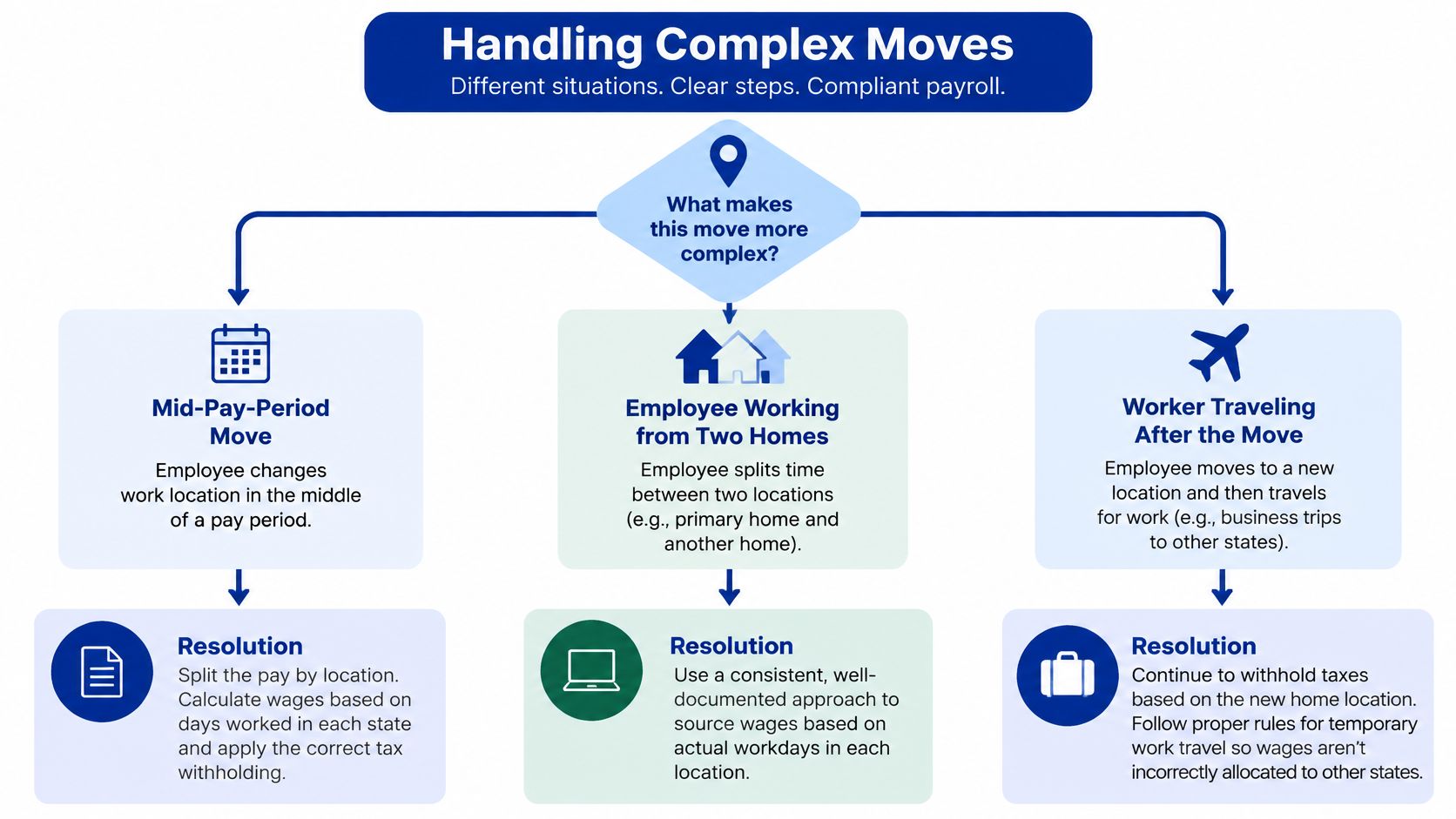
A clean permanent move has a known destination and a reliable start date. A split-home arrangement doesn't offer the same clarity. A move discovered after several payroll cycles also creates a historical correction question that a prospective address update won't answer.
Match the review to the facts, not the employee's label. Calling an arrangement temporary doesn't establish its payroll treatment. Manager approval also doesn't resolve tax sourcing or registration questions.
| Situation | Evidence needed | Review priority |
|---|---|---|
| Permanent move with advance notice | Confirmed start date and approved destination | Complete the standard review before implementation |
| Mid-pay-period move | Workdays before and after relocation | Determine allocation and payroll cutover treatment |
| Work from separate homes | Dated location log and expected recurring schedule | Review continuing multistate exposure |
| Travel after relocation | Business travel dates and work locations | Evaluate exceptions and continuing original-state work |
| Manager notified, payroll uninformed | Original communication and actual work history | Reconstruct the timeline and assess corrections |
| Move discovered late | Employee attestation and supporting records | Obtain tax advice before historical adjustments |
For example, an employee may move during a pay period and then return to the original state for client meetings. The employer should preserve each work location rather than classify the entire period by the address on payday. The tax reviewer can then evaluate the relevant states' rules for that payroll year.
Bonuses and equity require particular attention because relevant earning or vesting periods may include earlier work locations. Current residence alone may not provide the necessary sourcing information. Multistate payroll review should consider historical workdays and possible exceptions involving reciprocity, convenience-of-the-employer rules, local taxes, or other state-specific treatment (work-location audits and compensation sourcing guidance).
A monthly exception report should compare approved location, home address, timekeeping, travel, and payroll state. Every mismatch needs either correction or a recorded explanation. The internal goal should be resolution before payroll close, with unresolved technical questions escalated rather than guessed.
An unresolved location mismatch needs a named decision-maker, not an undocumented payroll override.
A location change can resemble entering a new state through hiring, even when no recruitment occurred. Paradigm International's state hiring tips provide a useful administrative reference. Historical tax corrections, uncertain allocation, and equity sourcing still require appropriately qualified review.
Keep payroll approval separate from employment-law review. The person configuring withholding shouldn't be expected to decide leave eligibility, handbook applicability, or termination timing. Those decisions require a different review and, when uncertain, qualified employment counsel.
The employer should commission a state-specific assessment for the year the work occurs. That assessment should name the governing law, administering agency, relevant effective date, and resulting policy action. A generic checklist is useful for intake, but it isn't a substitute for that determination.
A move involving California, Colorado, New York, or Washington should trigger a review of that named state's requirements. The employer shouldn't apply a California conclusion to Washington or assume that a New York policy fits Colorado. The necessary questions include:
These are review categories, not assertions that every listed state imposes the same duties. Counsel or the assigned specialist should identify the particular state labor department and applicable laws in the written assessment. If a local ordinance matters, the review should identify the locality as well.
The coordinator can find handbook requirements for each state while preparing policy questions. The resulting handbook work should explain which provisions apply to the employee. Distributing an addendum without explaining changed procedures leaves managers unprepared.
When leave administration is involved, the legal review should address the Family and Medical Leave Act, 29 U.S.C. § 2601, and DOL regulations, 29 C.F.R. Part 825, as applicable in the year of the leave request. Those federal references don't determine every state leave question. Counsel should verify current requirements, coverage, eligibility, and any interaction with state programs before the employer changes an active leave decision.
The same discipline applies when disability-related issues overlap with leave or attendance. An administrator can gather dates and documents, but shouldn't make an unsupported legal determination about protected absence or a proposed employment action. The owner should identify who has authority to approve the decision.
Escalation point: A complaint, investigation, leave request, or disability issue should be reviewed before a location-policy violation becomes a discipline decision.
If an employee disclosed a move while reporting a complaint or requesting leave, the employer should keep those issues factually distinct. Records should show what happened without assuming misconduct or drawing a legal conclusion. A termination after a complaint or leave, an investigation, or overlapping leave and disability issues warrants expert help before action.
Once the technical reviews are underway, the coordinator should reconcile benefits and employee records against the approved arrangement. A health-plan address change doesn't confirm network access. An updated remote-work agreement doesn't confirm workers' compensation coverage.
The benefits administrator should ask the carrier or plan administrator what the new location means under the actual plan terms. Questions should cover access, enrollment administration, eligibility, and coordination with any reviewed leave arrangements. Written responses are more useful than an undocumented assurance that everything remains unchanged.

The employee's remote-work authorization should identify the approved location and the process for requesting another change. Equipment and expense instructions should match the completed state review. Any new notices, state addenda, and acknowledgments should be distributed through a recorded process.
If the review involves hours classifications, Paradigm International's full-time guidance can help frame questions for a California arrangement. The administrator should still confirm the actual benefit-plan terms. A general employment label shouldn't substitute for the plan's eligibility definition.
A practical index should make the decision trail easy to retrieve:
A PEO or payroll platform can process information without resolving the employer's legal decision. The owner should ask what the provider reviewed, what it implemented, and what remains outside its scope. The engagement terms should clarify responsibilities rather than leave them assumed.
For an owner-led business, the best operational outcome is a coordinated record that another reviewer can understand. Documentation supports explanation and follow-through. It doesn't guarantee compliance or a particular legal outcome.
The owner should close the move only after the assigned reviewers confirm implementation. A completed intake form isn't enough. The final check should compare the approved decision with actual payroll, coverage, benefits, and employee communications.
Verification should be short enough to use consistently. Each item needs a responsible person and a completion record. Open questions should remain visible until someone with appropriate authority resolves them.
The reviewer should distinguish a completed correction from an issue merely referred to a provider. Referral isn't closure. An unanswered question needs an owner, a follow-up date, and a recorded decision when resolved.
Outside review is appropriate when workdays remain unclear, compensation sourcing involves bonuses or equity, or a late-discovered move may require historical corrections. Tax specialists should address technical tax questions. Employment counsel should address disputed legal applicability and sensitive employment decisions.
A proposed termination following a complaint or leave, an investigation, or overlapping leave and disability issues deserves expert help before action. An HR adviser can organize facts, improve documentation, and coordinate implementation. A law firm provides legal advice.
Owners seeking a clearer process can explore support that connects location evidence, policy review, and decision accountability. The useful next step is a focused assessment of unresolved risks, not another unassigned checklist.
This article is general information, not legal advice. Employment laws change and vary by state; consult qualified employment counsel about your situation.
As an external HR advisory option, Paradigm International Inc. offers multi-state policy review, documentation support, and counsel coordination for employers managing location changes. To identify gaps in an active move and establish clear review responsibilities, Book a Free HR Risk Review.