
In today's competitive landscape, building an attractive compensation plan is more complex than just offering a good salary. A thoughtful small business benefits package has become a critical tool for driving growth, not just another line item on the budget. The right mix of benefits can be your most effective strategy for attracting and retaining the talent you need to succeed.
Viewing benefits as a necessary expense is an outdated approach that falls short in a tight labor market. A well-designed package is a powerful motivator. For example, a recent study found that a majority of employees would choose a job with strong benefits over one offering a significantly higher salary but no benefits. This highlights a massive opportunity for small businesses to compete for top talent.
The first step is to see your benefits package as a strategic investment, not a cost. Instead of asking, "How much will this cost?" the better question is, "What return will this investment bring?" The returns directly impact the most important areas of your business, leading to tangible results.
A well-designed benefits package is a direct investment in your company's most valuable asset: its people. It signals stability, shows you care about their long-term well-being, and builds a culture of loyalty that a higher salary alone cannot buy. Of course, navigating the complexities of compliance and cost is no small task. The following sections will guide you in designing a package that supports both your team and your business goals.
Ready to build a benefits package that gives you a competitive edge? Let's talk about a strategy that fits your business. You can contact us for a consultation.
Think of your benefits package like building a house. Before adding unique features that showcase your company’s personality, you must pour a solid foundation. For any small business, that foundation consists of the core benefits that today's employees consider essential. This is about creating a baseline of security that tells your team you support them.
When you are ready to explore the wide world of employee benefits, it helps to start with the essentials that make your company a stable and attractive place to work.
Every strong benefits package is built on two cornerstones: health insurance and a retirement plan. These address the most immediate and long-term needs of your employees, providing critical peace of mind. While the Affordable Care Act (ACA) only requires businesses with 50 or more employees to offer health coverage, providing it as a smaller company sends a powerful message.
A solid retirement plan, like a 401(k) or a SIMPLE IRA, is also a game-changer for retention. With a large percentage of people worried about having enough money for retirement, offering a way for them to save demonstrates that you care about their future. This simple hierarchy shows how foundational benefits are the bedrock of everything else you want to achieve.
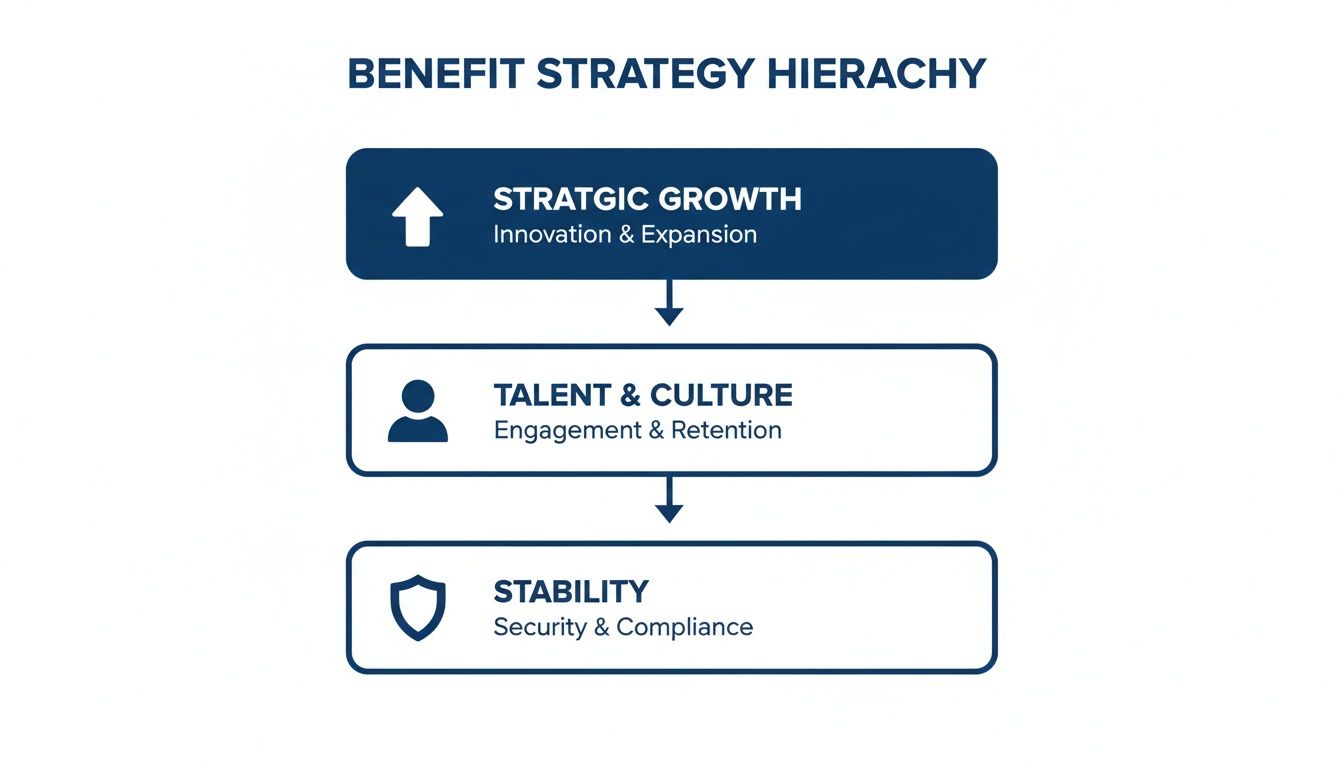
As you can see, stability is not just a concept; it is the platform on which you build your culture and, ultimately, your business's success.
Once you have health and retirement in place, a few other key insurance types have become standard expectations. These are the safety nets that protect your team from life’s unexpected turns. The table below breaks down these foundational benefits and how they contribute to your business strategy.
| Benefit Category | Component Examples | Strategic Purpose for the Business |
|---|---|---|
| Health & Wellness | Medical, Dental, Vision | Meets basic employee expectations, promotes a healthy and productive workforce, and reduces absenteeism. |
| Financial Security | Retirement (401k/IRA), Life Insurance, Disability Insurance | Demonstrates long-term commitment, attracts security-minded talent, and protects employees from financial hardship. |
| Work-Life Balance | Paid Time Off (Vacation, Sick, Holiday) | Prevents employee burnout, improves morale, and signals a healthy company culture. |
| Strategic & Competitive | Flexible Schedules, Professional Development, Student Loan Repayment | Differentiates you from competitors, targets specific talent pools, and drives employee engagement and loyalty. |
Let's look closer at the other key parts of this foundation:
A clear, well-structured policy for paid time off (PTO) is also vital for preventing burnout and fostering a healthy work-life balance. We dive deep into this topic in our guide on designing a paid time off policy. With this strong base in place, you are ready to add strategic benefits that will make your small business truly stand out.
For any small business owner, the conversation about benefits always comes back to one question: "Can I afford this?" It is a legitimate concern, especially with rising costs. However, that question should not be a roadblock. With the right plan, you can offer a competitive benefits package without derailing your budget.

The financial landscape for benefits is shifting. In 2026, healthcare costs are projected to increase significantly, fueled by soaring prices of specialty drugs. As a result, many employers are already looking for smarter ways to manage these expenses. You can find more details about how high costs will drive big shifts in employee benefits in 2026.
One of the most effective strategies for navigating these rising costs is offering a High-Deductible Health Plan (HDHP) paired with a Health Savings Account (HSA). This approach helps control your company's premium expenses while giving employees a tax-advantaged tool to manage their medical costs. An HDHP typically has a lower monthly premium for your business, with a higher deductible for the employee.
This is where the HSA becomes invaluable. An HSA is a personal savings account for healthcare with a triple-tax advantage: contributions are tax-deductible, funds grow tax-free, and withdrawals for qualified medical expenses are also tax-free. For 2026, the contribution limits are set to rise to $4,400 for individuals and $8,750 for families, offering a significant savings opportunity for your team.
By pairing an HDHP with an HSA, you give employees ownership over their healthcare spending and provide a vehicle for long-term savings. This transforms a high deductible from a potential burden into a strategic financial opportunity for both the employee and the business.
Beyond your plan design, there are other practical steps you can take to manage the costs of your small business benefits package. These tactics encourage smarter healthcare use and preventative care, leading to better health outcomes and lower costs for everyone.
Controlling costs also involves seeing the complete financial picture of your entire benefits offering. This includes accurately forecasting expenses for paid time off. It is crucial to understand the details of how to calculate accrued vacation time to prevent financial surprises and ensure your policies are sustainable.
Once you have built a solid foundation, it is time to shift from meeting employee expectations to exceeding them. This is where a small business benefits package becomes a powerful tool for attracting and keeping top talent. By hand-picking perks that speak to the real-life needs of today's workforce, you build a culture where people genuinely want to work.

The goal is to show employees you are invested in their entire lives, not just their work. This means looking at benefits that support their personal growth, mental well-being, and family ambitions.
Some of the most impactful strategic benefits today are those centered on family-building and fertility support. For many in the Millennial and Gen Z talent pools, access to these benefits has become a key factor in their employment decisions. Offering support for services like IVF, adoption, or egg freezing sends a powerful message that you support your people through major life events.
Given that infertility affects 1 in 6 people globally, this is not a niche concern. Forward-thinking employers are taking notice, with a recent report showing that two-thirds of employers plan to invest more in family health benefits over the next three years. You can explore the 2026 employee benefits market outlook for a deeper dive into this trend.
While family-building support is a huge differentiator, a truly strategic package looks at well-being from every angle. Today’s top candidates are actively seeking employers who understand the importance of mental health and work-life harmony.
A strategic benefits package sends a clear message: we see you as a whole person. By supporting your employees' personal and professional lives, you create a foundation of loyalty and engagement that is difficult for competitors to replicate.
These are tangible proof of your company's values. By offering innovative benefits your competitors aren't offering, you create a compelling reason for top talent to join your team and an even better reason for them to stay.
Taking your business across state lines is a major achievement, but it introduces a new layer of HR complexity for your small business benefits packages. A compliant policy in one state can easily become a liability in another, creating a tangled web of rules that is tough to navigate. Getting this wrong can lead to steep fines and legal headaches.
The goal is to build an HR framework that is both consistent for your team and flexible enough to adapt to local laws. It is about creating a defensible system that supports your growth.
One of the biggest hurdles for any multi-state employer is the patchwork of paid leave laws. While the federal Family and Medical Leave Act (FMLA) applies to businesses with 50 or more employees, many states have their own programs with much lower thresholds. This creates a messy compliance picture where rules can change from one state to another.
A common misstep is applying a single, one-size-fits-all leave policy everywhere. A more defensible strategy is to create a "high-water mark" policy that meets the standards of the most generous location you operate in. This ensures you are compliant everywhere.
Other state and local laws can directly influence how you structure and administer benefits. For instance, different minimum wage laws can affect benefits eligibility, especially for hourly workers. Additionally, some states have specific rules about paying out an employee's unused vacation time when they leave.
Following these state-specific rules is non-negotiable to avoid costly wage claims. Sharp record-keeping and a clear grasp of each location's rules are essential.
When your team is spread across different states, it is critical that your benefits administration is both fair and consistent. You can offer different benefit levels in different locations, but you need a legitimate business reason, like responding to local market costs or complying with state law. Any differences must be applied uniformly to established employee classes to avoid discrimination.
A key compliance piece is also handling the continuation of health coverage when an employee leaves. You can learn more about these federal requirements in our detailed guide on COBRA continuation rules.
Navigating these complex employment rules is a high-stakes challenge where expert guidance is invaluable. If you need help creating a defensible HR framework for your multi-state business, we encourage you to contact Paradigm to discuss your needs.
You have designed the perfect small business benefits package. Now, you need to ensure your team understands and uses it. A brilliant benefits program that no one engages with is a wasted investment. A rushed rollout or clumsy communication can sabotage your hard work, leading to confusion and low enrollment.
Successfully launching your new package demands a thoughtful communication strategy that educates, engages, and empowers your team. When you make the information accessible and offer clear support, you help employees make smart choices and ensure your investment pays off.
The first step is to make signing up for benefits as simple as possible. A clunky or confusing enrollment system is a major roadblock to participation. Your goal should be to remove every point of friction and guide employees through their decisions with clarity.
One announcement is never enough. Great benefits communication is an ongoing campaign. Research shows that employees need to hear information multiple times and in different ways before it sinks in.
A well-communicated benefits package does more than drive enrollment—it reinforces your company's culture. It is tangible proof that you value your team's well-being and are invested in their long-term security.
If you are preparing to roll out a new benefits program and want to ensure it is communicated effectively, a strategic partner can provide invaluable support. To build a plan that maximizes employee engagement, contact Paradigm to discuss your launch strategy.
When you're running a small business, designing a benefits package brings up many questions. From budgeting to compliance, every decision feels high-stakes. Below, we've tackled some of the most common questions from business owners and HR leaders.
While a benchmark of 25-40% of payroll is often cited, a more effective approach is to think in terms of return on investment (ROI). A well-designed benefits package is not just an expense; it is an investment in your people. The right offerings directly combat costly employee turnover and can significantly boost productivity.
Yes, but you must do it correctly. The key is to create distinct employee classes based on legitimate, non-discriminatory business reasons. This ensures your approach is both fair and legally defensible. For example, it is common to structure different packages for full-time versus part-time employees or for staff in different geographic locations. The golden rule is consistency.
The most common pitfalls in designing a benefits package include focusing solely on cost, communicating poorly during rollout, and offering a one-size-fits-all plan. By understanding your employees' needs, communicating with clarity, and ensuring compliance, you can build a package that truly delivers.
Crafting a benefits strategy that is compliant, competitive, and affordable is a complex task where expert guidance is crucial. To build a defensible and effective benefits framework for your business, we invite you to learn more about how we can help. Feel free to contact us to start the conversation.