
A Tampa company can have payroll running correctly and still be exposed when a manager terminates an employee after a complaint, mishandles an investigation, or hires someone who works from another state. The question isn't whether you need more HR support. It's whether your primary problem is administrative capacity or the defensibility of high-stakes employment decisions.
That distinction matters for owners, COOs, and HR leaders who don't have a deep internal bench. A PEO can centralize payroll, benefits, workers' compensation, and related administration. HR risk advisory focuses on judgment, documentation, investigations, manager conduct, and decisions that can create legal, financial, or reputational exposure. The right choice depends on what is failing inside the business, not on which provider offers the broadest service list.
A Tampa professional-services company is preparing to terminate a manager. The employee has complained about favoritism, the manager's performance file is incomplete, and a second employee works from another state. Payroll is handled through an established provider, benefits are stable, and the company's leaders assume the administrative infrastructure is sufficient.
It isn't. The immediate risk sits in the decision process. Someone must determine whether the complaint affects the termination, preserve relevant records, interview the right people, assess the manager's prior conduct, and document a legitimate, consistently applied business reason. If the company operates across state lines, someone must also verify that the employment decision aligns with the applicable rules for the employee's work location.
That's where the Tampa HR risk advisory vs PEO decision becomes practical. A PEO may reduce back-office burden, but it generally doesn't take over the client's day-to-day control of hiring, supervision, workplace conduct, or termination decisions. An advisory partner may not process payroll or provide insurance, but it can help leadership make and document decisions that withstand scrutiny.
This guide is for business owners, COOs, multi-state operators, and HR leaders without extensive internal support. It breaks the choice into service scope, control, liability, Florida compliance, cost structure, and real operating scenarios. The recommendation is direct: choose a PEO when administrative infrastructure is the primary gap, choose HR risk advisory when decision quality and defensibility are the problem, and use both when your company needs each capability.
HR risk advisory is an advisory-first relationship. The advisor helps leadership evaluate employment decisions before they become disputes, claims, or inconsistent practices. The work typically centers on:
The client retains employer control. An advisory firm doesn't become the payroll filer, benefits administrator, or workers' compensation carrier just because it provides employment-risk guidance. Its value lies in helping leaders act deliberately and create a defensible record.
For a detailed explanation of this advisory role, see HR risk advisory and decision support.
A professional employer organization, or PEO, bundles payroll, benefits, workers' compensation, and administrative HR functions through a co-employment structure. The model is designed to deliver those services at scale, which can be valuable for a growing SMB that lacks internal payroll or benefits infrastructure.
A client usually continues directing the work. Its managers assign duties, supervise employees, enforce workplace expectations, and make operating decisions. The PEO commonly manages payroll tax withholding and remittance, benefits administration, workers' compensation, and related filings.
The distinction is especially important in Tampa's business environment. Florida employers face Florida-specific obligations involving wages, E-Verify, and workers' compensation at the same time they must comply with federal FLSA and anti-discrimination requirements, as summarized in this Florida small-business employment law guide.
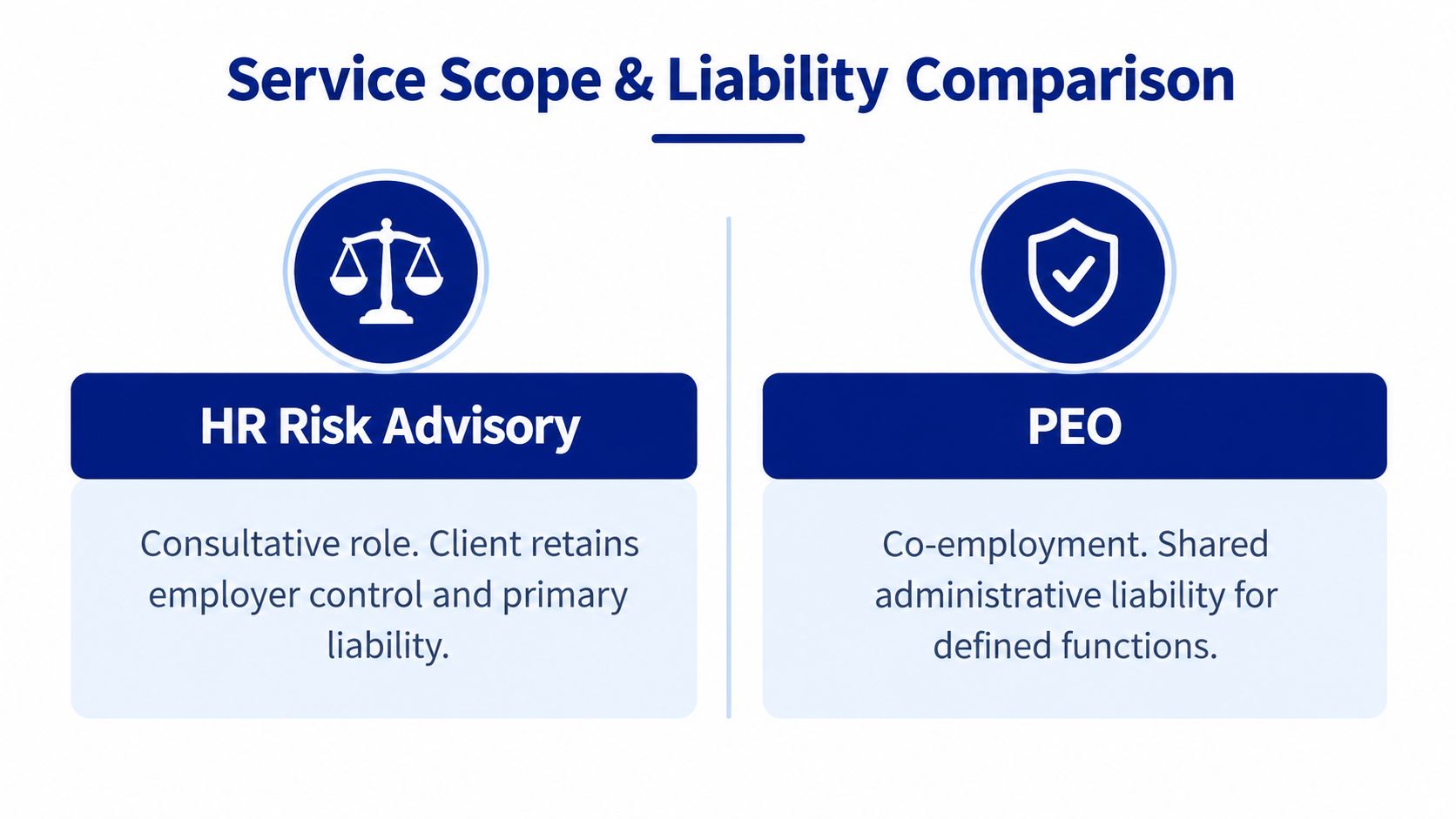
| Decision area | HR risk advisory | PEO |
|---|---|---|
| Primary purpose | Defensible people decisions and risk guidance | Bundled payroll, benefits, workers' compensation, and HR administration |
| Day-to-day supervision | Client retains control | Client generally retains worksite control |
| Termination judgment | Advisor supports analysis and documentation | Client usually owns the operational decision |
| Payroll and benefits | Usually outside the advisory scope | Core service functions |
| Workers' compensation | Doesn't assume coverage administration | May secure coverage for covered employees |
| Best fit | High-stakes decisions and exposure management | Administrative complexity and infrastructure gaps |
The practical dividing line is who makes the employment decision and who administers the surrounding infrastructure. In a PEO model, the client usually keeps operational control over hiring, supervision, terminations, and workplace conduct. The PEO commonly handles payroll tax withholding and remittance, benefits administration, workers' compensation, and related filings under the co-employment arrangement, as described in this explanation of shared PEO compliance obligations.
That arrangement can be effective, but “co-employment” shouldn't be treated as a transfer of every employment risk. The manager who made the decision still matters. So do the complaint history, performance records, witness accounts, investigation process, and consistency with how the company treated comparable employees.
A PEO's involvement in payroll or benefits doesn't automatically give it the facts needed to assess workplace conduct. The client's leaders remain closest to the operational context, including:
An HR risk advisor addresses those questions directly. The advisor can help leadership pause an impulsive decision, identify missing facts, conduct a structured investigation, and create documentation that reflects the actual reasoning. That support is different from processing a payroll change after the decision has already been made.
Core distinction: A PEO can reduce administrative burden. It doesn't replace defensible manager actions, documentation, or multi-state employment decisions.
The IRS says that “co-employer” isn't recognized as a federal tax term, although a PEO may be designated to perform employer tax acts under a service agreement and may file employment tax returns under its own EIN. That distinction matters because the PEO changes payroll-tax administration mechanics, not every underlying employment obligation. The IRS guidance on third-party payer arrangements and PEOs explains the federal tax treatment.
Approved section 3504 agents and certified professional employer organizations must file an aggregate Form 941 using their own EIN and attach Schedule R to allocate wages and taxes to each client. The IRS also states that aggregate Form 940 filing is required for CPEOs, as set out in the IRS instructions for Form 941 Schedule R and Form 940 Schedule R.
Those mechanics still require accurate client-level records. If both the employer and a third-party payer paid wages to the same employee during a quarter, both parties may need to file Form 941 for the wages each paid and issue separate Forms W-2, according to the IRS Form 941 instructions. A PEO can shift administrative work, but leaders must understand exactly what the agreement covers.
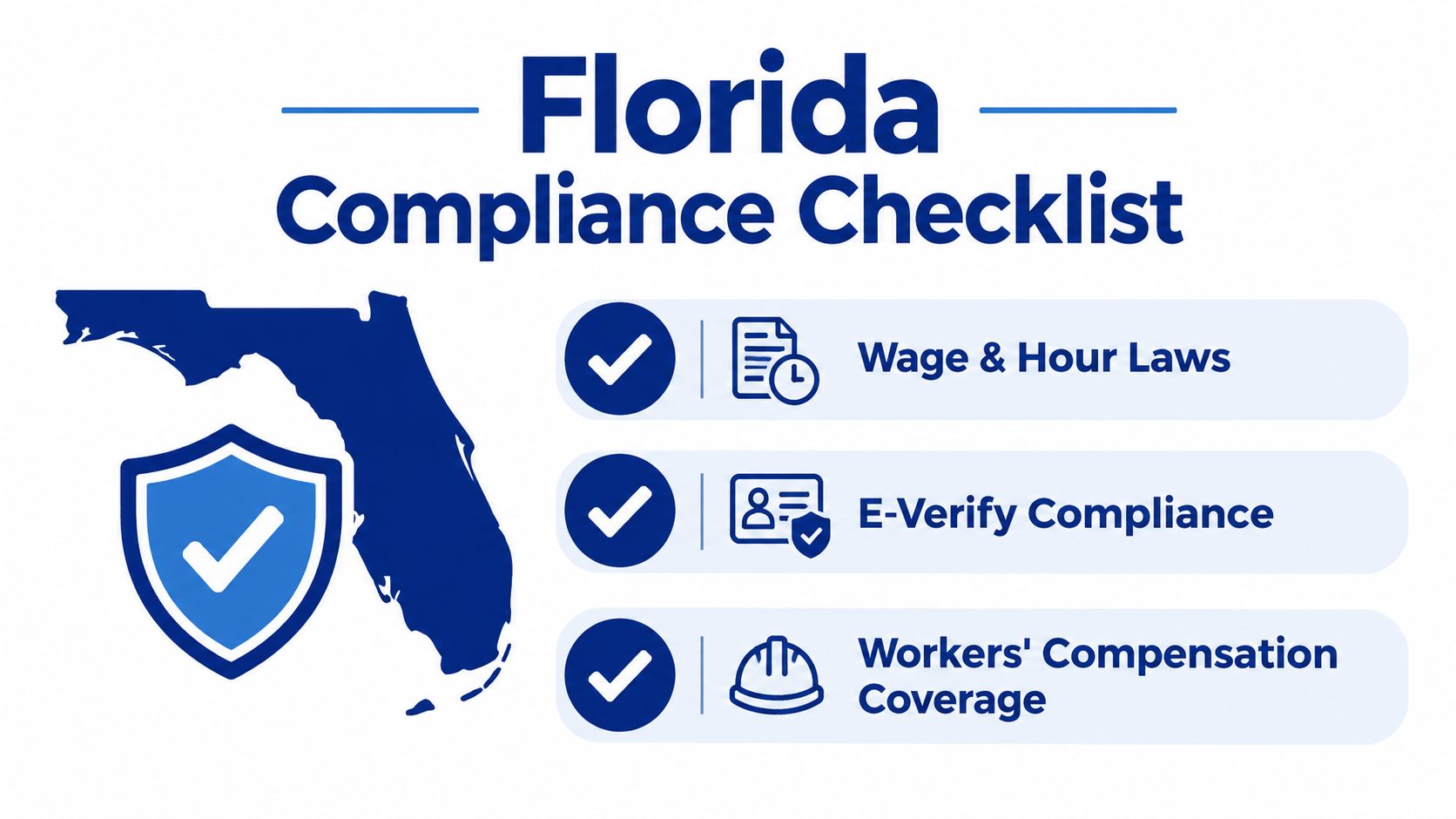
Florida employers manage overlapping state and federal obligations. A Florida small-business compliance guide identifies requirements involving wages, E-Verify, and workers' compensation alongside federal FLSA and anti-discrimination rules. For non-construction employers, E-Verify is required when the employer has 4 or more employees, according to this Florida HR compliance summary.
The exact administrative allocation depends on the PEO agreement and the employer's operating facts. Florida law permits a PEO to secure workers' compensation coverage for covered employees while the client retains day-to-day worksite control. That structure can move coverage administration to the PEO, but it doesn't remove the client's responsibility to manage the worksite, direct employees, and respond appropriately to incidents. The Florida framework is described in this overview of PEO workers' compensation arrangements.
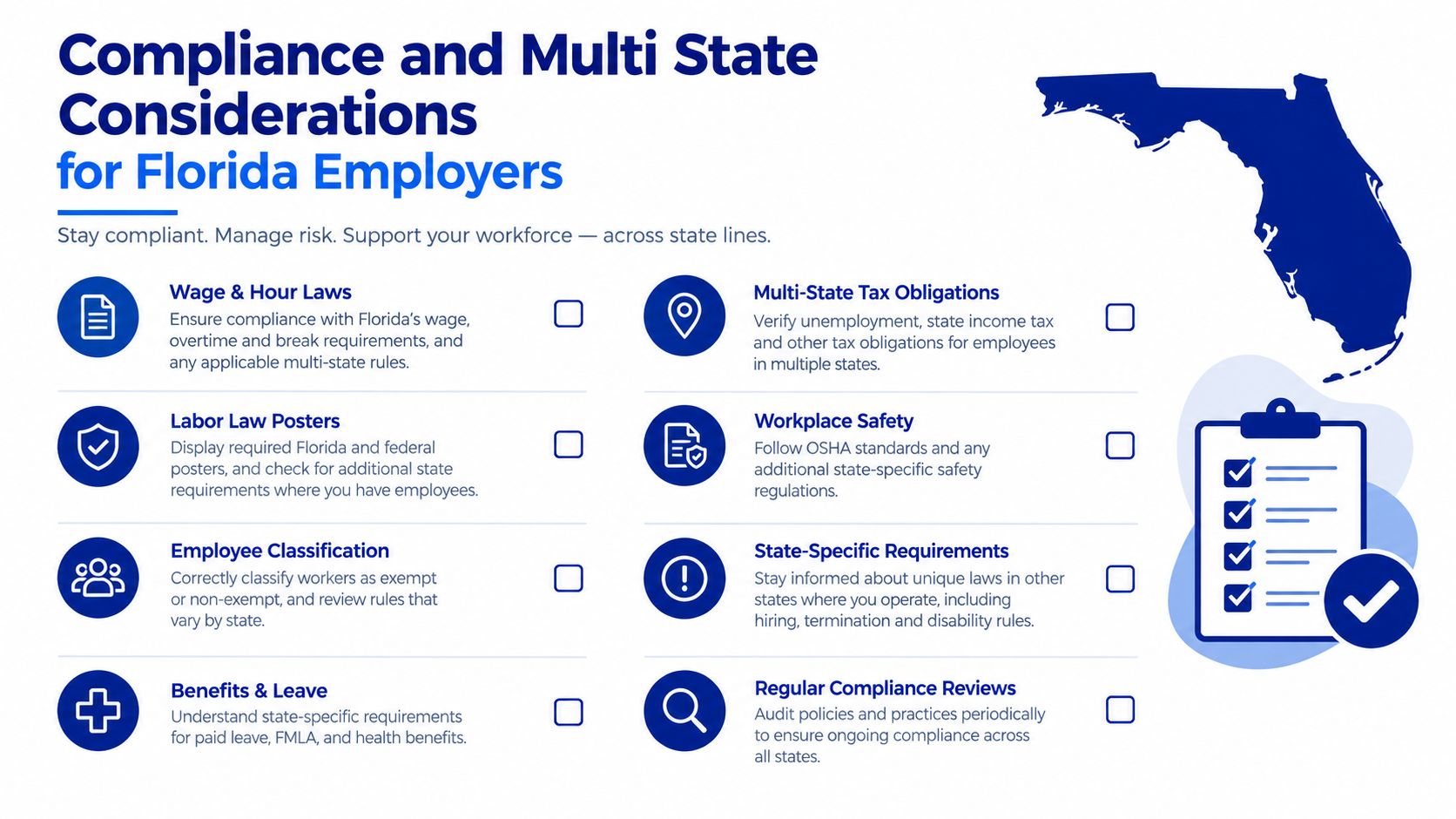
Multi-state employers rarely fail because they lack a broad handbook statement. They fail because someone executes a routine action under the wrong state's rule. Common examples include:
Multi-state workforce compliance guidance recommends a state-by-state compliance matrix, quarterly updates, and a review trigger whenever an employee changes work location. That process gives both an advisory partner and a PEO a reliable operating map.
Ask who owns each step, not merely whether the provider “handles compliance.” A PEO may manage tax filings, benefits, workers' compensation, and related administration. The client may still own manager training, complaint escalation, factual investigation, termination judgment, and workplace conduct.
A useful operating rule is to create a written responsibility matrix covering onboarding, location changes, payroll registration, leave requests, disciplinary action, investigations, terminations, and record retention. If the matrix doesn't identify the owner, the issue will likely fall between the client and provider when timing matters most.
A PEO generally sells a bundled operating platform. The price reflects a combination of payroll administration, benefits access, workers' compensation administration, technology, service teams, and compliance-related processing. Because PEOs operate as capital-intensive, high-volume businesses, scale is central to the model. One industry estimate places the U.S. PEO market at $270.9 billion in 2026, while another projects the global market at $81.75 billion in 2026 and $189.75 billion by 2034, a rise of more than 131% over eight years. Those estimates are reported by IBISWorld's professional employer organizations industry page.
Those figures establish the model's scale, not a guaranteed return for your company. A PEO can make financial sense when internal payroll, benefits, insurance coordination, and administrative compliance consume leadership time or require infrastructure the company doesn't want to build.
HR risk advisory is narrower and more precise. You're paying for judgment and execution support around exposure, not for a bundled payroll and benefits platform. The value appears in stronger records, more consistent decisions, better investigation handling, and earlier identification of preventable risk.
Use these questions before reviewing proposals:
For context on how advisory engagements may be structured, review HR consultant fees and cost considerations. The comparison should focus on the risk you're buying down and the work you're removing, not on a superficial price comparison.
A Tampa company has no dependable payroll process, struggles to administer benefits, and wants a coordinated workers' compensation arrangement. Leaders spend too much time resolving administrative questions, and employees receive inconsistent answers about enrollment and payroll.
A PEO fits this problem. Its bundled structure can centralize administrative functions and give the company a defined service model. Leadership should still confirm who handles employee questions, payroll corrections, work-location changes, incident reporting, and decisions involving discipline or termination.
The key advantages of professional employer organizations are most relevant when the company needs a functioning administrative platform rather than case-specific decision counsel.
An employee alleges harassment or retaliation, then receives a proposed termination for performance. The manager wants the decision completed quickly, but the company's documentation is uneven and no one has tested whether the stated reason is consistent with prior treatment of similar employees.
HR risk advisory is the right first response. The advisor should help preserve records, define the investigation scope, interview relevant witnesses, assess timing, and determine whether the termination can proceed on a defensible basis. The PEO may process the final payroll and benefits changes, but administrative processing doesn't answer whether the decision is well supported.
When the risk comes from the reasoning behind a decision, adding administrative capacity won't solve the underlying problem.
A Tampa employer hires a remote employee who will work from another state. The leadership team assumes its existing Florida process will apply, but payroll registration, leave, wage notices, and final-pay timing may follow the employee's work location.
This situation needs an execution framework. The company should update its state-by-state compliance matrix, identify payroll and tax registration responsibilities, confirm required notices, and establish a trigger for future location changes. A PEO may handle defined payroll and filing functions, while an advisory partner can help leadership align policy, manager practice, documentation, and decision workflows.
This is the execution gap many comparisons miss. The company has payroll, benefits, workers' compensation administration, and a service portal, yet managers still mishandle complaints, fail to document performance, and escalate terminations only after the decision has effectively been made.
The company doesn't necessarily need to replace its PEO. It needs decision support around the work the client still controls. An advisory partner can supplement the PEO by reviewing sensitive actions, improving investigation protocols, setting documentation standards, and helping executives establish a consistent approval process.
A PEO and an HR risk advisor can serve the same company because they solve different operational problems.
Start with the risk profile, not the vendor category. If your main concern is payroll, benefits, workers' compensation administration, or fragmented HR infrastructure, a PEO deserves serious consideration. If your concern is a pattern of difficult terminations, employee complaints, inconsistent manager conduct, weak documentation, or multi-state decision execution, prioritize HR risk advisory.
Use this decision checklist:
Ask any PEO:
Ask any HR risk advisory firm:
Paradigm International Inc. supports SMB leadership teams with advisory guidance for terminations, investigations, manager conduct, documentation standards, and multi-state HR risk decisions. To determine whether an advisory-first model fits your current exposure, contact the team.
Paradigm International Inc. helps owners, COOs, and executive teams make defensible people decisions when payroll systems or a PEO don't address the underlying risk. Visit Paradigm International Inc. to discuss termination reviews, workplace investigations, manager conduct, and multi-state employment decisions with an advisory partner.