
Terminating an executive rarely fails because the owner lacked a business reason. It fails because the announcement says the leader stepped down, the file says performance, and the agreement implies something else. For an owner or COO with no senior HR leader to check that alignment, the exit label, the decision file and the retaliation timeline are one linked decision. Treat them as separate tasks and the record will contradict itself.
An executive exit is four decisions at once: classification, approval, payment and communication. The governing documents decide who can act, so start with the bylaws, board charter, employment agreement and equity plan before anyone discusses dates. For cause usually means whatever the employment agreement defines it to mean, and that definition may require notice or a chance to cure. Read those documents first. They tell you whether you even have the label you want.
| Exit label | What it means | What it changes | Who signs off |
|---|---|---|---|
| Termination for cause | Employer treats documented misconduct as the reason | Often tied to the contract definition and any notice or cure steps | CEO or board, with counsel review |
| Termination without cause | Employer ends employment without alleging misconduct | Severance is usually governed by the agreement | Board or CEO, with counsel review |
| Performance-based removal | Documented performance gaps and prior written feedback | The file must show the same standard applied to peers | CEO or board, with HR review of the file |
| Suspension pending investigation | Paid leave or restricted access while facts are gathered | Keeps the decision open; pay and access rules still apply | Counsel and the investigator |
| Negotiated transition | Executive agrees to leave on agreed terms | The agreement sets release, timing and announcement wording | Board, with counsel review |
| Resignation or retirement | Executive chooses to leave | Verify the choice was voluntary; pressure can change the label | Executive, with counsel review of any agreement |
The hard cases sit in the middle. Credible allegations exist, the investigation isn't finished, and results are falling at the same time. In that setting, paid leave, a negotiated exit or termination can each be defensible, but they carry different consequences for severance, references, incentive pay and disclosure. Scale doesn't remove the ambiguity. Reuters reporting on S&P 500 CEO exits counted at least 41 CEOs had exited S&P 500 companies by July 2025, versus 49 during all of 2024. In practice, dismissal outcomes differ by the type of misconduct alleged and by how the company was performing, so the label has to match what the file can prove. A neutral-sounding announcement that conflicts with the label in the file is the kind of contradiction that turns a clean exit into a dispute.
That's why containment and the final decision should stay separate. Restrict access or use paid leave to control immediate risk, complete independent fact-finding, then choose the exit label on finished evidence. Don't let a temporary step become the explanation by default. If the suspension drifts into being treated as the reason, the executive gains an argument that the actual decision was made before the facts were in.
Practical rule: Write the chosen label and a one-sentence reason before anyone speaks to the executive, and use that same label in every document that follows.
Owners who want the underlying distinction clear before they classify the exit can start with HR guidance on employee separations.
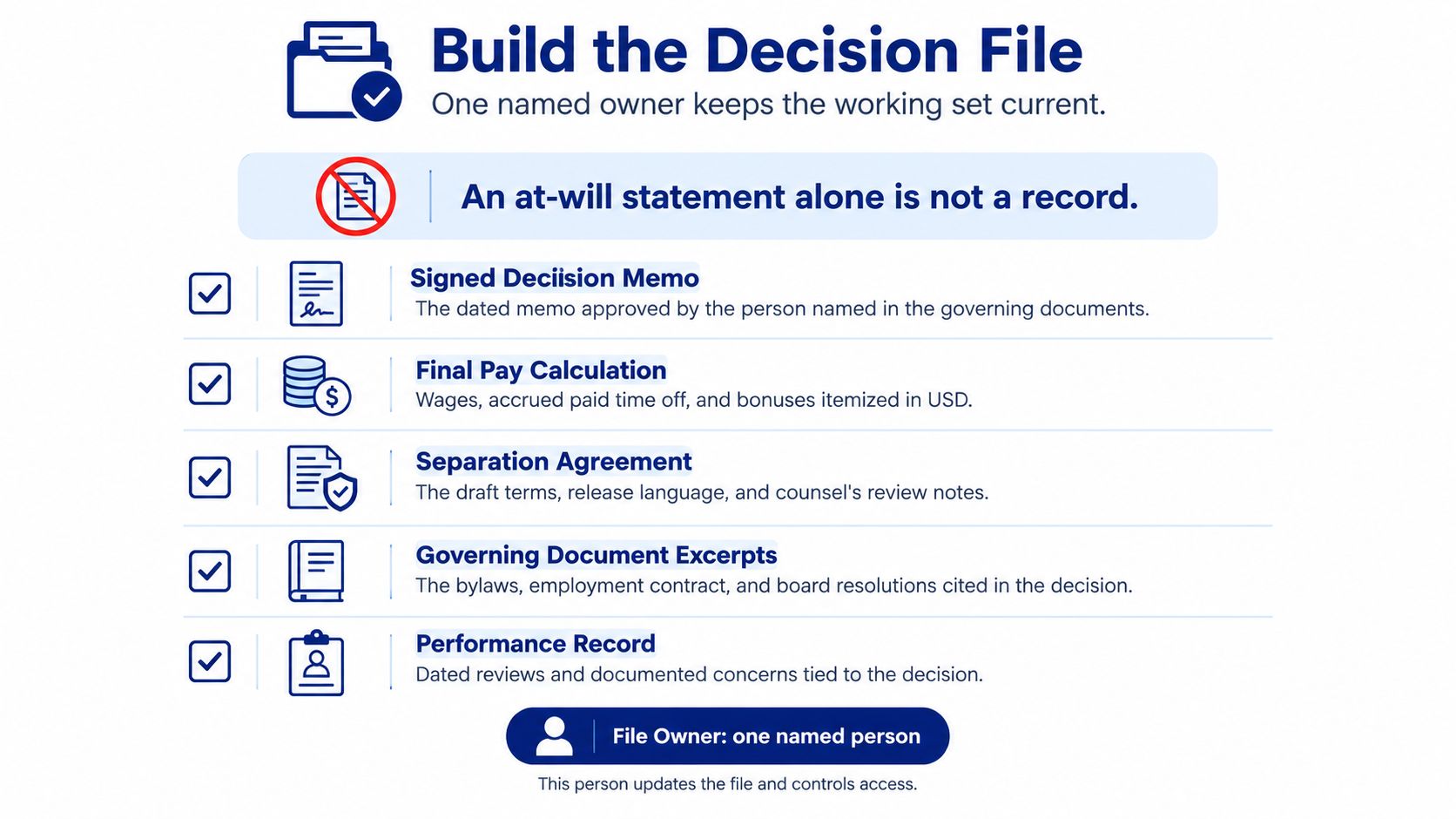
A one-line statement that the executive is at-will does no work in a dispute. It shows neither who decided, nor when the issue arose, nor whether peers were treated the same way. The decision file should be a working set kept current by one named person, assembled as the decision develops rather than rebuilt afterward from inboxes and memory.
The label, the file and the timeline move together. The exit label chosen in the previous step, the chronology that supports it, and any protected activity on the record are one linked decision. If a neutral-sounding announcement later describes the departure differently than the memo does, the file contradicts the story and the story loses.
Build it in that order for a reason. Identify protected activity first, then build the chronology, compare the proposed reason against contemporaneous records and peers, separate facts from allegations, and have counsel review privilege, release, wage-payment, restrictive-covenant and state-law issues. Only then lock the explanation.
The enforcement context justifies the discipline. The EEOC Agency Performance Report for FY 2025 reported 88,201 new discrimination charges in FY 2025 and more than $528 million in pre-litigation monetary relief, with retaliation representing 33% of the EEOC Office of General Counsel's FY 2025 lawsuits. The EEOC figures set a benchmark for why chronology and comparator analysis come before scheduling.
Don't rewrite the reason after the termination to fit new information. If the facts change, add a dated supplement and keep the original. A file that improves without notice over time creates more risk than a thinner file that stays consistent. Owners building the working set from scratch can browse templates for documenting HR decisions to structure the memo and chronology.
The chronology should be finished before the meeting is scheduled. If it can't be finished, the meeting date is premature.
A documented business reason doesn't settle the question when the timeline points the other way. Under federal EEO laws enforced by the U.S. Equal Employment Opportunity Commission, retaliation can include a materially adverse action taken because an employee asserted protected rights, and discharge is a listed example. The EEOC retaliation guidance questions and answers also state that the Americans with Disabilities Act prohibits both retaliation and interference with ADA rights.
The exit label, the file and the timeline have to tell one story. Check three things: whether the reason predates the protected activity, whether the decision-maker knew about that activity, and whether the timing can be explained without rewriting history. Timing alone draws scrutiny, and a process that suddenly accelerates after a complaint can undercut an otherwise sound reason.
| Trigger | Why it matters | What to do first |
|---|---|---|
| Recent complaint about discrimination, harassment, pay or safety | Retaliation can be a materially adverse action under federal EEO law | Pause; get an impartial review and expert help before acting |
| Witness or participant in another investigation | Participation in an investigation can be protected activity | Confirm the decision-maker is not a subject or witness |
| FMLA leave requested or taken, or a leave record near the decision | Leave use is protected and cannot be counted against the employee | Verify eligibility and leave accounting; get expert help |
| Open disability accommodation request | The ADA prohibits retaliation and interference with rights | Route the decision through counsel before any notice |
| Concerns about securities or accounting issues at a public company | Sarbanes-Oxley whistleblower protection can apply | Counsel reviews before any action |
| No protected activity found | A business reason still needs a dated record | Document the reason and comparators, then proceed |
Answer five questions in writing before any date is set. Who is the decision-maker? When did the performance or conduct issue arise? Does prior discipline exist? Which comparators were treated the same way? Why is the company acting now? A manager's unsupported conclusions answer none of them.
Leave overlap needs its own check. Under the Family and Medical Leave Act, the DOL FMLA fact sheet states that the law generally covers private employers with 50 employees within 75 miles, and an eligible employee generally needs 12 months of service and 1,250 hours in the preceding 12 months. Verify headcount, worksite distance, notices, certification and leave accounting before relying on attendance records. The ADA and Sarbanes-Oxley whistleblower protection, 18 U.S.C. § 1514A, can apply on separate tracks, along with state law where the executive works.
If the executive complained shortly before the decision, or the complaint involved the decision-maker, pause for an impartial review and get expert help before acting. That includes the complaint that lands on the eve of a planned termination, and the executive who is both subject and witness in an open investigation. Separate the investigator from the decision-maker in those situations. Owners facing that sequence should review post-complaint termination risk before setting a date.
The decision belongs to whoever the governing documents name, usually the CEO or the board. Everything after that decision still needs an owner. When terminating an executive, unclear roles produce the classic failures: payroll uses one date, IT uses another, and the announcement goes out before access is controlled.

The date in the board minutes is the date payroll, IT and the announcement must use. When those versions differ, the file reads as after-the-fact justification. Communications owns the announcement, but the announcement is also evidence: a neutral note that calls the exit a resignation will be set against minutes that record a termination for cause. One misaligned line can undercut an otherwise clean record, so the label in the memo, the minutes and the message should say the same thing.
Succession can't be improvised in the same week. Leadership teams that plan coverage early benefit from mapping critical roles for succession so interim authority is settled before notice, not negotiated in a hallway afterward. The interim assignment should name spending authority and external contacts, not just a person.
Public companies add a disclosure clock. Under SEC Form 8-K Item 5.02, disclosure is generally required within four business days when a named executive officer, principal financial officer or principal operating officer is terminated from the disclosed position. A separate analysis applies if the separation changes or materially modifies an executive compensation plan. Private multi-state companies don't have that filing, but they have the same date discipline problem.
We work with companies led by an operator, a COO, president or CFO, that don't have a senior HR leader. In that structure, the checklist often needs an outside owner because the decision-maker shouldn't also be the record keeper. State payroll rules sit with payroll, and owners with Texas staff can check the Texas final pay rules for that state's approach.
Before notice, confirm who must be told in advance, usually counsel, payroll, IT and the interim leader. Confirm who must not be in the room, including anyone who is a subject of the executive's complaint or a witness in a related investigation. Extra attendees add commentary, not control.
Severance terms and final pay belong in the same decision file, but they follow different rules. The agreement sets out what the company offers in exchange for a release. Final pay covers compensation already earned. Treating wages as bargaining chips can create a separate wage dispute.
For an executive aged 40 or older, a release of age-discrimination claims must meet the requirements of the Older Workers Benefit Protection Act, 29 U.S.C. § 626(f). The EEOC explains that the consideration period is generally 21 days for an individual separation and 45 days for a group program, followed by a seven-day revocation period after signing. Have counsel confirm which period applies before presenting the agreement. Payroll should not promise a payment date that conflicts with the revocation period.
The agreement should preserve the executive's right to file a charge or participate in an agency investigation. A release may resolve private claims within legal limits, but it cannot prevent contact with regulators. For a plain-language overview, read severance agreement basics, then have counsel review the proposed terms.
Check restrictive covenants against the law in each relevant state. A noncompete, nonsolicit or confidentiality clause may be treated differently where the executive worked than where the company is headquartered. Counsel should assess the applicable rules before relying on those terms.
Federal law does not require an immediate final paycheck, according to the U.S. Department of Labor's last paycheck guidance. State law may set a faster deadline. The Fair Labor Standards Act, 29 U.S.C. §§ 201–219, governs minimum wage and overtime; state rules may control when final wages are due.
Calculate wages through the termination date, commissions and bonuses that are earned and payable, reimbursable expenses, lawful deductions, equity-related items, and accrued vacation or paid time off when policy or state law requires payout. The executive's home address, payroll location and company headquarters do not necessarily determine which state's rules apply.
| Location | Typical final pay timing | Confirm with |
|---|---|---|
| Federal baseline | No federal deadline for a final paycheck; FLSA sets wage rules | U.S. Department of Labor |
| California | Generally due at discharge, with narrow exceptions | California Labor Commissioner |
| Texas | Generally due within six calendar days after discharge | Texas Workforce Commission |
| New York | Generally due by the next regular payday | New York State Department of Labor |
| Florida | Check the applicable pay date rule for the work performed before processing payroll | Florida statutes and employment counsel |
| Other states where the executive worked | Check the state's discharge deadline and paid time off payout rule before the termination date | That state's labor department and counsel |
Verify the applicable state rule before payroll processes payment. A payroll provider can issue wages, but leadership must resolve questions about classification, bonus eligibility and equity treatment. Our firm handles ongoing HR and compliance work and judgment calls, while the client's PEO, payroll provider or HR app handles payroll and administrative tasks.
Close the offboarding list with named owners and dates. Include benefit notices such as COBRA where applicable, access removal, company property, confidentiality obligations and records retention.
Use a go or stop check, not a sense of momentum. Terminating an executive on a date chosen weeks earlier, after new facts have arrived, is how defensible decisions become hard to explain.
Stop if any item is open. Stop if the decision-maker is part of the complaint, or if the overlap review produced a flag that no one impartial has signed off on. A stop pauses the business decision so the record can be fixed while that is still possible.
A short delay to close the file costs less than explaining an inconsistent record later.
Closing the last open item is usually cheap: one more document version, one more signature, one more day on the calendar. The Terminations and Separations service gives a plain recommendation before the client acts and documentation that holds up after. For a company run by an operator, such as a COO, president or CFO, with no senior HR leader in place, that outside review carries the weight an internal HR director would normally carry. Schedule the decision review with counsel and an HR risk advisor before the meeting is booked, and hold the room reservation until the review closes.
The meeting should be short because the work happened earlier. Its job is to communicate a decided outcome clearly and humanely. The merits are settled, the wording is agreed, and every person in the room knows both before the executive arrives.
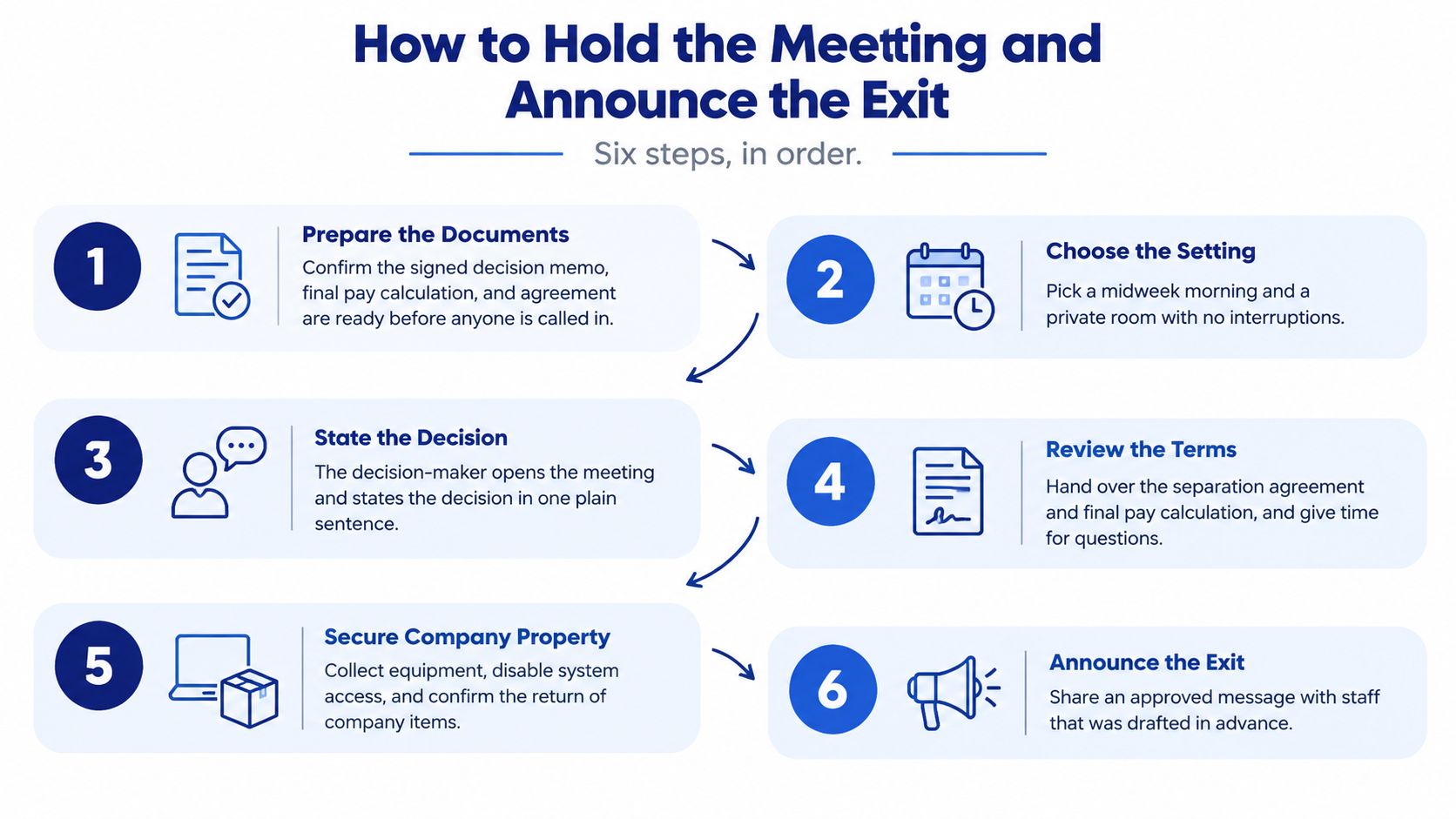
Two slips cause most of the damage. The first is announcing the exit to staff before the executive hears it directly, which guarantees distrust and leaks. The second is adding new reasons in the room under pressure, which creates a second explanation that doesn't match the memo, the agreement or the announcement. If a question can't be answered from the file, the honest answer is that the named contact will confirm it in writing.
Scenario planning helps. Say the executive disputes the performance record and asks for examples. The decision-maker shouldn't build a fresh case from memory at the table. The agreed reason gets restated, the written terms get handed over, and factual questions go to the named contact for a written response.
If the executive raises a complaint, discrimination concern, leave request or accommodation request during the meeting, stop the discussion. Write down the exact words, don't argue about them, and send the matter to counsel before any further step. Continuing as planned, without pausing to assess that new information, turns a controlled process into a retaliation timeline. Get expert help at that point, before anything else is said or signed.
Read the announcement against the file one more time before it goes out. Wording that sounds neutral can still contradict the record. "Retiring to pursue other opportunities" implies a voluntary departure, and if the file documents an involuntary exit, that single phrase hands the executive an inconsistency to use later. The label, the file and the announcement are one decision, and they have to tell the same story.
External communication deserves the same restraint. Customers, lenders and key partners who need to know should hear the interim contact and the transition date, nothing about reasons. References should follow whatever the agreement says, and anyone likely to receive a reference call should know the approved wording in advance.
The room should hear only what the file already says.
Owners, presidents and COOs who want a second set of eyes on the exit label, decision file and retaliation timeline before acting can learn more from Paradigm International Inc., an HR consulting firm that supports high-stakes people decisions with structured, defensible guidance. This article is general information, not legal advice. Employment laws change and vary by state; consult qualified employment counsel about your situation. To discuss a specific executive separation before notice is given, Book a Free HR Risk Review.