The notice usually lands at the worst time. Payroll is due, a manager is asking about coverage, and then an unemployment claim arrives for someone you thought had a straightforward exit. For many business owners, the first reaction is frustration or concern about cost.
That reaction is normal. The better response is disciplined. Unemployment insurance claims are manageable when you treat them as a documentation and timing issue, especially if you operate in more than one state or you have employees working reduced schedules, variable hours, or partial weeks.
A claim notice doesn't automatically mean something went wrong. It means a former worker has asked the state to review whether they qualify for benefits, and your business now has a limited window to provide facts. The risk usually comes from the employer's response, not from the notice itself.
For a small or mid-sized employer, the process can feel more serious than it first appears. A claim can affect tax costs, absorb management time, and expose weak records around attendance, coaching, or termination decisions. Multi-state employers face an extra layer of complexity because each state applies its own rules, forms, and deadlines.
The broader system has shown how quickly pressure can build. In April 2020, unemployment claims surged to an unprecedented 40 million during the initial COVID-19 lockdowns, a sharp example of how fast workforce changes can strain employers and state systems alike, as reflected in the U.S. unemployment insurance overview.
The state requires a simple answer. Was this separation a layoff, a resignation, or a discharge, and what records support that answer?
That sounds basic, but many employers answer too loosely. They write “not a good fit,” “attendance issues,” or “employee quit without notice” without attaching the records that make those statements credible. States don't decide claims based on frustration. They decide based on facts that can be verified.
Practical rule: If your response wouldn't make sense to a neutral reviewer who has never met the employee, it isn't specific enough.
The documentation gap gets worse when employees file while still earning some income. A worker may be on reduced hours, picking up occasional shifts, or doing part-time work after a schedule cut. That's where many generic guides stop being useful.
The primary issue is whether the employee remains eligible under state rules while reporting partial earnings and remaining available for work. According to the BLS FAQ on UI applicants and benefit recipients, unemployment insurance often involves people who worked in the prior year but aren't fully employed, which is why partial-work scenarios create such a persistent compliance blind spot for employers.
Most employers understand that unemployment insurance exists. Fewer understand how claims can turn into a recurring cost issue. If you don't know how your account is charged, you can't make good decisions about when to respond, when to contest, and when a sloppy separation is going to keep costing you later.
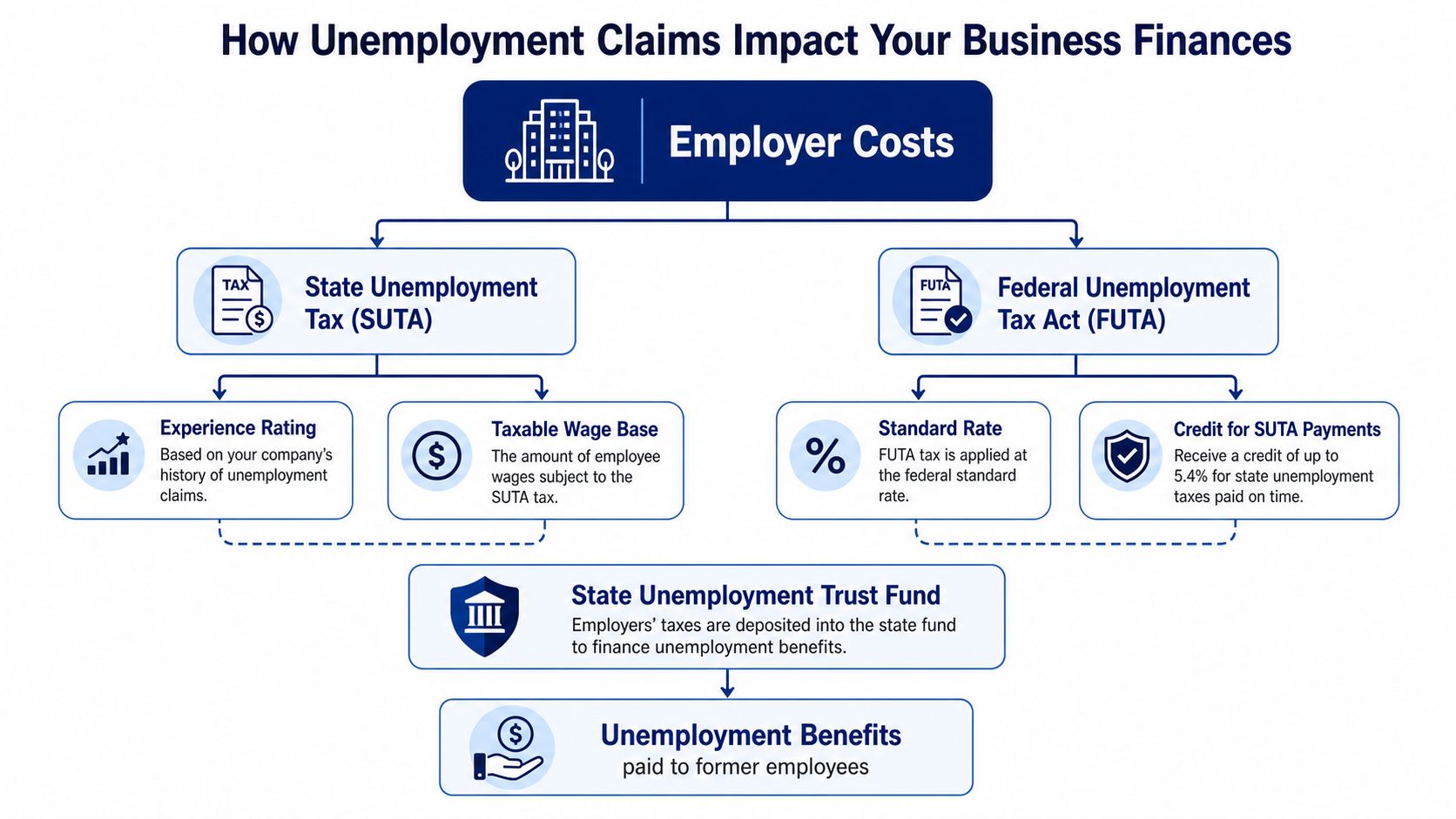
State unemployment systems are funded through employer taxes. In practical terms, many employers experience this like auto insurance. More chargeable claims can lead to a less favorable rate history, which can raise future state unemployment costs.
That doesn't mean every claim should be fought. It means every claim should be evaluated with financial discipline. A clean layoff with proper records may be chargeable and still not worth disputing. A voluntary quit, a refusal of suitable work, or a misconduct separation with strong documentation may justify a challenge because the downstream cost can outlast the employee's departure.
If you want a plain-language overview of how employer funding works, this breakdown of whether companies pay for unemployment is a useful companion on the tax side.
Claims data also helps employers read labor conditions, especially across multiple locations. As of the week ending July 4, 2026, the U.S. recorded 215,000 initial claims and 1.81 million continued claims, with initial claims down from 217,000 the prior week and below the expected 218,000. Continued claims rose 1.34% from 1.786 million the week before but were down 7.04% from 1.947 million a year earlier, according to Trading Economics tracking of U.S. jobless claims.
That distinction matters. Initial claims often signal immediate layoffs, reduced staffing, or hiring freezes. Continued claims reflect how long people stay on benefits and can point to labor market tightness or re-entry into work.
For employers, the takeaway is practical:
Employers often treat unemployment as a payroll afterthought. Finance teams do better when they treat it as a trend line tied to separation quality.
The hardest financial cases are rarely clean terminations. They're reduced-hour situations where the employee reports some earnings and seeks benefits for the gap. If your records don't show actual hours offered, hours worked, and whether full-time work was available, you lose the ability to explain the situation clearly.
That creates two problems at once. First, the business may absorb avoidable charges. Second, inconsistent reporting can create friction with the state if your payroll records and the employee's weekly certifications don't line up.
The biggest mistake multi-state employers make is assuming unemployment insurance works the same way everywhere. It doesn't. Eligibility, benefit formulas, filing expectations, and appeal deadlines all vary by state, so a separation process that seems orderly in one location can create avoidable exposure in another.
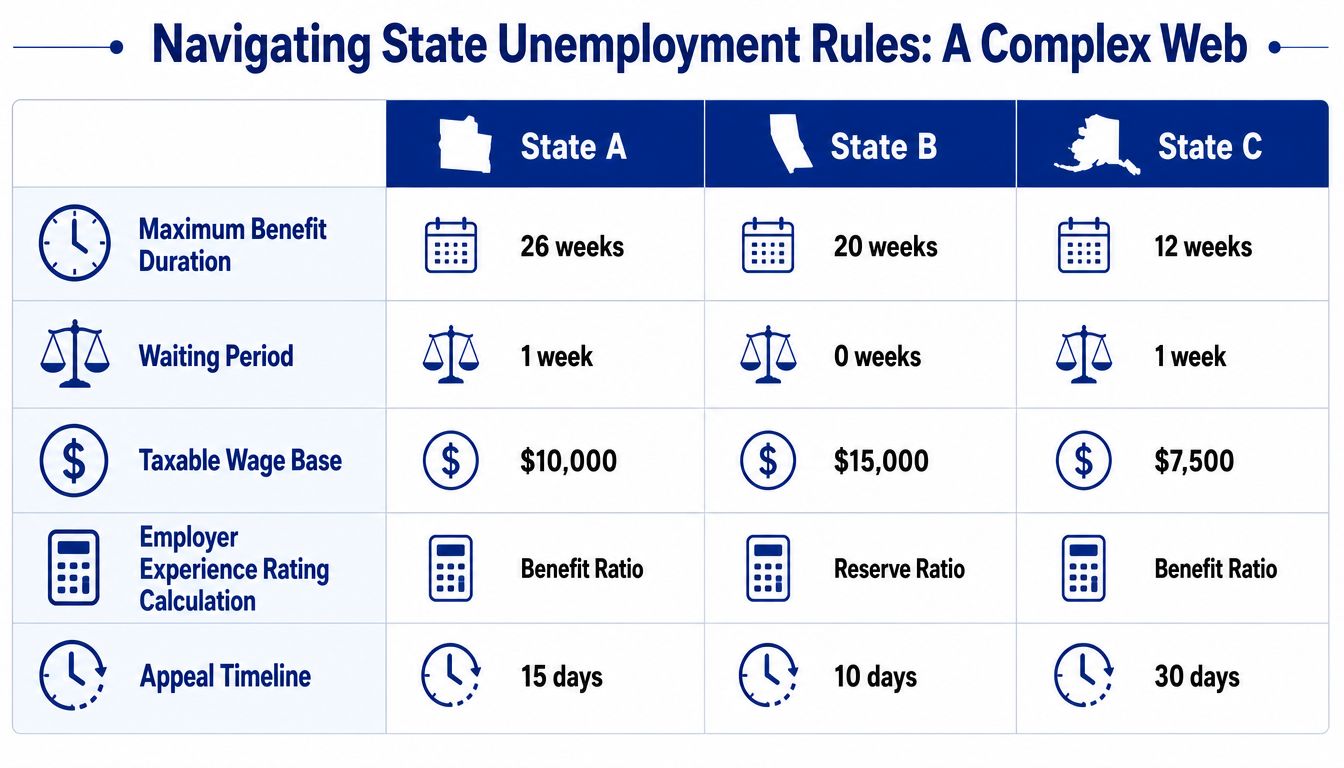
A worker may qualify in one state and fail in another based on wage history alone. For example, in New York, a claimant filing in 2026 must have earned at least $3,500 in one calendar quarter, must have wages in at least two calendar quarters, and total wages of at least 1.5 times the high quarter amount under the New York claimant handbook.
That kind of threshold matters operationally. If your payroll team can't quickly verify quarter-by-quarter wage history, your response may be incomplete or inaccurate. In New York, insufficient base period earnings also played a significant role in denials, which is why employers need wage records that are easy to retrieve and explain.
Nevada illustrates the other side of the issue. Weekly benefits are generally calculated as 1/25 of the highest quarter's earnings, and claims begin on the Sunday of the filing week, with benefits generally not payable for prior weeks under the Nevada claimant handbook.
A simple comparison shows why one policy won't fit every state:
| State example | Key rule | Employer implication |
|---|---|---|
| New York | $3,500 in one quarter, plus multi-quarter wage requirements | Wage verification can directly affect eligibility analysis |
| Nevada | Weekly benefit based on 1/25 of high-quarter earnings | Earnings volatility can affect likely payout value |
If you need a broader primer on how state unemployment tax systems vary, this explanation of the SUI tax definition helps frame why payroll, tax, and claims administration need to stay aligned.
State-level variation is why generic templates fail. A response that is technically accurate but framed for the wrong state can still hurt your position.
Another state-administered concept employers often miss is the benefit year. Once a claim is filed, eligibility generally extends through a fixed 52-week period beginning on the day or week the worker first filed for benefits, and no state allows a claimant who already received benefits in one benefit year to qualify again in a second benefit year without intervening employment, as outlined in the Social Security Administration program description.
This matters when you rehire, reduce hours, or separate someone again. If the employee has an existing benefit year, your later staffing decisions can interact with that prior claim in ways managers often don't anticipate.
The same multi-state problem shows up with notices and responses. One location may route mail through accounting. Another may rely on a local manager. Another may receive electronic notices no one monitors closely.
That's how valid defenses are lost. Not because the facts were weak, but because no one owned the state-specific process from notice through submission.
The first response usually decides whether the rest of the process will be orderly or expensive. Employers get into trouble when they answer too fast with incomplete facts or too slowly after a notice sits in the wrong inbox.

Before you explain the separation, confirm the basics:
This step sounds administrative, but it prevents a common failure. Employers often contest a claim emotionally before confirming that their own records are consistent.
The strongest response package is chronological. It tells the story in records, not adjectives.
For a misconduct case, employers need a paper trail. To effectively contest a claim, employers should have signed policy acknowledgements, disciplinary records, and performance counseling notes, and many states require evidence 24 to 48 hours before a scheduled hearing, according to guidance on managing unemployment claims.
Useful records often include:
If the file only proves that a manager was frustrated, it won't carry much weight. The file needs to prove what happened, when it happened, and what the employee knew.
Many employers lose control of the narrative at this stage. If the worker had reduced hours, intermittent assignments, or a return-to-work offer, your response should identify:
These cases are rarely about one dramatic event. They're about precision. A vague statement such as “employee was still working some hours” doesn't answer the state's real question.
Avoid legal conclusions unless the state form requires them. Stick to what you can document. Short, direct statements tend to work better than long narratives filled with opinion.
A clean response usually includes the separation date, reason, prior warnings if relevant, and attached records in the order they occurred. If a hearing follows, that early discipline will make preparation easier.
Not every claim should be contested. Some should be accepted and processed efficiently because the separation was a layoff or the facts are clear. Contesting every claim makes employers look reactive, and it wastes time that should be spent on the cases where the evidence supports a challenge.
The stronger reasons to contest are usually straightforward. The employee resigned without a work-related reason recognized by the state. The employee was discharged for documented misconduct. The employee refused suitable work or created a disconnect between reported availability and actual work offered.
Before appealing, ask three practical questions:
If the answer to any of those is no, the appeal may not be the best use of time. A weak appeal can expose poor management habits more clearly than the original claim notice did.
For employers tightening their internal fact-finding process before a hearing, the framework in Logical Commander on workplace integrity is a useful reference because unemployment disputes often reveal the same problem found in investigations: people acted, but no one documented the sequence well enough.
If an employer disagrees with the state's initial determination, the employer typically must request a hearing within a strict deadline, often 30 days from the date on the determination notice, according to materials cited by the Supreme Court source collection on unemployment appeal timing. Miss that window and the right to appeal is usually gone.
That timing changes how you should organize your files. Don't wait for a denial to start preparing. Keep a hearing-ready folder from the moment the first notice arrives.
Hearings usually reward clarity over volume. The goal isn't to overwhelm the reviewer. It's to present a credible sequence:
Witnesses should stick to firsthand knowledge. Managers often hurt a case by speculating about motive when they should be describing conduct, attendance, communication, or refusal of work.
The cheapest unemployment claim is the one your business never mishandles. Employers often focus on defense after a notice arrives, but the better strategy starts much earlier with manager habits, payroll discipline, and separation consistency.

A defensible unemployment file is rarely created at termination. It is built over time through ordinary management actions that are recorded consistently.
The employers that manage claim exposure well tend to do a few things reliably:
That last point matters more than most leaders realize. If payroll codes a separation as lack of work, but HR later argues misconduct, the inconsistency weakens the whole file.
The most overlooked unemployment risk for multi-state SMBs involves employees who keep working some hours while filing for benefits. These situations are common during census fluctuations, healthcare scheduling changes, weather disruptions, practice slowdowns, or seasonal shifts.
A stronger process includes:
Reduced-hours claims are where sloppy scheduling becomes a compliance problem.
Most weak unemployment defenses start with a supervisor who didn't understand the importance of documentation. They delayed coaching, skipped written follow-up, or used vague language at termination. That isn't just an HR training issue. It is an operational risk issue.
A simple internal checklist can reduce that risk:
| Before separation | What good looks like |
|---|---|
| Performance issue | Prior coaching and written expectations exist |
| Attendance problem | Dates, policy reference, and prior warnings are in file |
| Resignation | Employee statement or confirming email is retained |
| Reduced hours | Offered work and accepted work are documented separately |
Another overlooked exposure point is claim communication after separation. A standard exit packet may be readable to HR and legal, but still be hard for employees with limited English proficiency, limited computer access, or low familiarity with state systems.
Washington State highlighted this gap in a program focused on helping underserved communities access unemployment benefits through community organizations, as described in the Washington State Employment Security Department announcement. For employers, the lesson is practical. Clear, plain-language separation materials help reduce confusion, disputes, and reputational friction.
Unemployment insurance claims are not just an administrative chore. They test whether your business can explain its people decisions with consistency, timing, and records that hold up under review.
The strongest employers treat claims management as part of a broader risk framework. Payroll, operations, HR, and front-line managers all affect the result. If one part of that chain is loose, the business ends up reacting to preventable exposure instead of controlling it.
That broader discipline also applies to systems. If your team is reviewing policies, workflows, and record ownership across platforms, guidance on managing HR software governance is worth a look because claims discipline depends on where records live, who can retrieve them, and whether key actions are consistently logged.
For businesses facing recurring separation issues, reduced-hour complexity, or multi-state growth, termination practices deserve the same level of scrutiny. This practical overview of termination rules for employers is a good next step if you want to tighten the decisions that often trigger unemployment disputes in the first place.
A steady process works better than a forceful one. Clear records, prompt responses, state-aware workflows, and disciplined manager habits usually do more to protect the business than aggressive arguments after the fact.
If your leadership team wants a more defensible approach to unemployment insurance claims, terminations, and multi-state HR risk, Paradigm International Inc. can help you build the structure behind better decisions.