

A manager brings you a familiar problem: an employee starts FMLA leave, and leadership wants to complete a termination that was already under discussion. The business may be dealing with missed deadlines, restructuring, misconduct, or a position that no longer fits. The pressure to act quickly is real, but the timing creates a second question that can matter more than the first: can the company prove the employee would have been terminated even if the leave had never occurred?
FMLA leave doesn't make an employee untouchable. It does make a termination during or near the leave period harder to defend. A decision that might look routine in another context can appear retaliatory when the employer's records are incomplete, the explanation changed, or managers made comments connecting the employee's absence to the termination.
The financial exposure can also extend beyond an internal HR issue. Since the Family and Medical Leave Act took effect, the U.S. Department of Labor's Wage and Hour Division has helped thousands of workers who were denied leave, unjustly terminated, or lost health coverage, recovering more than $63 million in back wages for affected workers. In fiscal year 2022, the agency investigated 780 FMLA complaints and recovered more than $870,000 in back wages for violations ranked most significant. These figures appear in the U.S. Department of Labor's enforcement release.
The right executive response isn't panic or automatic delay. It's disciplined proof. You need to establish the business reason, confirm that the reason predates or stands independently from the leave, apply the same standards used for comparable employees, and complete any ADA or state-law review before acting.
The safest starting point is to stop asking only, “Can I terminate someone on FMLA leave?” Ask instead, “What evidence shows this decision would have happened anyway?”
That distinction changes the entire review. Suppose a supervisor began documenting serious performance failures before the employee requested leave. The supervisor issued written feedback, gave the employee a reasonable opportunity to improve, and discussed a possible termination with HR. If the employee then begins FMLA leave, the company may still have a defensible path. But the company must prove that the decision was already moving toward completion and wasn't accelerated because the employee exercised protected rights.
Now change the facts. The manager says performance has “always been a problem,” but there are no written warnings. The termination occurs shortly after the leave request, and the company uses attendance as part of its explanation. That record creates a very different risk profile. The employer may have a legitimate concern, but a legitimate concern isn't the same as a defensible termination.
Practical rule: Timing doesn't automatically make a termination unlawful. It does make your documentation and decision process more important.
FMLA protects eligible employees who take qualifying leave, but it doesn't grant permanent job security. Employers can still make legitimate employment decisions that are unrelated to the leave. The problem begins when leave becomes a negative factor, when managers treat protected absences as attendance failures, or when the company creates a post hoc explanation after the decision has already been challenged.
Leaders should also recognize that reinstatement, retaliation, interference, disability accommodation, and state leave requirements can overlap. A company that reviews only the FMLA calendar may miss a separate obligation that remains active after FMLA leave ends.
This guide focuses on the decision standard that matters most: would the same action have occurred without the leave? The answer should come from contemporaneous records, consistent treatment, and a clear process, not from a polished explanation created after termination.
The FMLA became law on February 5, 1993, and its protections took effect on August 5, 1993. The statute guarantees eligible workers up to 12 weeks of unpaid, job-protected leave in a 12-month period, along with continuation of group health coverage during leave. The Department of Labor's FMLA materials describe the core obligations employers must manage when leave is requested and administered.
Think of FMLA as a pause button, not an absolute shield. The employee's protected leave pauses ordinary work expectations, but it doesn't erase a legitimate reduction in force, a documented misconduct decision, or a business decision that would have affected the employee regardless of leave. The employer must still separate the protected absence from the reason for the employment action.
Key concept: FMLA protects the employee's exercise of leave rights. It doesn't require an employer to keep someone employed who would have lost the job for an independent, documented reason.
During qualifying leave, the employer must manage several connected obligations:
The restoration right remains important even if the position was covered by another employee or restructured during the absence. The Department of Labor explains that an employee returning from FMLA leave is entitled to the same or an equivalent job with equivalent pay, benefits, and other terms and conditions. The DOL restoration guidance is useful when HR is evaluating whether a proposed return position is equivalent.
An employer can deny restoration if it can show the employee wouldn't otherwise have been employed when reinstatement was requested. That exception doesn't permit a company to disguise leave-related retaliation as a business decision. It requires credible evidence that the employment relationship would have ended independently.
Employers that want a practical overview of the risk allocation can review PEO Metrics on FMLA risk. For eligibility and process controls, HR teams can also navigate FMLA rules with Paradigm International before a manager moves from concern to termination.
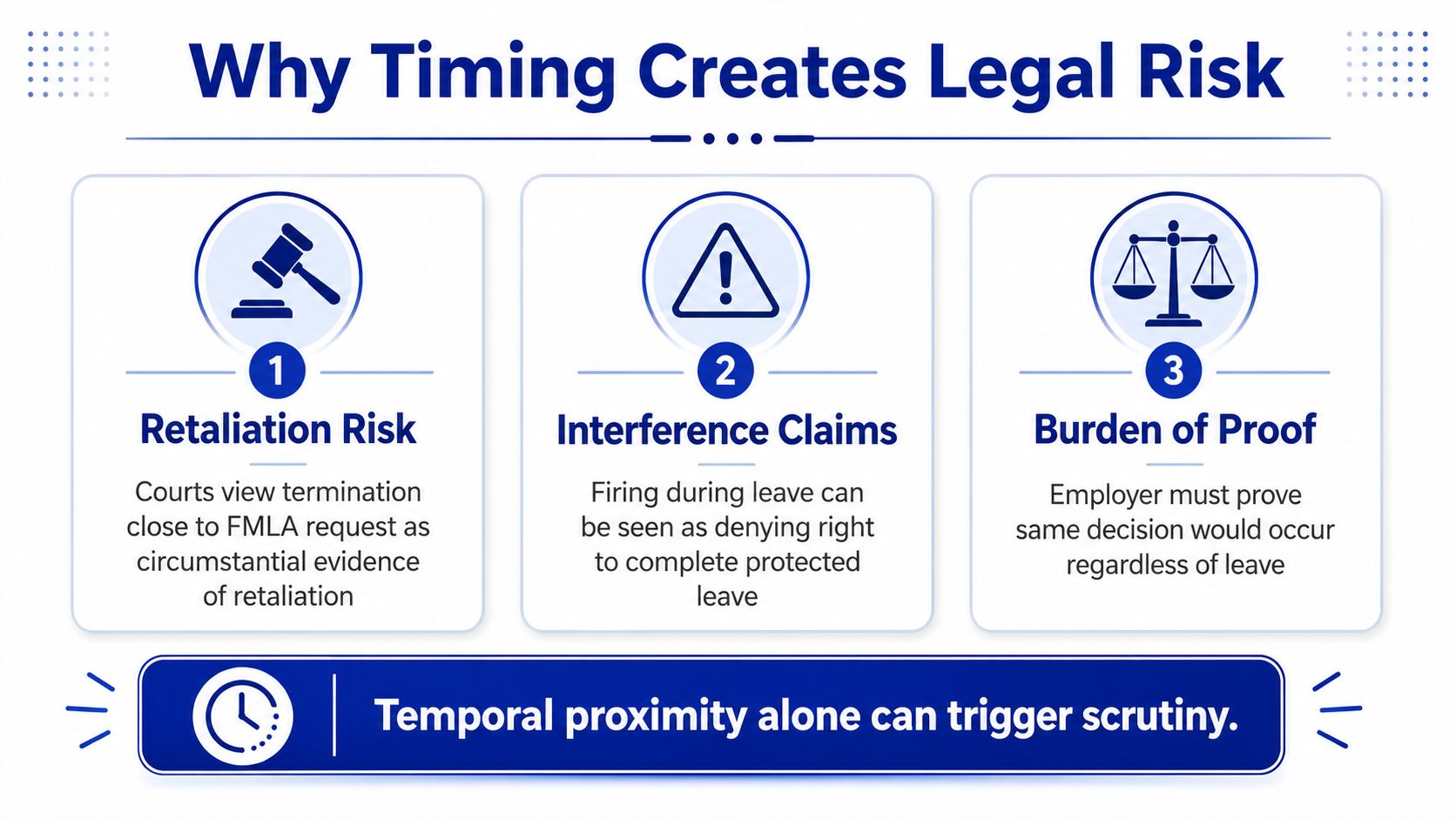
Termination during FMLA leave creates immediate suspicion because the employment action and the protected activity are close together. Courts can treat temporal proximity as circumstantial evidence of retaliatory intent. In one Fifth Circuit case, a termination occurring about one month after FMLA leave expired was considered close enough in time to support causation. The Fifth Circuit decision illustrates why employers shouldn't assume that waiting until leave ends eliminates the problem.
The central issue isn't whether the employer can identify any legitimate reason. The issue is whether the leave influenced the decision. FMLA leave can't be used as a negative factor even when the employer also cites attendance, performance, or policy violations. If the company can't show that the decision was fully independent of the leave, a claimant may argue that the stated reason was only part of the story.
A challenged termination often brings attention to the entire timeline, not just the termination letter. Reviewers may examine:
A termination during leave can also create interference concerns if the action effectively denies the employee protected leave or prevents restoration. The company may face claims involving job restoration, benefits restoration, and wage recovery, not merely a dispute over internal HR procedure.
The damages can become substantial when records and timing are weak. In a Massachusetts FMLA retaliation case, the state's highest court upheld a total damages award of $1,332,271, including back pay, front pay, and related damages. The Massachusetts decision is a direct reminder that a questionable termination can become a material financial event.
The enforcement environment also warrants attention. Reported FMLA filings rose from 3,593 in 2024 to 4,707 in 2025, the highest level reported since at least 2016, as described in the Department of Labor's FMLA resources. Higher filing activity doesn't decide an individual case, but it reinforces the need for a repeatable internal process.
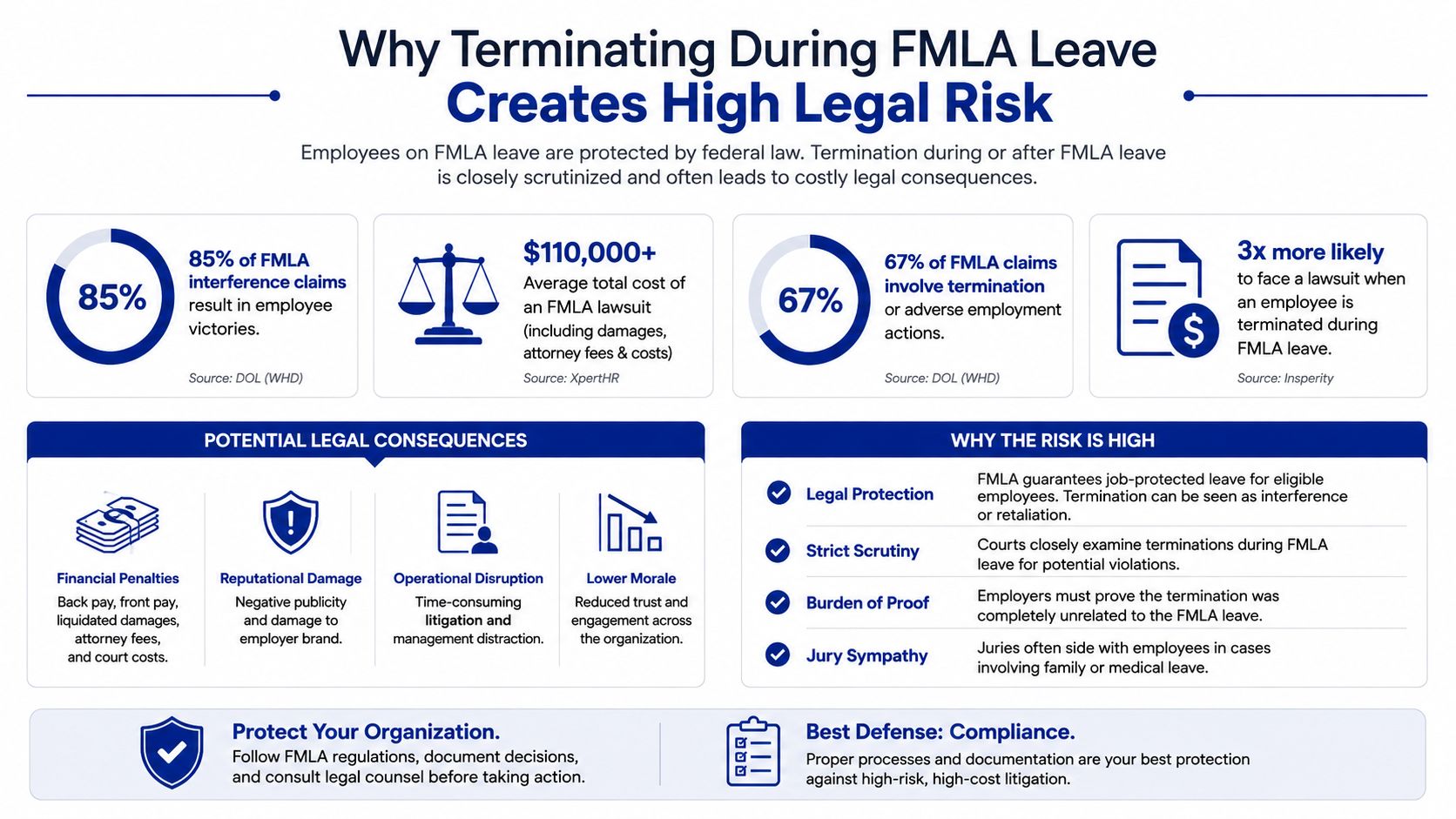
A termination may be permissible when the employer can show that the same decision would have been made without the employee's leave. That usually requires more than a general statement that the employee wasn't meeting expectations. The record should show what happened, when it happened, who made the decision, and how the company treated similar situations.
A pre-documented performance termination is stronger than a new performance explanation created after leave begins. A genuine reduction in force is stronger when it follows a consistent selection process and affects employees based on documented business criteria. A serious policy violation can support termination when the employer investigates it consistently and doesn't use the leave as an additional reason.
| Scenario | Permissible or Risky | What Makes It Defensible |
|---|---|---|
| Documented performance termination discussed before leave | Potentially permissible | Records show the concerns, decision path, and expected outcome existed before the leave |
| Company-wide reduction in force | Potentially permissible | The selection criteria are business-based, consistently applied, and independent of leave |
| Serious policy violation | Potentially permissible | The investigation and discipline follow normal procedures used for comparable employees |
| Counting FMLA absences against attendance | Risky | Protected leave is being used as a negative factor |
| Terminating because coverage is difficult during leave | Risky | Operational inconvenience is connected directly to the employee's protected absence |
| Vague claim that performance was “ongoing” | Risky | The employer lacks dated records and may appear to be reconstructing its rationale |
| Automatic termination when FMLA leave ends | Risky | The company may ignore reinstatement, ADA, or state-law obligations |
Executives should ask whether the company could hand the file to a neutral reviewer and explain the decision without relying on anyone's memory. A defensible file might include dated coaching records, prior warnings, a written restructuring plan, comparable employee records, and an approval trail that doesn't change after leave begins.
Managers should never add FMLA absences to an attendance tally or describe protected leave as evidence that the employee is unreliable. Those statements can undermine an otherwise legitimate business rationale. For guidance on creating legally sound employee documentation, HR leaders can use a structured approach that records observable conduct, expectations, dates, and consequences without personal judgments.
The decisive question remains simple: would the termination have occurred on the same basis, at the same stage of the process, if the employee had never requested FMLA leave? If the answer depends on facts that appeared only after the leave began, pause the decision and investigate further.
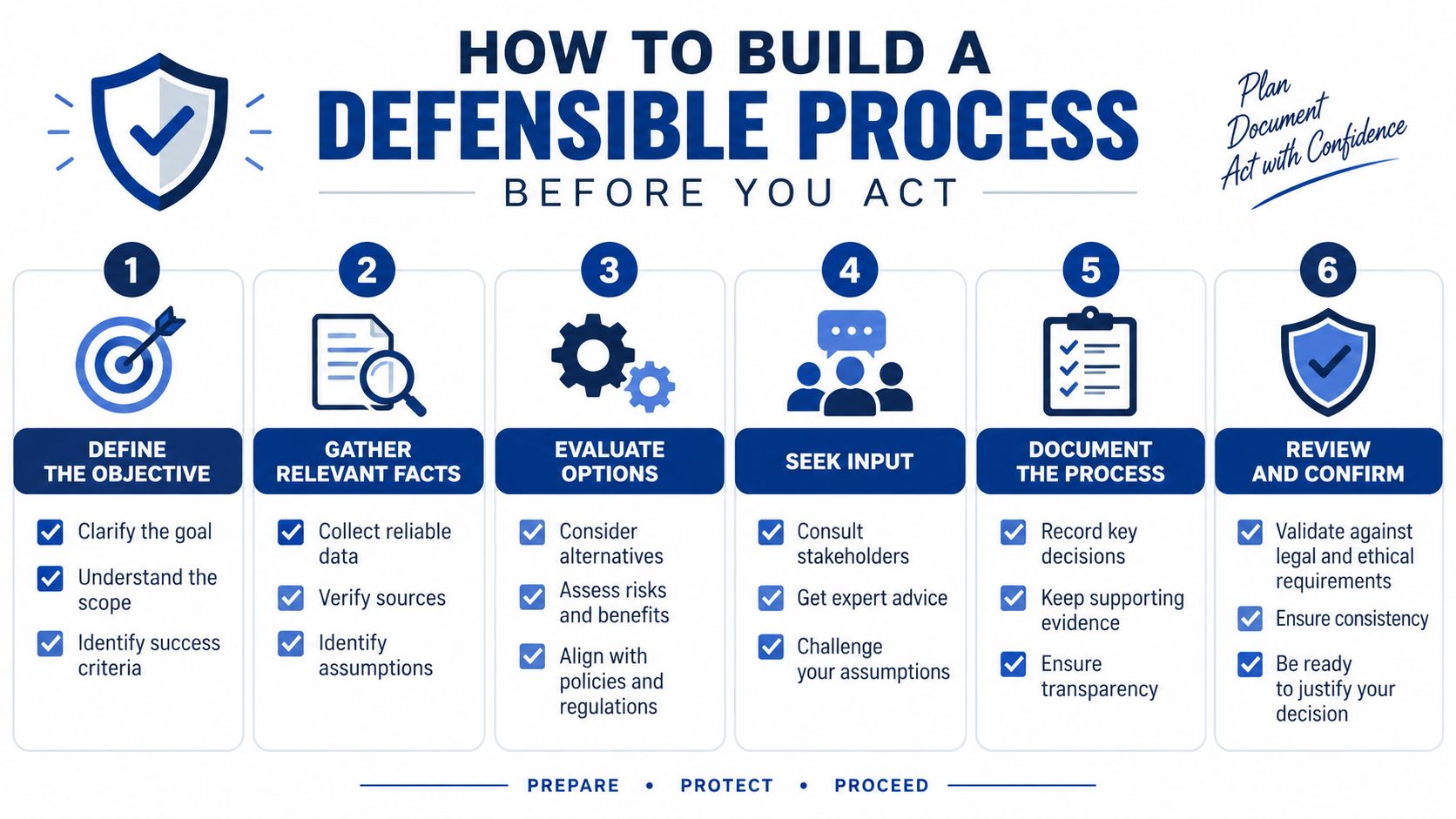
Speed is rarely the best risk-control strategy when a termination overlaps with protected leave. Use a documented review that separates the business reason from the leave and tests whether the reason existed independently.
Confirm the employee's eligibility, approved leave status, expected schedule, certifications, and applicable notices. Identify whether the leave is continuous or intermittent, and make sure managers aren't treating approved absences as ordinary attendance events.
Then isolate the proposed reason for termination. Write it in one neutral sentence without mentioning FMLA. “The position is being eliminated as part of the approved restructuring plan” is materially different from “We can't keep the position open while the employee is gone.”
Ask what would have happened if the employee had remained at work. The answer should identify the same decision-maker, the same policy or business criterion, and substantially the same timing. If the manager says the decision would have occurred anyway, ask for the records that prove it.
Use this review:
A useful file should make clear which facts existed before leave, which facts emerged later, and which facts played no role in the decision. Don't backdate documents, rewrite old notes, or ask managers to recreate conversations as if they had been documented earlier.
The termination notice should state the legitimate business reason accurately and consistently. It shouldn't imply that the employee is being punished for taking leave, and it shouldn't contain unnecessary medical information.
Coordinate the message among the manager, HR, payroll, benefits, and any leave administrator. The employee should receive clear information about final pay, benefits, property return, and any applicable continuation or restoration issues. Keep the communication narrow. A termination meeting is not the place to debate the entire leave history.
A certification or fitness-for-duty issue is a separate question from retaliation. The FMLA regulations permit restoration to be denied when an employee fails to provide a required fitness-for-duty certificate, and the Department of Labor states that reinstatement may be denied when the employee never provides required medical certification. Those rules still require the employer to have properly communicated the requirement and applied it consistently. They shouldn't be used as a convenient substitute for a weak business rationale.
For policy controls that support consistent administration across jurisdictions, review employee handbook requirements by state before finalizing the process.
FMLA is only one part of the analysis. A company can reach the end of an employee's FMLA entitlement and still have obligations under the Americans with Disabilities Act or a state disability accommodation law. Automatic termination after a set leave period is especially dangerous because the employer may need to evaluate whether additional leave or another reasonable accommodation is possible.
The better question isn't whether FMLA has ended. Ask whether the company has a separately documented business reason and whether the employee's medical condition triggers an accommodation review. EEOC-focused guidance warns that automatic termination following a set leave period can create ADA problems, and a recent employment-law reminder on ADA and automatic termination addresses that overlap directly.
An employee returning from FMLA leave generally must be restored to the same job or an equivalent position. The right can apply even when the employer replaced the employee temporarily or changed the role during the absence. The position should be evaluated for equivalent pay, benefits, responsibilities, and employment conditions rather than judged by title alone.
The FMLA doesn't give the employee greater reinstatement rights than continuous employment would have provided. Under the applicable regulation, restoration may be denied if the employer can show that the employee wouldn't otherwise have been employed when reinstatement was requested. That proof must stand on its own and can't point to the employee's leave.
A narrow exception applies to certain salaried key employees. The employer may deny restoration only when the employee is among the highest-paid 10 percent of employees within 75 miles of the worksite and reinstatement would cause substantial and grievous economic injury. The employer must provide written notice of key-employee status when leave is requested or when leave begins, whichever is earlier. The key-employee regulation should be reviewed before relying on this exception.
State family leave, paid leave, wage payment, disability, and anti-retaliation requirements may add another layer. Multi-state operators should review multi-state employee termination requirements before treating a federal FMLA analysis as complete.
Before terminating someone on FMLA leave, require a written decision review. Confirm the leave status, identify the independent business reason, gather records that predate the leave, compare treatment of similar employees, and complete the ADA and state-law analysis.
Don't let a manager's urgency replace a defensible process. If the reason is sound but the records are thin, improve the record through legitimate contemporaneous review rather than inventing history. If the reason depends on the employee's absence, stop and reassess because that is precisely where retaliation and interference concerns begin.
Leadership teams should also align HR, payroll, benefits, leave administration, and the decision-maker before delivering notice. Consistent language and coordinated records reduce preventable contradictions.
Paradigm International Inc. helps owners, COOs, and HR leaders evaluate high-stakes terminations, FMLA administration, documentation, manager conduct, and multi-state employment requirements. Visit Paradigm International Inc. to discuss a structured review before acting on a termination that overlaps with protected leave.
![Can I Fire an Employee for [Performance / Attendance / Attitude] - What Holds Up](https://cdn.prod.website-files.com/651ae2364fc149ea83aae3ef/6ad0a3068d443a5a6cbd81f3_can-i-fire-an-employee-for-performance-attendance-attitude-what-holds-up-hr-assessment.jpeg)

