
A harassment or misconduct complaint lands on the desk of an owner or COO who is already managing payroll, sales, and multi-state operations. Statements are gathered, emails reviewed, interviews completed. Then the harder question arrives: what does the evidence prove, what corrective step fits the facts, and what belongs in the company's files? The fact-finding feels like the difficult part. In practice, the main business risk starts when the fact-finding stops.
A workplace investigation is a structured review of an employee concern to determine whether company policy or law was violated. The finding is the starting point for discipline, remediation, communication, and follow-up, not the end of the matter. In my judgment, closure is where most small and mid-size employers lose ground. The investigation itself may be sound, but if the file lacks a written conclusion, a documented rationale for the corrective action, and a record of follow-up, leadership has little to stand on when an employee later files an administrative charge or legal claim.
The stakes are visible in federal enforcement numbers. The U.S. Equal Employment Opportunity Commission recorded 88,531 new discrimination charges in fiscal year 2024, an increase of more than 9% from FY 2023. According to the EEOC's 2024 Annual Performance Report, the agency resolved 87,219 charges that year, with 18% ending in a merit factor resolution, and secured more than $469.6 million in monetary relief through its administrative process. Each of those resolved charges began as a workplace concern that someone inside the company had to evaluate, document, and act on.
The seven standard workplace investigation outcomes below cover the full range of what an investigation can conclude. Each one carries its own record-keeping requirements and its own risk profile. Operators who match every finding to the right documentation and the right response reduce exposure that a defensible investigation should have eliminated.
The owner's first decision after a harassment complaint is whether the record supports a policy violation. A substantiated finding means the investigator concluded, more likely than not, that the reported conduct occurred and violated a written company policy or applicable law. Private employers generally use the preponderance of the evidence standard. That asks whether theevidence makes the allegation more probable than not, not whether it proves the case beyond a reasonable doubt.
Under Title VII of the Civil Rights Act of 1964, EEOC guidance for small employers on supervisor harassment sets out two duties when a complaint comes in: investigate the allegations and take appropriate corrective action when the facts support them. The same guidance warns that corrective steps must stop the conduct without penalizing the person who reported it. An involuntary transfer of the complainant can become unlawful retaliation, even when the employer believed it was solving the problem.
That is the practical trade-off. The company has to stop proven misconduct, preserve the reporting employee's position, and leave a file that explains why the chosen response fit the facts. Careful documentation turns a substantiated conclusion into a defensible employment decision.

Repeated sexual comments by a supervisor to a direct report after being asked to stop can support a substantiated finding. The record matters as much as the conclusion. The company documents the finding, issues a final written warning, removes the supervisor's authority over the complainant's pay and scheduling, and sets a 30-day check-in with the complainant. Each step ties to proven conduct without moving or disadvantaging the reporting employee.
A clear decision file protects leadership from claims of arbitrary discipline. Separating the fact-finder from the final decision-maker also helps show impartiality when an owner or executive reviews the report.
A complaint with several allegations can produce different answers for each one. An employee reports verbal abuse, a retaliatory demotion, and a physical threat. Witness interviews confirm the verbal abuse. Payroll and review records support a performance-based reason for the demotion, while the available evidence does not establish the threat. Together, these findings produce a partially substantiated outcome.
Each allegation still needs its own conclusion.
The EEOC harassment charge resolution data for FY 2010 through FY 2024_FY_2010_-_FY_2024.xlsx) records 33,891 harassment charge resolutions in FY 2024, compared with 29,051 in FY 2023 and 21,680 in FY 2022, with 6,364 FY 2024 resolutions, about 18.8%, classified as merit resolutions. Those agency classifications do not establish how frequently internal complaints are partially substantiated. For an owner deciding what to do next, the relevant question is which specific conduct the investigation established.
Base corrective action on the confirmed policy violation. In this example, a written warning would address the verbal abuse alone. The confidential investigation report would separately explain why the records supported a performance-based demotion and why the threat allegation remained unsupported.
Keep that distinction visible in the records. The report should connect each allegation to its evidence and conclusion. The disciplinary memo should identify only the conduct supporting the action. Carrying every accusation into that memo risks making unsupported claims look like reasons for discipline.
Unconfirmed allegations should not appear in the accused employee's personnel file as established misconduct. Nor should the report call them lies without clear evidence of deliberate fabrication.
Documentation rule: Tie every disciplinary memo to the specific proven behavior. Keep the broader evidence analysis in the investigation report so leadership's decision can be traced to supported findings.
At closeout, explain the outcome to each party within company confidentiality rules. Reinforce the prohibition on retaliation and identify whom employees should contact with new concerns.
An unsubstantiated finding means the investigator couldn't gather enough evidence to conclude that the reported conduct more likely than not occurred. It does not mean the reporting employee lied or acted in bad faith. Many good-faith complaints involve private conversations with no witnesses and no written trail.
Under 1999 guidance and current enforcement practice for federal employment-discrimination laws, the EEOC Small Business Fact Sheet on workplace harassment advises employers to investigate even informal or unwritten complaints promptly, thoroughly, and impartially. That means interviewing the complainant, the accused employee, and relevant witnesses, preserving records, evaluating credibility consistently, and taking interim steps to stop alleged conduct while the review runs.
Picture a team call where an employee reports that a coworker made an unwelcome remark. Two other attendees say they didn't hear the comment, and there's no chat log or recording. The investigator closes the matter as unsubstantiated, documents that team communication expectations were reinforced, and schedules a follow-up check with the complainant to confirm no further issues have happened.
When evidence falls short, the strength of the investigation file depends on showing the inquiry was fair and complete. Employers should also watch out for silent disengagement, where staff assume leadership ignored a report because no one followed up.
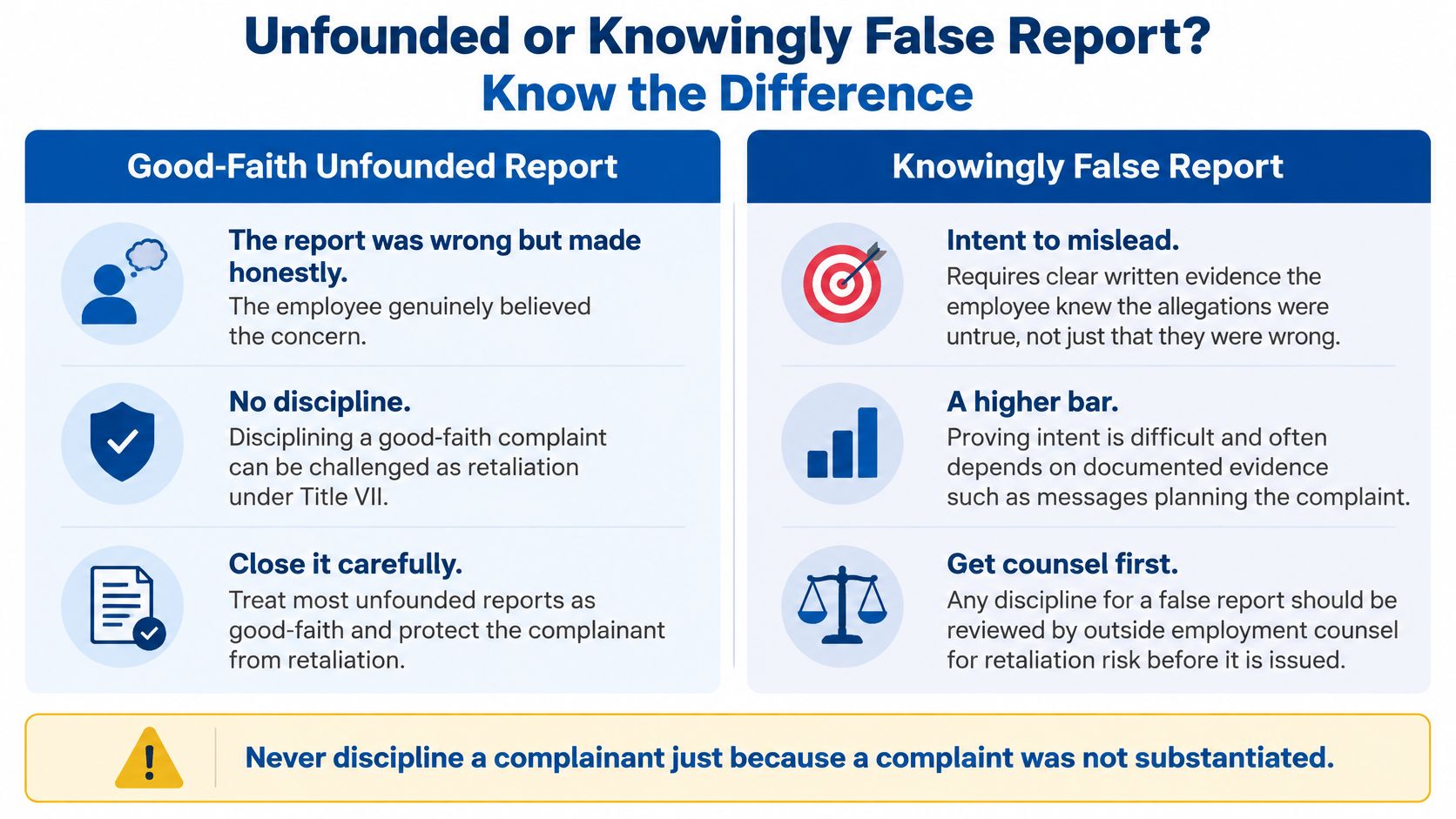
A complaint filed the week after a poor review needs a different level of scrutiny. An unfounded finding means the evidence affirmatively shows the alleged event did not happen. A knowingly false report sets a much higher bar. It requires clear evidence that the complainant intentionally fabricated the allegation to mislead leadership or harm someone.
Those two categories should stay separate in the file. Title VII of the Civil Rights Act of 1964, enforced by the EEOC, makes disciplining an employee for raising a good-faith complaint a retaliation risk, even when the underlying claim turns out to be mistaken. For owners handling HR alongside operations, the practical point is simple. Treat most unfounded reports as misunderstandings unless the record proves deliberate dishonesty. That gives the company a defensible basis for the next decision.
The report should show exactly why the complaint falls into one category rather than the other. If company messaging records show the employee knew the claim was untrue and wrote to a coworker about filing a fabricated complaint, the record may support a higher level of review. Even with direct written proof of intent, leadership should pause before discipline so employment counsel can assess retaliation risk. The finding starts the decision. It does not end the company's obligations.
Never discipline a complainant solely because an allegation was not proven. Before using the term "knowingly false" in a report, warning, or termination notice, require concrete proof of intent. That proof may include an admission or written messages showing deliberate fabrication. Keep the proof in the investigation file, and connect it to the policy the employee is accused of violating.
Any discipline directed at an employee who recently filed a complaint carries heightened scrutiny, so outside employment counsel review should happen before a warning or termination is finalized.
Owners should also review handbook anti-harassment and reporting policies. Any clause about false statements should be narrowly written. Termination language for unproven complaints can discourage employees from raising legitimate concerns and invite scrutiny from federal and state agencies.
Some investigations never touch harassment or discrimination law at all. A warehouse supervisor notices discrepancies on an employee's timesheets over several weeks. An investigation compares door-badge logs against timekeeping entries, confirms the employee falsified hours, and checks the personnel file to verify the employee signed the handbook's timekeeping policy. That result is a conduct violation outside protected-class issues.
These findings cover policy breaches unrelated to harassment, discrimination, or other protected characteristics, including theft, timecard falsification, workplace violence, safety violations, or misuse of company equipment. The core question is whether the policy was broken and enforced consistently. Even so, sloppy documentation or uneven enforcement can quickly turn a routine misconduct termination into a wrongful-termination or discrimination dispute.
Wage and leave laws still apply during non-protected misconduct reviews. Under the Fair Labor Standards Act (FLSA), enforced by the U.S. Department of Labor (DOL), employers must pay non-exempt employees for all hours worked, even if the employee is disciplined or terminated for falsifying time records. If the accused employee recently filed a complaint or requested leave under the Family and Medical Leave Act of 1993 (enforced by the DOL) or an accommodation under the Americans with Disabilities Act of 1990 (enforced by the EEOC), get expert help before acting. A disciplinary decision that ignores a pending leave request can invite the same scrutiny as the misconduct itself.
Consistency across sites and managers is what makes a policy-based disciplinary decision hold up. Operators managing teams across multiple states should verify that local supervisors aren't enforcing handbook rules differently in one branch than another.
The file is the outcome here. A substantiated timecard violation with signed policy acknowledgment, preserved originals, and consistent past practice gives the owner a defensible record. The same violation documented loosely leaves the company defending the process instead of the decision.
Retaliation creates a separate exposure from the complaint that started the investigation. According to EEOC charge receipt statistics for FY 1997 through FY 2025_FY_1997_-_FY_2025.xlsx), 54,350 retaliation charges were filed in FY 2025, representing roughly 62% of all charges filed with the agency, while discharge or constructive discharge appeared in 22 of 31 EEOC retaliation lawsuits filed in FY 2025, or 70.9%.
Federal laws including Title VII of the Civil Rights Act of 1964 (EEOC), the Age Discrimination in Employment Act of 1967 (EEOC), the Americans with Disabilities Act of 1990 (EEOC), and the Family and Medical Leave Act of 1993 (DOL) prohibit punishing employees for reporting concerns, taking protected leave, or participating in an investigation. Retaliation stands as an independent violation. An employer can face liability for retaliation even when the original complaint was unsubstantiated.
The practical risk is that a routine staffing decision can look like punishment once a complaint enters the timeline.

An employee reports harassment. Two weeks later, her manager moves her from a consistent day shift to rotating nights, cutting the predictable schedule she had before the complaint. An investigator examines who approved the change, whether staffing needs required it, how other employees were assigned, and what the schedule history showed before the report. Leadership pauses the change, assigns an uninvolved manager to review the staffing facts objectively, and consults employment counsel before altering the employee's hours or status.
A substantiated retaliation finding starts the correction process. Restore the employee's schedule or working conditions where possible, correct the decision record, and address the manager responsible. Then document each step with dates, reasons, and approvals. That file becomes the evidence that leadership corrected the problem instead of allowing it to continue.
Even when an investigation does not confirm retaliation, identifying retaliation risk calls for immediate guardrails. Later schedule cuts, exclusion from meetings, sudden micromanagement, or unexpected write-ups often supply the core evidence employees use when learning how to prove retaliation in the workplace.
Timing check: Treat any adverse employment action within weeks or months of a complaint, witness interview, or protected leave request as high risk, and never finalize a termination without outside HR or legal review.
Leadership should remind involved managers in writing that retaliation against the complainant or any witness is strictly prohibited. Keep a dated decision log for any later action involving those employees. If legitimate attendance, conduct, or performance issues arise, record the objective business reason with dates, metrics, and pre-complaint history, then have an uninvolved leader review the record before action is taken. In daily practice, that means no schedule reduction, shift transfer, written warning, or termination moves forward on a manager's word alone. The decision needs a documented reason that existed independently of the complaint and a reviewer who was not accused in it.
A front-line manager hears two separate verbal complaints about the same employee over three months and reports neither one. The investigation uncovers the pattern only after a third complaint arrives in writing. That is what a systemic or process failure finding looks like in practice: the facts reveal broken escalation paths, outdated policies, missing training, or managers who treat verbal complaints as noise. Disciplining one individual while leaving the broken system in place virtually guarantees repeat incidents.
In that scenario, the company issues corrective action to the manager, updates its escalation procedure so supervisors must report complaints within a defined window, and trains managers at every operating location. The finding is the start of the decision, not the end of the investigation.

Under Title VII of the Civil Rights Act of 1964 and other federal EEO statutes, the EEOC harassment policy tips for small businesses recommend that workplace policies expressly bar retaliation against reporters and participants, require managers to escalate complaints to authorized responders, and account for state and local rules that add protections or procedures.
Multi-state employers can't fix a process gap in one office and assume every other location is covered. State requirements for anti-harassment policies, complaint notices, and periodic training differ sharply. Some states require periodic harassment training and specific policy disclosures from covered private employers; others impose no state-level training mandate at all. The table below shows what to compare and what to file.
| Compliance Area | What Varies by State | Record to Keep |
|---|---|---|
| Anti-harassment training | Some states require periodic training for private employers; others set no state-level mandate. | Attendance logs with dates, trainer, and content outline. |
| Policy and notice disclosures | Required handbook language, postings, and complaint-procedure disclosures differ by jurisdiction. | Signed policy acknowledgments and handbook version dates. |
| Complaint escalation paths | State and local rules can add agencies, procedures, or deadlines beyond the federal process. | Written escalation procedure and an intake log with response dates. |
When a systemic gap appears, separate the individual misconduct record from the organizational fix and manage the remediation like any operational project:
That file matters later. If a second complaint surfaces in the same department, the remediation record is the difference between showing a good-faith fix and showing that leadership knew about the gap and left it open.
| Outcome | Link to Prior Section | Record to Keep Ready | Decision Risk to Control |
|---|---|---|---|
| Substantiated finding | Section 1: policy violation confirmed. | Keep the allegation-by-allegation findings, the evidence tied to each finding, the policy cited, and the written discipline rationale with the approver named. | The record must show why this response fits the confirmed conduct and the company's prior practice. |
| Partially substantiated finding | Section 2: some allegations confirmed. | Keep a separate file section for each allegation, with the supported facts, rejected facts, evidence reviewed, and any action tied only to confirmed conduct. | The file should let a reviewer see which facts support the action and which do not, without implying the complainant was dishonest. |
| Unsubstantiated finding | Section 3: evidence was insufficient. | Keep the scope, interview list, records reviewed, evidence gaps, closure notice, and any follow-up step. | The record should show that the concern was examined, not brushed aside, and that the decision rests on the available evidence. |
| Unfounded or knowingly false report | Section 4: report unsupported or knowingly misleading. | Keep two separate records: whether the conduct occurred, and any evidence of intent to mislead before discipline is considered. | The distinction protects a good-faith complainant from being treated as a false reporter and keeps any discipline tied to a documented finding. |
| Conduct violation outside protected-class issues | Section 5: policy issue, not protected-class conduct. | Keep the policy acknowledgment, source records, interview notes, and comparison with how similar conduct was handled. | The file should make the rule and the enforcement pattern clear enough to answer a later challenge. |
| Retaliation finding or retaliation risk | Section 6: adverse treatment or risk after protected activity. | Keep the protected-activity timeline, later employment actions, supporting records, decision reviews, and any protective steps. | The decision record must isolate business reasons from complaint activity and show what leadership did to prevent further harm. |
| Systemic or process failure | Section 7: organizational gap beyond individual conduct. | Keep separate findings for individual conduct and process gaps, plus the remediation owner, target date, completion record, and follow-up review. | The company needs proof that the gap was fixed, because unfixed processes turn one complaint into the next exposure. |
Use this table as a record check, not as a shortcut to the answer. The finding starts the decision. The file is what lets leadership defend the decision later. For owners and executives handling HR alongside operations, the practical question is simple: can each file show what was reported, what was checked, what was found, who approved the step, and why that step followed from the finding? If any of those pieces are missing, close the gap before implementing discipline, closure, or remediation.
A defensible decision record starts with seven elements: the original concern, the investigation scope, the people interviewed, the documents reviewed, the credibility analysis, the person who approved the outcome, and the reason the action fits prior company practice. Each element answers a question that may arise later. Missing approvals create inconsistent discipline. Missing credibility analysis makes a conclusion look arbitrary. Missing policy comparisons make similar cases difficult to explain.
The written report is the start of the decision, not the end of the investigation. Leadership still has to decide what corrective action is proportionate, who will carry it out, and when completion will be verified. If a warning stalls on a manager's desk or planned training never happens, the underlying conduct can resume and the company may have a documented problem it failed to correct.
Record each implementation step in the same file. Include the decision date, responsible owner, completion deadline, and supporting documentation. Closeout communication should use the limited approach applied to partial and insufficient-evidence findings: confirm that the process has concluded, reinforce anti-retaliation expectations, and protect confidential personnel details.
Owners and COOs who handle HR alongside operations should get outside employment counsel or experienced HR risk guidance before acting when the stakes or conflicts are high. That includes complaints involving a senior executive, a planned termination after a complaint or protected leave, overlapping FMLA or ADA issues, or evidence suggesting a knowingly false report. These situations often turn on timing, consistency, and documentation rather than the underlying allegation alone.
For leadership teams that need external neutrality, International Inc. conducts workplace investigations built around EEOC, DOL, and FLSA requirements. Its work includes executive misconduct, harassment, and retaliation claims, and the client receives a written report with conclusions and next steps.
If you're working through an active complaint or want to strengthen investigation and documentation practices across states, review your current HR risk posture before the next decision forces the issue.
This article is general information, not legal advice. Employment laws change and vary by state; consult qualified employment counsel about your situation.
The company supports growing multi-state employers with impartial workplace investigations, corrective action documentation, and multi-state HR compliance advisory across more than 30 U.S. states. Visit Paradigm International Inc. to explore its HR risk and investigation services, or Book a Free HR Risk Review to discuss your organization's current practices with an advisor.