
An employee transfers from Texas to California, and the payroll report shows the same unused vacation balance before and after the move. The number looks accurate, but the employer may face a different payout obligation at termination because vacation calculation is also a policy and jurisdiction decision. The formula matters, but so do the accrual clock, written rules, employee classification, and governing state law.
A defensible process answers two separate questions: how much time has the employee earned, and what treatment does that earned time receive? The sections below provide the math, then apply it to proration, carryover, payout, and multi-state administration.
A small business may use a spreadsheet that divides annual vacation by pay periods. That approach can produce a clean balance for a salaried employee with a consistent schedule. It can also fail when an hourly employee works variable hours, a new hire starts midyear, or an employee moves into a jurisdiction with different treatment of unused time.
The problem usually isn't arithmetic. It's the gap between the formula and the policy that controls it. A balance can be mathematically correct while still being difficult to defend if the employer hasn't documented whether accrual begins on the hire date, anniversary date, or calendar-year start.
Assume two employees each show an unused balance of 40 hours. One works in a state where the employer's written policy controls forfeiture. The other works in a state that treats accrued vacation as earned wages and restricts forfeiture. The payroll system displays the same figure, but the employer's potential termination obligation may differ.
Several state-law summaries identify California, Colorado, Illinois, Maine, Massachusetts, Nebraska, and North Dakota as states where accrued vacation is treated as earned wages and unused balances may require payout at separation. The same source also notes that some states prohibit use-it-or-lose-it forfeiture of already-earned time. Review the state-by-state vacation payout treatment before applying a cap or forfeiture rule.
Practical rule: Treat the balance calculation and the legal treatment of that balance as separate control points.
Before accepting a payroll report, verify:
A simple calculator answers only one part of the question. An HR leader needs a calculation that payroll can reproduce and a policy that management can explain consistently.
Employers generally choose between accrual over time and a lump-sum grant. Neither model is automatically compliant or operationally superior. The right choice depends on workforce schedules, state requirements, hiring patterns, and how much control the company needs over earned versus advanced time.
| Method | How it works | Where it fits | Main trade-off |
|---|---|---|---|
| Accrual | Employees earn time by pay period, month, or hour worked | Variable schedules, part-time work, and gradual earning | Requires accurate tracking and policy controls |
| Lump sum | The employer grants the annual allowance at a defined point | Consistent salaried workforces seeking simple administration | Can complicate midyear hires, early usage, and departures |
Accrual is often easier to align with time worked. An hourly employee can earn vacation in proportion to recorded hours, while a part-time employee doesn't automatically receive the same annual amount as a full-time employee. The trade-off is administrative detail, especially when employees change schedules or classifications.
Frontloading creates a clear available balance and reduces recurring accrual calculations. It can also create disputes when an employee uses time early in the year and leaves before the employer considers the full annual amount earned. Any recovery or forfeiture language needs careful review because state law may limit what the employer can take back.
The clock determines when earning begins, when annual limits reset, and how the system handles midyear events.
Recent HR reporting indicates that 67% of organizations use hire-date accrual for vacation, while 61% use it for PTO, and calendar-year methods are much less common. These figures appear in the 2025 Leave Management and HR Trend Report. The practical lesson is that most organizations already operate with individualized clocks, even when employee-facing explanations sound simple.
A policy should state what happens when an employee:
State-specific sick leave requirements can also require more flexible structures than a single vacation bank supports. A hybrid PTO plan may look efficient, but it can blur the difference between vacation, protected sick leave, and legally protected balances.
For practical payroll administration, teams can also consult these 2026 payroll setup tips when configuring pay schedules and related controls.
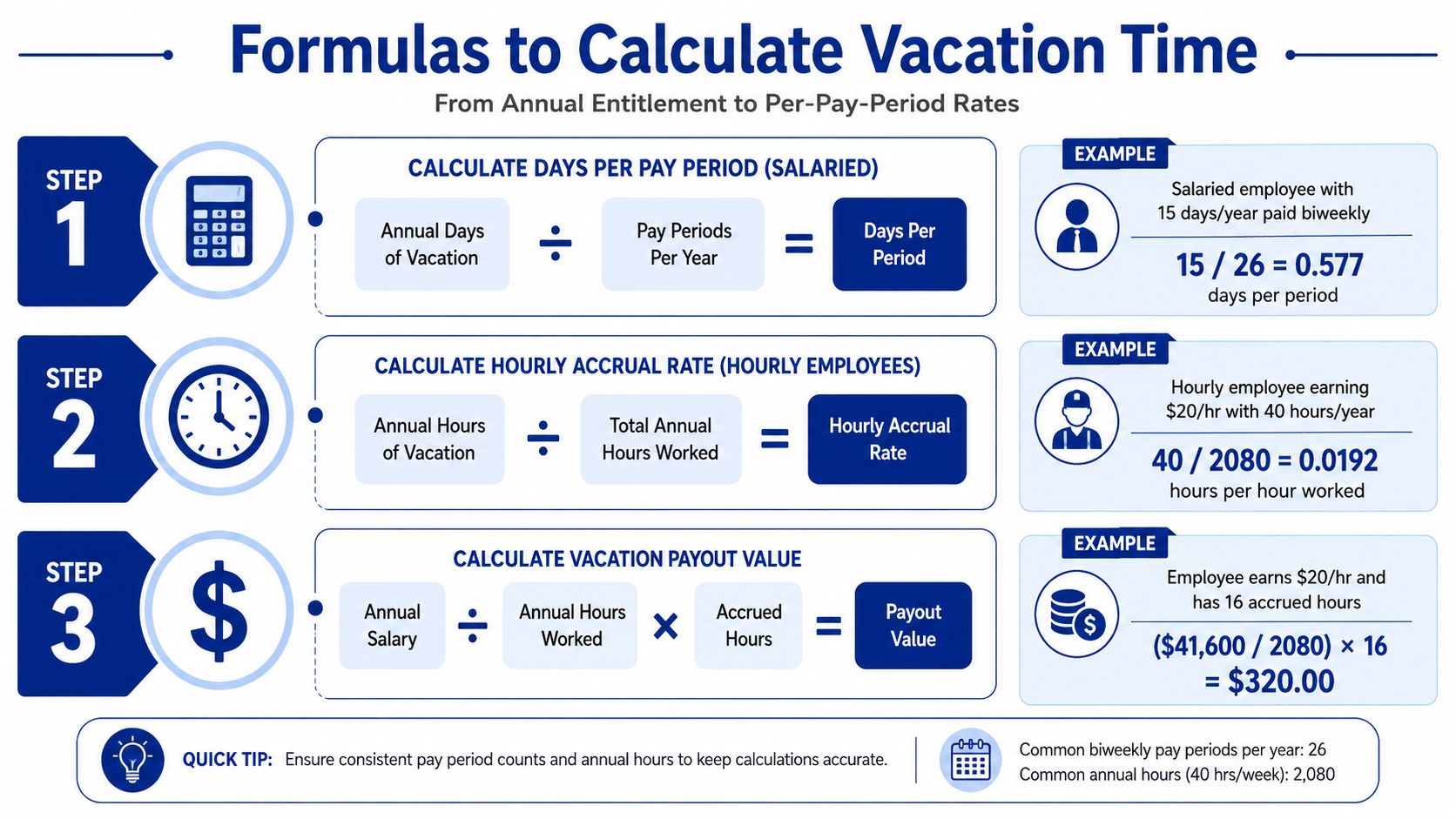
Start with the annual entitlement, then choose the unit that matches the employee and payroll system. A company may state vacation in days, but payroll often needs hours. Convert the entitlement before calculating accrual.
For a salaried employee whose annual allowance is expressed in days:
Annual vacation days ÷ annual pay periods = vacation days per pay period
For example, an employee with 15 days per year paid biweekly accrues:
15 ÷ 26 = 0.577 days per pay period
The calculation follows the standard pay-period example shown in the required infographic. If payroll tracks hours instead, convert the annual days into hours using the employee's standard workday before dividing by pay periods.
Monthly accrual uses a similar approach:
Annual vacation entitlement ÷ 12 = monthly accrual
A 25-day annual allowance becomes 2.08 days per month, as illustrated by this vacation-time calculation reference. Monthly accrual is easy to explain, but it may be less precise for employees whose schedules vary.
Hourly accrual connects earning to hours worked:
Annual vacation hours ÷ total annual work hours = hourly accrual rate
The infographic's worked example uses an employee earning 40 vacation hours per year across 2,080 annual work hours:
40 ÷ 2,080 = 0.0192 vacation hours per hour worked
For each payroll period, multiply recorded eligible hours by the accrual rate. The policy must define whether overtime, paid holidays, training time, or leave hours count as eligible hours. Don't let the payroll system make that decision by default.
Payroll control: Store the unrounded rate in the system when possible, then define how displayed balances are rounded. Repeated rounding at each pay period can create reconciliation differences.
Some employers first determine the employee's full-time equivalent percentage:
Annual hours worked ÷ 2,080 = FTE percentage
They then apply that percentage to the accrual rate for the employee's job level and service tier. This method is described in Creighton University's vacation accrual chart, which uses 2,080 hours as the annual full-time reference.
For example, if an employee works fewer annual hours than the full-time standard, multiply the resulting FTE by the applicable annual entitlement. Confirm that the policy uses scheduled hours, actual hours, or a defined eligibility threshold. Mixing those bases can produce inconsistent outcomes for employees with similar schedules.
A five-day schedule may use days for employee communication and hours for payroll. A compressed schedule may make “one day” longer than the standard workday. The calculation should therefore identify:
The formula is only reliable when each input has a defined source.
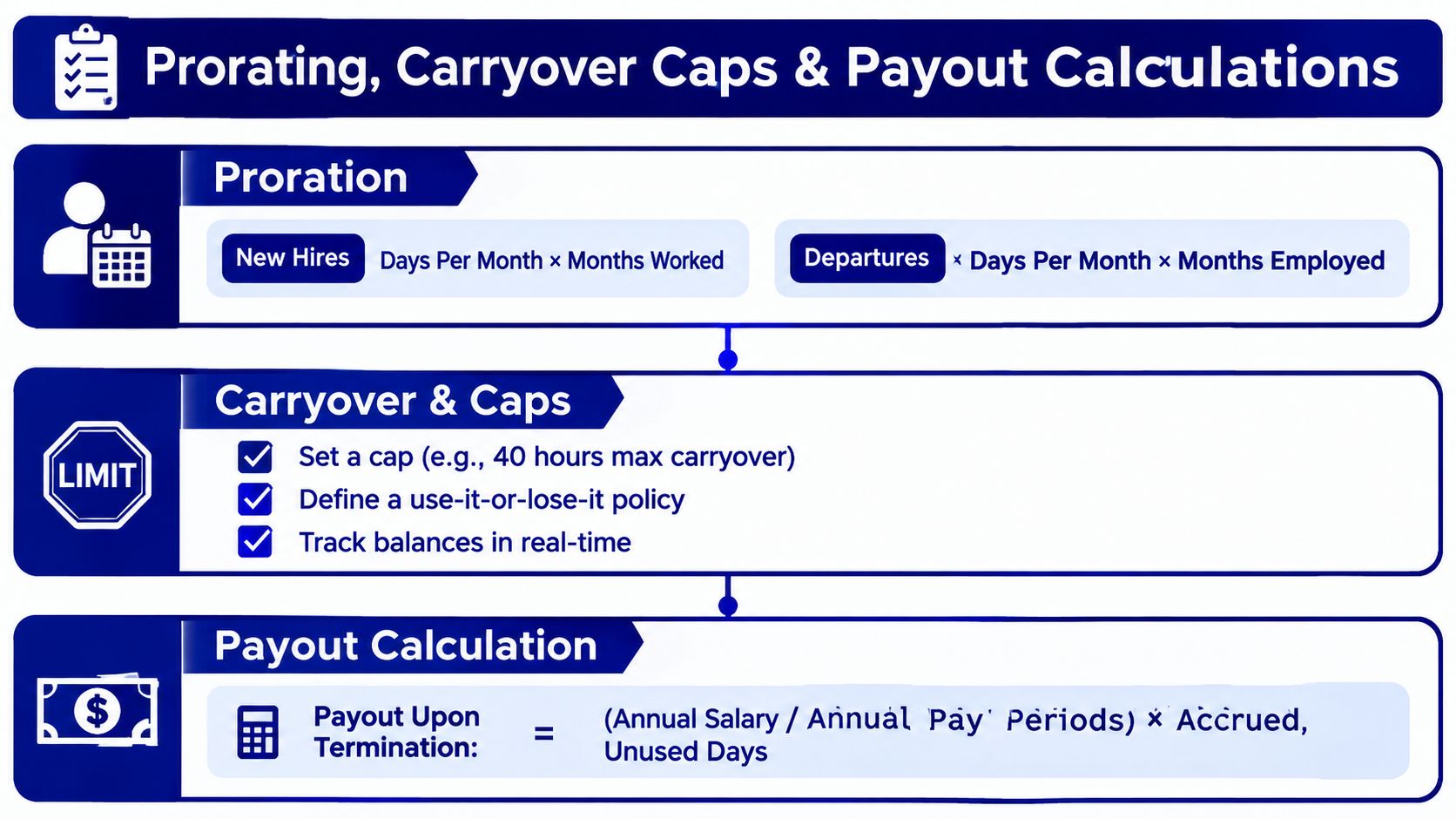
Proration is where a general annual promise becomes an employee-specific balance. The calculation must identify the employee's applicable entitlement, the period covered, and the policy rule for partial periods. Don't assume that a single “months employed” formula works for every state or every policy year.
For a policy that accrues monthly, the basic structure is:
Monthly entitlement × eligible months = prorated entitlement
For a new hire, define whether the first month counts based on the hire date, a completed service period, or the next payroll cycle. For a departure, define whether the final month is measured through the last day worked or another policy-defined date. The written rule should also address partial months instead of leaving managers to make one-off decisions.
A strong record shows:
A cap limits how much time can accumulate. A carryover rule determines what happens at the end of the policy year. Those are different controls and should not be combined into one sentence.
A policy might state that accrual stops when the balance reaches a defined cap and resumes after the employee uses time. It might instead allow a defined amount to carry into the next period. Either approach needs review against the governing law, especially where earned vacation is treated as wages.
Avoid language that says earned time automatically disappears without confirming the jurisdiction. The PTO payout compliance multistate guidance can help leadership teams separate policy design from state-specific payout analysis.
Payout generally starts with the unused accrued hours and the employee's applicable rate:
Accrued unused hours × hourly or salary-equivalent rate = gross payout value
For a salaried employee, the salary-equivalent rate may be derived from annual salary divided by the defined annual work hours or another policy and payroll basis. For an hourly employee, use the rate required by the policy and applicable law. Payroll deductions may then apply to the gross amount.
The important distinction is earned balance versus legally payable balance. A system may show time that is protected, excluded from payout, subject to a cap, or governed by a different state rule. Review the balance before termination rather than waiting for final payroll.
Separation review: Confirm the employee's location, policy version, accrual history, cap status, and unused balance before approving final pay.
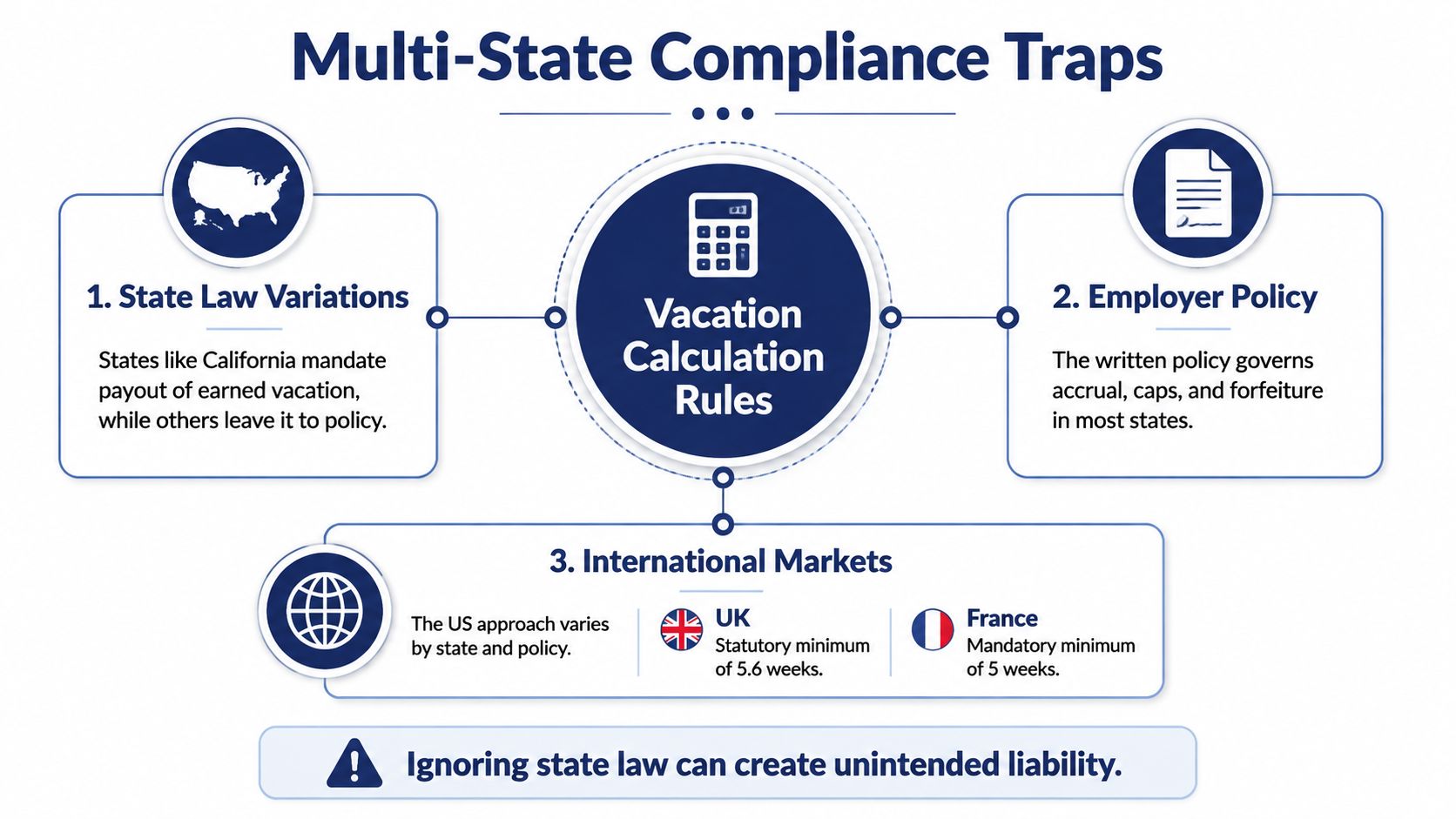
In the United States, vacation calculation starts with employer policy and state law because federal law doesn't require paid vacation. Federal law also doesn't require employers to pay unused vacation at termination. This overview of federal PTO rules and state-driven payout obligations explains why a company can't rely on a federal baseline when setting its balance or separation process.
That approach differs from many international labor markets. The OECD identifies 20 working days per year as a common baseline across many countries for full-time employees, while also noting that the United States has no permanent federal law requiring employers to provide paid vacation leave. The OECD Employment Outlook discussion of working time and regulation shows why a global policy cannot assume that U.S. practice applies everywhere.
The European Union Working Time Directive established a minimum of four weeks of paid annual leave for member states, commonly equal to 20 working days on a five-day workweek. Statutory minimums exceed that baseline in several countries. Austria, Denmark, France, and Sweden each set a minimum of 25 days, while Portugal and Spain set 22 days. These figures are summarized in Eurofound's comparison of work and rest across Europe.
For a global employer, annual entitlement must be converted into the local payroll unit. That can mean monthly accrual, prorated balances, carryover treatment, and separate rules for employees who move between countries. A single global spreadsheet often hides those differences rather than resolving them.
Several states treat accrued vacation as earned wages and require payout of unused balances at separation. Those include California, Colorado, Illinois, Maine, Massachusetts, Nebraska, and North Dakota, according to the state-law summary cited earlier. Some states also restrict use-it-or-lose-it treatment for time employees have already earned.
The risk is not limited to the final payout. A cap may be invalid, a policy may be unclear, or a payroll system may stop accrual in a way the state doesn't permit. The employer needs a location-specific review of the policy, balance history, and separation calculation.
A multi-state operator should ask these questions before changing a balance:
For broader controls, review multi-state wage and hour compliance alongside the vacation policy. Vacation administration rarely operates in isolation from classification, timekeeping, payroll, and location records.
A reliable vacation program has three connected parts: a clear policy, a configured payroll process, and an audit trail. The formula belongs in the second part, but it can't compensate for vague eligibility rules or undocumented exceptions.
The policy should state:
Avoid promising “unlimited flexibility” while payroll maintains a fixed bank. Avoid saying unused time is forfeited unless the rule has been reviewed for every relevant jurisdiction. A policy should describe the actual system, not the intended system.
A practical audit can run before policy-year resets, after major payroll changes, and before employee separations. Compare the employee roster, work location, hire date, accrual tier, pay frequency, current balance, and used time. Investigate manual adjustments rather than allowing them to disappear into a general ledger entry.
Managers also need a defined approval process. They should know who approves vacation, how requests are recorded, and when operational coverage concerns can affect scheduling. The employee handbook should connect those approval rules to the broader employment framework. This guide by Paradigm International Inc. provides related guidance on state-specific handbook requirements.
A payroll or HRIS platform can automate accruals, but automation only repeats the rules entered into it. Configure separate leave banks where required, preserve policy versions, and test a transfer, a midyear hire, a status change, and a termination before relying on production reports.
Companies expanding internationally may also need a structured approach to distributed hiring. For leadership teams comparing regional employment options, the best place to hire LATAM talent can provide context on building teams across Latin American markets, while local leave rules still require separate review.
The final standard is reproducibility. Another HR professional should be able to take the policy, employee record, payroll inputs, and applicable jurisdiction and reach the same result. If they can't, the organization doesn't yet have a defensible vacation calculation process.
Paradigm International Inc. helps owners, COOs, and HR leaders design consistent leave policies, audit payroll practices, and address multi-state employment risk before a balance becomes a termination dispute. Visit Paradigm International Inc. to discuss a practical review of your vacation calculations, policy language, and recordkeeping controls.