When an employee decides to leave, their departure creates a valuable opportunity. Beyond the administrative tasks of offboarding, there is a chance to gather honest, unfiltered feedback that can protect and improve your business. This is accomplished through a well-structured conversation known as an exit interview, a powerful tool for any leader focused on building a resilient organization.
An exit interview is a structured conversation with a departing employee to learn their reasons for leaving and gather feedback about their experience at your company. It is much more than a final HR checkpoint. Think of it as a business intelligence tool designed to reveal actionable insights about your management, culture, and operational processes. A properly conducted exit interview transforms a routine task into a vital source of organizational improvement.

Let's move beyond the simple exit interview definition. This is not just about checking a box during an employee's final week. An exit interview is a final, candid conversation that helps you see your organization through a new lens—one free from the filters of job security or office politics. Its purpose is to uncover the full story behind an employee's decision to leave.
This discussion, whether the departure is voluntary or involuntary, is your chance to hear the kind of honest feedback you might not get from your current team. It provides a clear window into your company's strengths and weaknesses. By formalizing this step, you can analyze turnover trends and strengthen your offboarding procedures. You can see how this fits into a defensible process with our complete employee termination checklist.
For small and mid-sized businesses, the insights from an exit interview are invaluable. They provide a direct view into issues that might otherwise remain hidden until they become significant problems. A departing employee may be the first to alert you to a dysfunctional team dynamic, a manager needing more training, or an unknown compliance risk.
By standardizing this process, you create a consistent method for capturing feedback. This documentation can become a critical asset in demonstrating fair practices and mitigating legal risks down the road.
The goal is to turn this feedback into action. A well-managed exit interview program helps you:
Viewing the exit interview as a proactive strategy instead of a reactive chore is the first step toward unlocking its true value. If you need help creating an effective and defensible process, our team is here. Connect with an expert at Paradigm to get started.
It is easy to dismiss an exit interview as just another HR task. For any company, however, these conversations are far more than a formality. They are one of the most effective tools you have for protecting your business, managing risk, and understanding what is really happening within your organization.
Think of a well-run exit interview as an early warning system. It creates a safe space for a departing employee to share concerns they may have been reluctant to voice before, such as compliance shortcuts or unreported misconduct. Identifying these issues allows you to address them before they escalate into formal complaints or costly legal disputes.
A primary benefit is getting to the real reason an employee is leaving. A resignation letter might politely mention a “new opportunity,” but the exit interview is where you may hear about an ineffective manager, a toxic team, or a lack of career growth that actually prompted the departure. These honest insights are critical for addressing the root causes of turnover.
A consistent, well-documented exit interview process creates a defensible record of your offboarding practices. This documentation demonstrates a good-faith effort to listen to and address employee concerns, offering powerful protection against potential claims.
This isn't just theory. For example, some studies have shown that companies with formal exit interview programs significantly reduce turnover. They do so by systematically identifying and fixing common issues like poor management and limited career development. You can see how this fits into the bigger picture with a complete employee termination checklist.
To get a better sense of what to listen for, consider the most common issues that surface in effective exit interviews.
This table highlights the common themes that emerge during well-conducted exit interviews, helping leaders understand what to listen for.
| Departure Driver | Percentage of Departing Employees Citing This Issue |
|---|---|
| Lack of Career Growth & Development | 45% |
| Poor Management or Leadership | 41% |
| Compensation & Benefits | 36% |
| Toxic Work Culture or Environment | 29% |
| Poor Work-Life Balance / Burnout | 25% |
| Lack of Recognition or Appreciation | 22% |
Data compiled from multiple industry reports on employee retention and exit interview findings.
These drivers often overlap, but they provide a clear roadmap for where to focus your retention efforts. Paying attention to these themes can help you make targeted improvements that have a real impact.
This process is not just about providing closure for the departing employee; it's a powerful business intelligence tool. By collecting and acting on this feedback, you build a more transparent, resilient, and stable organization. Knowing the benefits is one thing, but building an effective and legally sound process is the next step.
If you need help creating a structured exit interview program, our team is here to guide you. Contact a Paradigm expert today to learn how we support leaders through these high-stakes situations.
While exit interviews are powerful tools for gathering feedback, they can become a legal minefield without careful planning. For business leaders, understanding the compliance guardrails is essential for managing risk. A poorly documented or inconsistent conversation can create more problems than it solves, while a structured process provides a strong defense.
The most important principle is consistency. If you only hold exit interviews for certain employees or ask different questions each time, you open the door to claims of discrimination. Your first line of defense is a standardized approach where every departing employee is offered the same opportunity and asked the same core questions.
To keep the conversation objective, the interview should be conducted by a neutral party. This is typically a trained HR professional or an external consultant. The one person who should never conduct the exit interview is the employee’s direct manager. Their involvement can intimidate the employee and create a conflict of interest if the manager's conduct is part of the problem.
Accurate, neutral documentation is just as vital. The interviewer’s notes should capture the employee’s statements factually, without adding personal opinions or interpretations. Think of it as reporting, not storytelling.
If an employee raises serious allegations—such as harassment, discrimination, or illegal activity—the interviewer must know how to respond. This is no longer just feedback; it is a formal complaint that requires immediate escalation and investigation according to company policy.
For businesses operating in multiple states, a structured approach is even more critical. A consistent, documented process shows a good-faith effort to uncover and address workplace issues. To build out a more defensible process, you might also want to review our guide on using an employment separation agreement template.
Finally, remember to protect your company's sensitive information. Having a solid employee confidentiality agreement template in place clarifies post-employment obligations and helps safeguard your intellectual property. It is a simple step that turns a potential vulnerability into a protective asset for your business.
An effective exit interview is not just a conversation; it is a process. To obtain valuable and honest feedback, you need a clear, repeatable framework. A successful program turns every discussion into a source of insight while protecting your business.
First, get the timing and setting right. Schedule the interview during the employee’s final week, but avoid their last day. That day is often filled with emotions and last-minute tasks, which can hinder a productive discussion. Hold the meeting in a private, neutral space where the employee feels comfortable speaking freely.
This may be the most important decision you make. To get unbiased and open feedback, the conversation must be led by a neutral party. This is almost always a trained HR representative or an experienced third-party consultant for even greater impartiality.
The employee’s direct manager should never conduct the exit interview. Their involvement can prevent honest feedback, especially if the manager's own conduct is a factor in the employee's departure.
To ensure consistency, use a standardized set of open-ended questions. This helps you spot trends over time rather than just gathering disconnected anecdotes. As the visual below illustrates, a structured process is your best defense against the legal risks that arise from inconsistent practices.
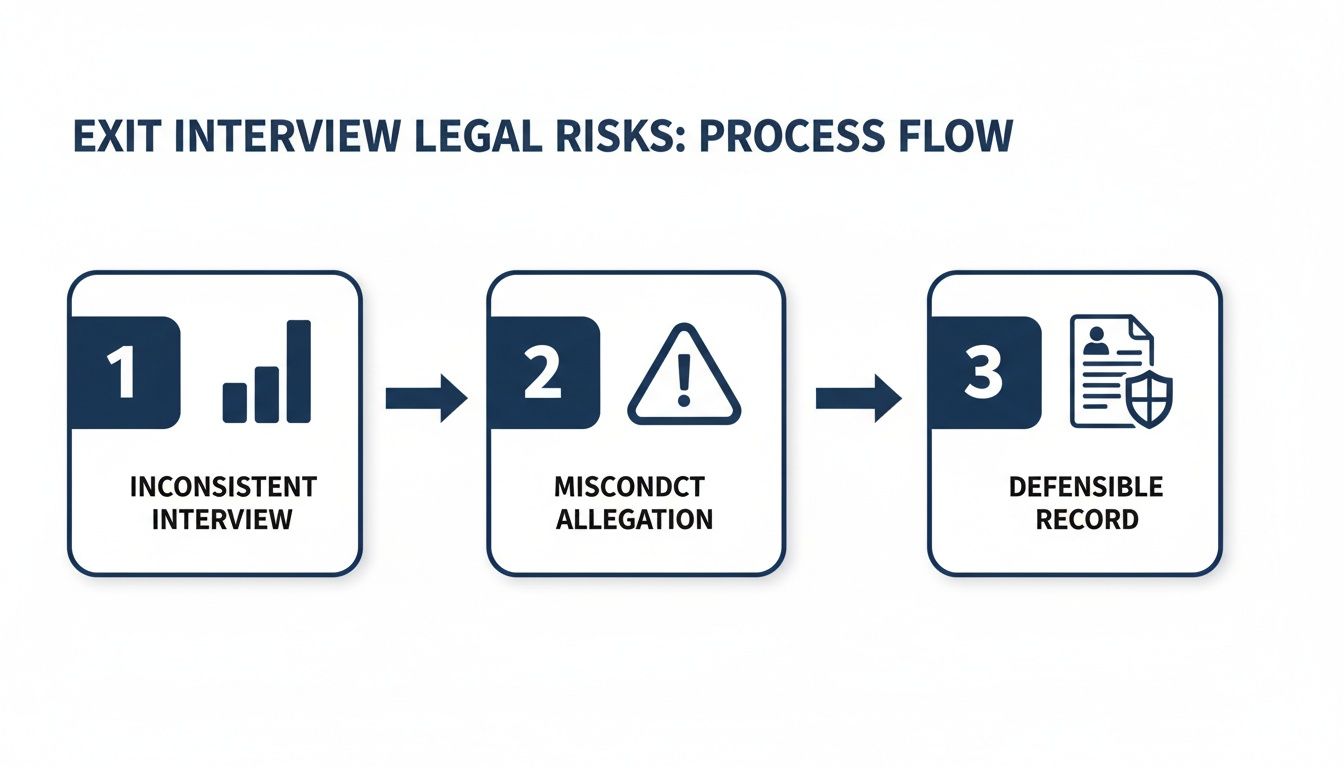
Starting with inconsistent interviews can open the door to serious allegations. In contrast, following a structured process creates a defensible record you can rely on. For more guidance on building legally sound offboarding procedures, our complete employee termination checklist is an excellent resource.
Putting a solid framework in place transforms a simple goodbye conversation into a strategic business tool. If you need assistance designing a process that gets real results, our experts are here to help.
The insights you gain from an exit interview depend entirely on the quality of your questions. Generic questions lead to polite but unhelpful answers. To truly understand why someone is leaving, you need thoughtful, open-ended questions that encourage them to share their real experiences.
The best approach is to group your questions into specific categories. This structured method helps you cover all critical aspects of the employee experience, from daily tasks to company culture. It also makes it much easier to spot recurring themes when reviewing multiple interviews.
Organizing your conversation this way provides a comprehensive review of the employee's journey with your company. We recommend building your discussion around these four pillars:
This focused method helps you pinpoint specific issues that might otherwise go unnoticed. For example, some industry surveys have found that a high percentage of employees in certain fields leave due to specific operational issues, like scheduling conflicts—a critical pain point that a structured interview is designed to uncover.
A great way to begin the conversation is by asking, "Could you walk me through your decision to leave, starting from when you first considered a new opportunity?" This question often gets to the core issues behind their departure. You can find more ideas for framing these conversations in our guide to interview questions about culture.
To help you get started, here is a reference table of structured questions. These are designed to uncover deep insights about the employee experience, giving you a powerful tool for diagnosis and improvement.
| Category | Sample Open-Ended Question |
|---|---|
| Overall Experience | "Looking back, what were the best and worst parts of your job here?" |
| Role & Responsibilities | "Did the job you were hired for align with what you ended up doing day-to-day?" |
| Management | "What could your manager have done differently to better support you?" |
| Team Dynamics | "How would you describe the communication and collaboration within your team?" |
| Company Culture | "What three words would you use to describe our company culture?" |
| Training & Development | "Did you feel you had enough opportunities for professional growth in your role?" |
| Compensation & Benefits | "Were our compensation and benefits packages competitive with what you found elsewhere?" |
| Reason for Leaving | "What was the single most important factor that led to your decision to leave?" |
These questions serve as a solid foundation, but remember to listen carefully and ask follow-up questions to dig deeper. The goal is not just to complete a checklist; it is to have a genuine conversation that reveals actionable feedback for your business.
If you need help building an exit interview strategy that delivers real, actionable insights, we're here to help. Contact Paradigm to speak with an expert.

Collecting candid feedback is a great start, but it is only half the battle. The true power of an exit interview is unlocked when you use that insight to make meaningful improvements. Raw notes are just data; the goal is to transform them into a concrete action plan that strengthens your business and helps you retain top talent.
It is important to look for patterns across multiple interviews over time rather than reacting to a single piece of feedback. When different people from different teams start saying the same thing, you have likely uncovered a systemic issue, not just an isolated complaint. This approach allows you to focus on the most impactful changes.
Once you spot a clear trend—such as multiple employees citing poor communication—it’s time to consolidate your findings. Summarize the raw feedback into a focused, easy-to-digest report for your leadership team. This report should highlight the most critical and frequently mentioned problems.
Your action plan should focus on addressing the systemic problems you've uncovered. This closes the feedback loop, showing your entire team that their voices, even on their way out, lead to positive change.
The final step is to build a real strategy to tackle these core issues. This means turning insights into a clear plan. You can learn about defensible employee termination practices to further strengthen your offboarding.
A few strategic next steps include:
This disciplined approach turns the exit interview from a simple conversation into a strategic driver for continuous improvement. It helps you build a healthier, more resilient business where people want to stay and grow.
Turning sensitive feedback into a strong action plan requires experience and objectivity. If you need help analyzing your exit interview data or presenting it to your leadership team, contact Paradigm to speak with an expert. We specialize in helping leaders navigate these high-stakes decisions with confidence.
When it comes to exit interviews, business leaders often have a handful of practical, recurring questions. Let's tackle some of the most common ones to give you the clarity and confidence to move forward.
Yes, absolutely. While it might seem uncomfortable, this is a crucial risk management step. The conversation provides a final opportunity to document the separation from the employee’s perspective. This insight can be invaluable if you ever need to defend against a wrongful termination claim. Just ensure the interview is handled by a neutral party, like an HR representative, to maintain objectivity.
You cannot force an employee to participate, and you should not try. If someone declines, simply make a note of it in their offboarding file. Document that the offer was made on a specific date and respectfully declined. This simple record demonstrates that you followed a consistent, good-faith process for every departing employee.
No, there are no federal or state laws that mandate exit interviews. However, they are widely considered a legal and HR best practice for mitigating risk. The feedback gathered is also incredibly useful for spotting internal issues and improving communication in the workplace, which ultimately contributes to a stronger company culture.
Understanding how to define and implement a proper exit interview process can turn a routine task into a strategic advantage. If you are looking for guidance on building a defensible HR framework that protects your business and fosters a better workplace, our experts are ready to help. Contact us to learn more.