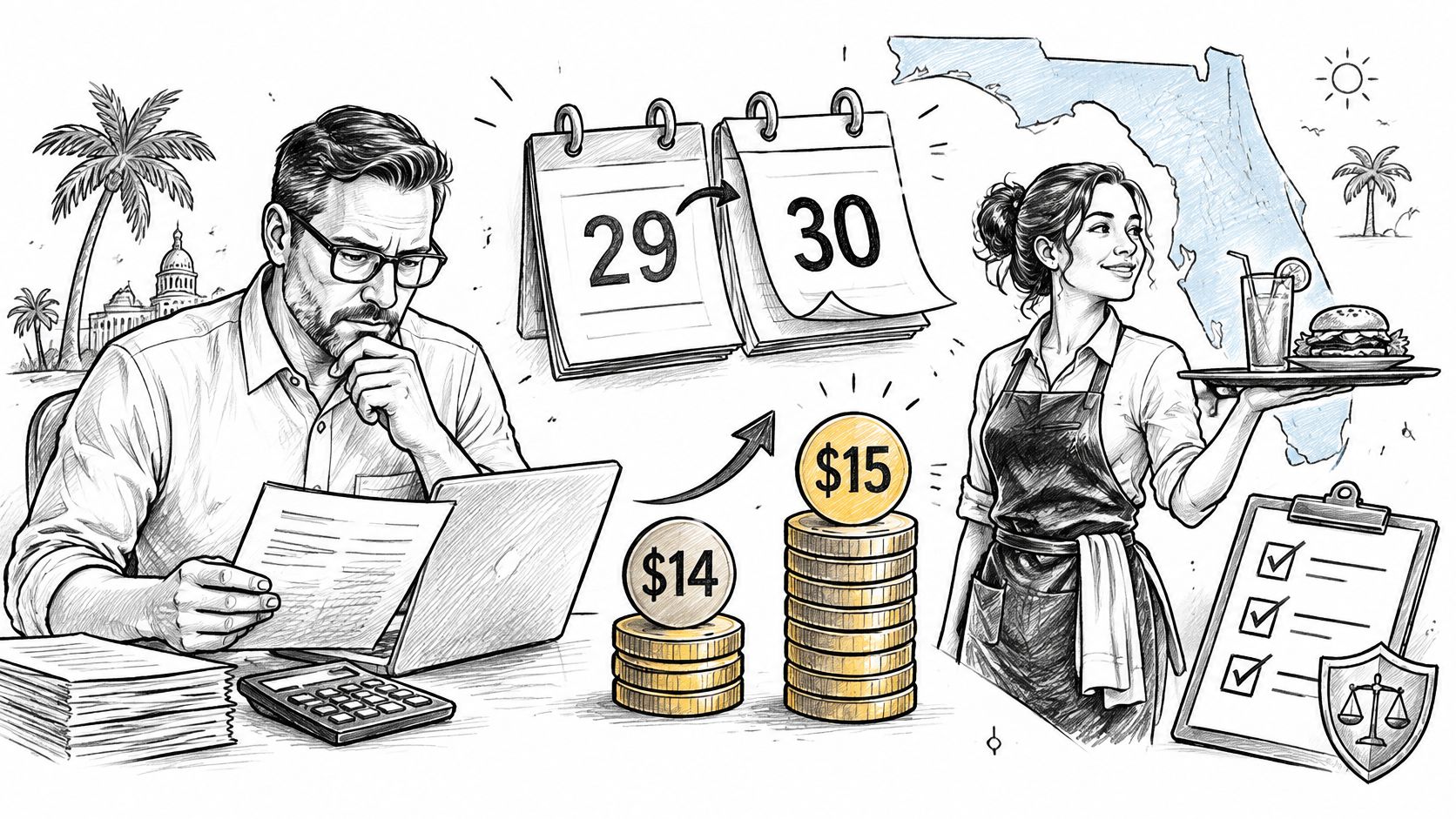
Florida's minimum wage is $14.00 per hour through September 29, 2026, and rises to $15.00 per hour from September 30, 2026. For an owner approving payroll between customer calls and operating meetings, the problem isn't finding the new rate. It's making sure the system applies it to the right hours, including overnight shifts, tipped work and remote employees.
Florida has a split-rate payroll year, not a single calendar-year rate. Under Article X, section 24 of the Florida Constitution, the Florida Department of Commerce minimum-wage schedule sets the rate at $14.00 through September 29, 2026, and $15.00 beginning September 30, 2026, with the latter scheduled to remain effective through December 31, 2027.
The schedule completes the phased increases approved by voters on November 3, 2020. Each scheduled annual step adds $1.00. The final increase is approximately 7.14% above the 2025 rate, and the scheduled rate is 25% above the $12.00 rate that began in 2023.
| Effective period | State minimum wage | Change from prior rate |
|---|---|---|
| September 30, 2023 to September 29, 2024 | $12.00 | Scheduled annual increase |
| September 30, 2024 to September 29, 2025 | $13.00 | +$1.00 |
| September 30, 2025 to September 29, 2026 | $14.00 | +$1.00 |
| September 30, 2026 to December 31, 2027 | $15.00 | +$1.00, about 7.14% |
These are hourly minimums, subject to applicable exemptions and federal requirements. They aren't permission to reduce an employee's agreed pay to the statutory floor. An employer should distinguish the legal minimum from its compensation commitments and established pay practices.
For the Florida minimum wage 2026 employers must implement, the date the employee performs the work controls the transition. A payroll period can contain hours governed by different rates. Treating the entire check as an old-rate or new-rate check creates an avoidable configuration problem.
The payroll lead should compare the employee roster with compensation bands, approved offers and department budgets. A statutory increase may also narrow the gap between entry-level employees and experienced staff. Leadership should decide deliberately whether to adjust those differences rather than leave managers to make inconsistent promises.
Useful preparation includes:
Practical rule: Compare the employee's rate with the minimum applicable to the hours worked, not with the rate in effect when the offer was signed.
Florida's constitution provides for inflation-based adjustments after the scheduled period. Owners shouldn't treat completion of the phased increases as the end of wage monitoring. Keep an assigned reviewer and a recurring compliance-calendar task.
The higher applicable minimum governs covered work performed in Florida. For 2026, employers must assess Article X, section 24 of the Florida Constitution alongside the federal Fair Labor Standards Act, including its minimum-wage provision in 29 U.S.C. § 206. An old federal poster doesn't reduce the state obligation.
The federal minimum is $7.25 per hour, while Florida's scheduled minimum becomes $15.00 from September 30, 2026. These are overlapping requirements, not alternatives an employer can choose between. Federal coverage, overtime and recordkeeping still require separate attention.
| Rule | Florida | Federal (FLSA) |
|---|---|---|
| Base minimum wage | $15.00 from September 30, 2026 | $7.25 |
| Automatic adjustment | Inflation-based after December 31, 2027 under the state constitution | None; changed only by Congress |
| Rate that binds | The higher applicable rate | The higher applicable rate |
| Enforcement agency | Florida Attorney General for state enforcement; FloridaCommerce publishes the rate and notice | U.S. Department of Labor, Wage and Hour Division |
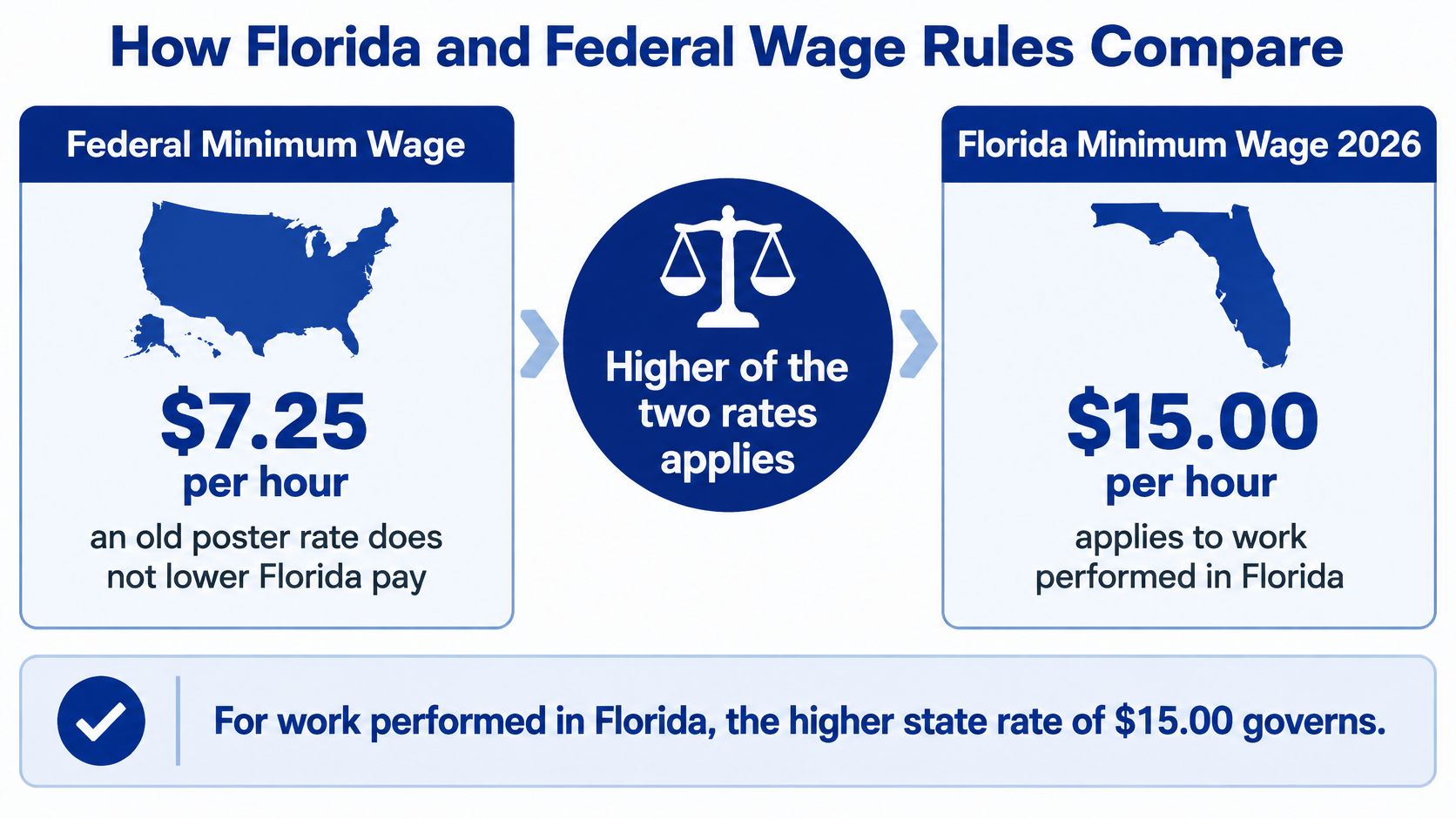
A hypothetical Florida warehouse employee receiving the new state minimum clears both base-wage floors. An employee left at the previous state rate after the change doesn't satisfy Florida's requirement merely because the pay exceeds the federal minimum. The payroll review must test the applicable state requirement, not just the federal baseline.
Paying a salary doesn't settle whether overtime applies. For covered employers in 2026, the FLSA administered by the U.S. Department of Labor requires a separate classification review. A guide to deciding whether a specific role is exempt or non-exempt provides a practical starting point for organizing that review.
Agricultural employers also shouldn't assume the ordinary minimum-wage table resolves every wage obligation. Employers using the H-2A program should check the latest H-2A wage levels through Contigo Labor Solutions and confirm the applicable requirements before approving pay.
The role-level question is straightforward: Which wage rules apply to this employee's work and location? Classification, work location and any specialized program requirements belong in the same review file.
Approve a written transition procedure before changing the live wage table. Under Florida's constitutional minimum-wage requirements for 2026, the state minimum-wage notice identifies the move from $14.00 through September 29 to $15.00 effective September 30, 2026.
The payroll lead should test how the system handles effective-dated earnings, not merely confirm that the new rate appears on an employee profile. A correct profile can still produce an incorrect check if imported time, overnight shifts or retroactive adjustments use the wrong date.
List every employee paid below $15.00. Organize the list by job, actual work location and pay type, including remote employees performing work in Florida. The usual miss is filtering by assigned office instead of where the employee works.
Set the September 30, 2026 effective date. Confirm that payroll allocates rates to the applicable hours within the pay period, rather than applying a rate based on the check date. A pay-period start date alone isn't a reliable substitute for an earnings-date rule.
Split shifts that cross the effective date. In a hypothetical shift running from 9 p.m. on September 29 to 3 a.m. on September 30, three hours fall at $14.00 and three at $15.00. Check whether the timekeeping export splits the shift at midnight or assigns all hours to the clock-in date.
Recalculate affected regular-rate and overtime calculations. Under the FLSA's 2026 overtime requirements, review shift differentials, commissions and attendance bonuses for their treatment in the regular rate. A higher base rate can increase overtime costs, but it doesn't automatically increase every separately stated bonus or differential.
Update compensation documents and budgets. Review offer letters, job postings, compensation bands and labor forecasts for figures still built around $14.00. The common mistake is fixing payroll while managers continue issuing offers from an outdated template.
Run a test payroll. Include late-September hours, an overnight shift, overtime, tipped earnings and a corrected time entry where relevant. Compare the calculated earnings with a manual worksheet instead of relying on a successful import message.
Record changes and approvals. Retain the configuration change, test results, employee communication and approver's name in a dated file. A completed task without supporting records leaves the next payroll reviewer guessing.
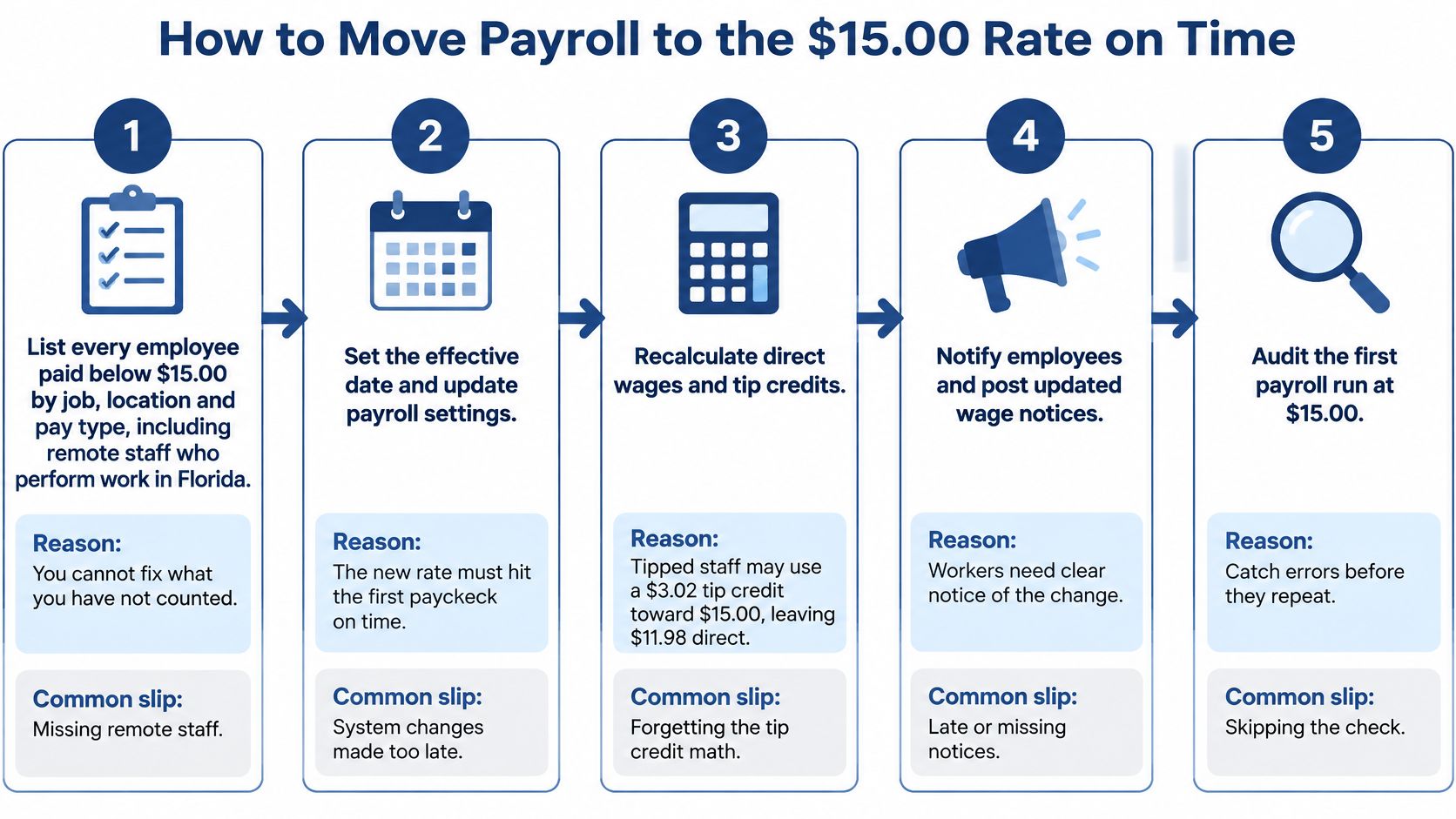
If a payroll has already paid affected hours at the old rate, recalculate those hours and any related overtime consequences. Pay the difference and document which original earnings were corrected. The correction should reconcile with the original time records, not replace them without explanation.
The guide to what retro pay means can help the payroll owner distinguish a correction from an unrelated bonus. Keep the correction identifiable in the payroll record and employee explanation. Escalate disputed hours or uncertain calculations rather than improvising an adjustment.
A payroll vendor or PEO can update a wage table. Management still owns classification, timekeeping and employee communication.
Before release, reconcile the affected employee list, approved rates and actual hours. After release, inspect the earnings detail on the first live run. Testing and live-payroll review serve different purposes, and neither should replace the other.
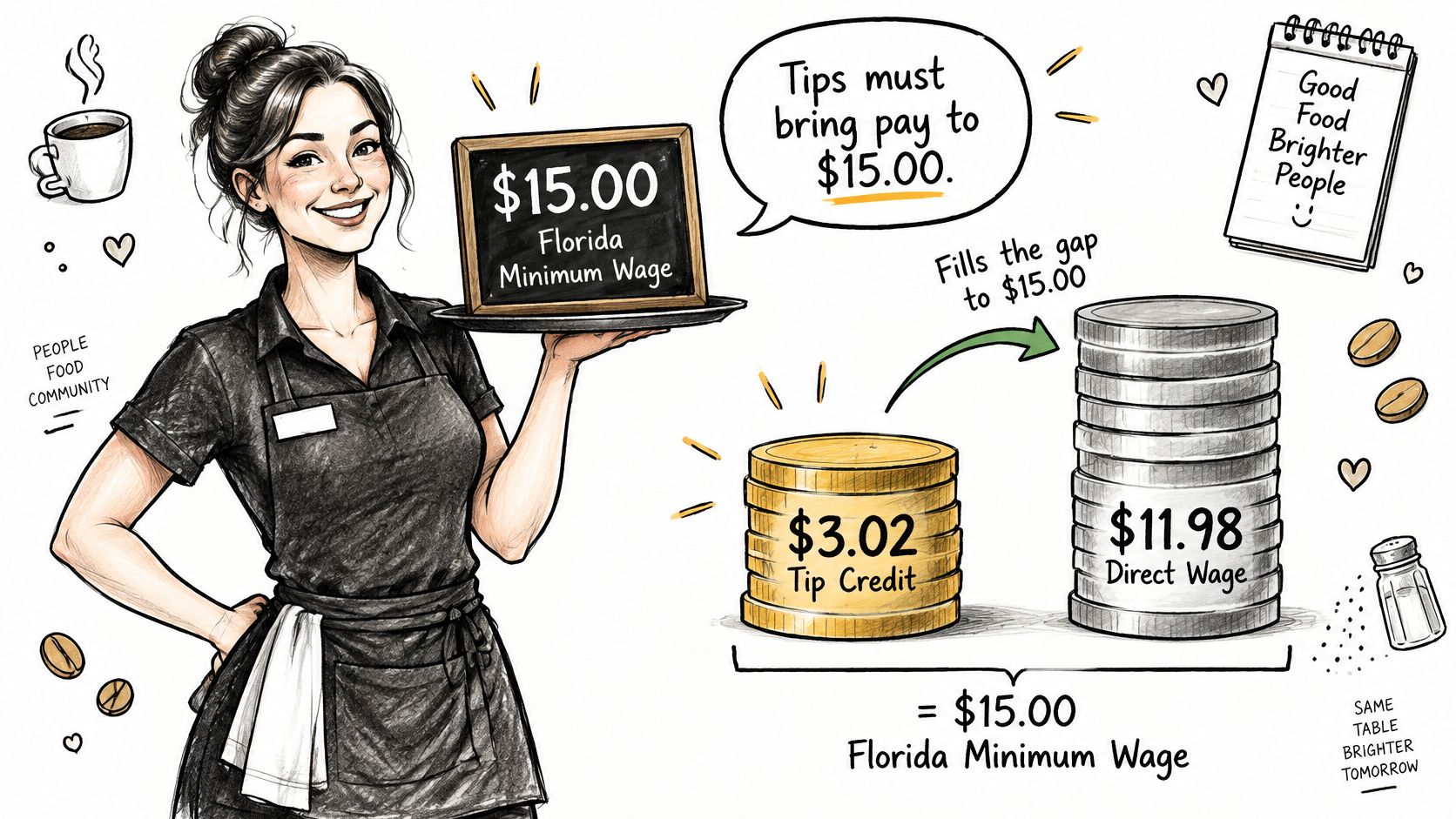
For eligible tipped employees, the Florida Department of Commerce 2026 minimum-wage announcement permits a $3.02 tip credit against the $15.00 minimum, leaving a $11.98 direct cash wage beginning September 30, 2026. Eligibility depends on the federal FLSA tip-credit requirements in 29 U.S.C. § 203(m), alongside Article X, section 24 of the Florida Constitution.
The direct cash wage is paid in addition to tips. It isn't the employee's complete minimum-wage entitlement. An employer must verify both eligibility for the credit and whether direct wages plus tips satisfy the full minimum-wage requirement.
| Component | 2026 amount | What it means |
|---|---|---|
| State minimum wage from September 30, 2026 | $15.00 | Total pay per hour, including tips, must reach this amount |
| Maximum tip credit | $3.02 | Applies only to tipped employees who qualify under the FLSA |
| Minimum direct cash wage | $11.98 | Paid by the employer in addition to the employee's tips |
In a hypothetical server calculation, $11.98 in direct wages plus $3.02 in tips per hour equals $15.00. If tips instead equal $1.50 per hour, the same direct wage leaves a $1.52 hourly shortfall for the employer to cover. This simplified example illustrates the arithmetic; payroll must assess actual earnings using the applicable FLSA calculation rules.
An employee who doesn't qualify for the tip credit must receive the full state minimum in cash wages. Managers shouldn't assume that a restaurant job title establishes eligibility. Actual duties and the employer's tip-credit practices need review.
Mixed duties deserve particular attention. The employer should review time spent on non-tip work and confirm the current federal treatment before applying the credit. Restaurant and hospitality tip-credit setups are worth an expert review before implementation, especially when employees move between tipped service and other assignments.
For 2026, Florida Statutes section 448.109 requires covered employers to display the state minimum-wage notice in a conspicuous and accessible location at each establishment where covered employees work. The Florida Department of Commerce 2026 notice states the $15.00 rate effective September 30, 2026, and the $11.98 direct wage for eligible tipped employees through December 31, 2027.
A file saved in an administrator's folder isn't a workplace posting. The location manager should confirm employees can see and access the notice. Covered employers must also maintain the applicable federal FLSA minimum-wage notice under the U.S. Department of Labor's 2026 posting requirements.
For companies with different work locations, a central notice inventory is more useful than an informal email asking whether posters are current. Assign a person to each establishment and require confirmation. The guide to labor-law posters by state can help organize the broader review.
Under Florida's constitutional minimum-wage protections applicable in 2026, employees exercising minimum-wage rights are protected against retaliation. The state notice also identifies a $1,000 fine per intentional violation, payable to the state. That potential fine is separate from employee remedies, including claims for unpaid wages.
A manager shouldn't respond to a pay question by cutting shifts, threatening discipline or changing the employee's role without review. Preserve the complaint, time records and payroll detail. A pay complaint or audit is a high-stakes moment, and qualified employment counsel should review the response before related discipline or a disputed pay change.
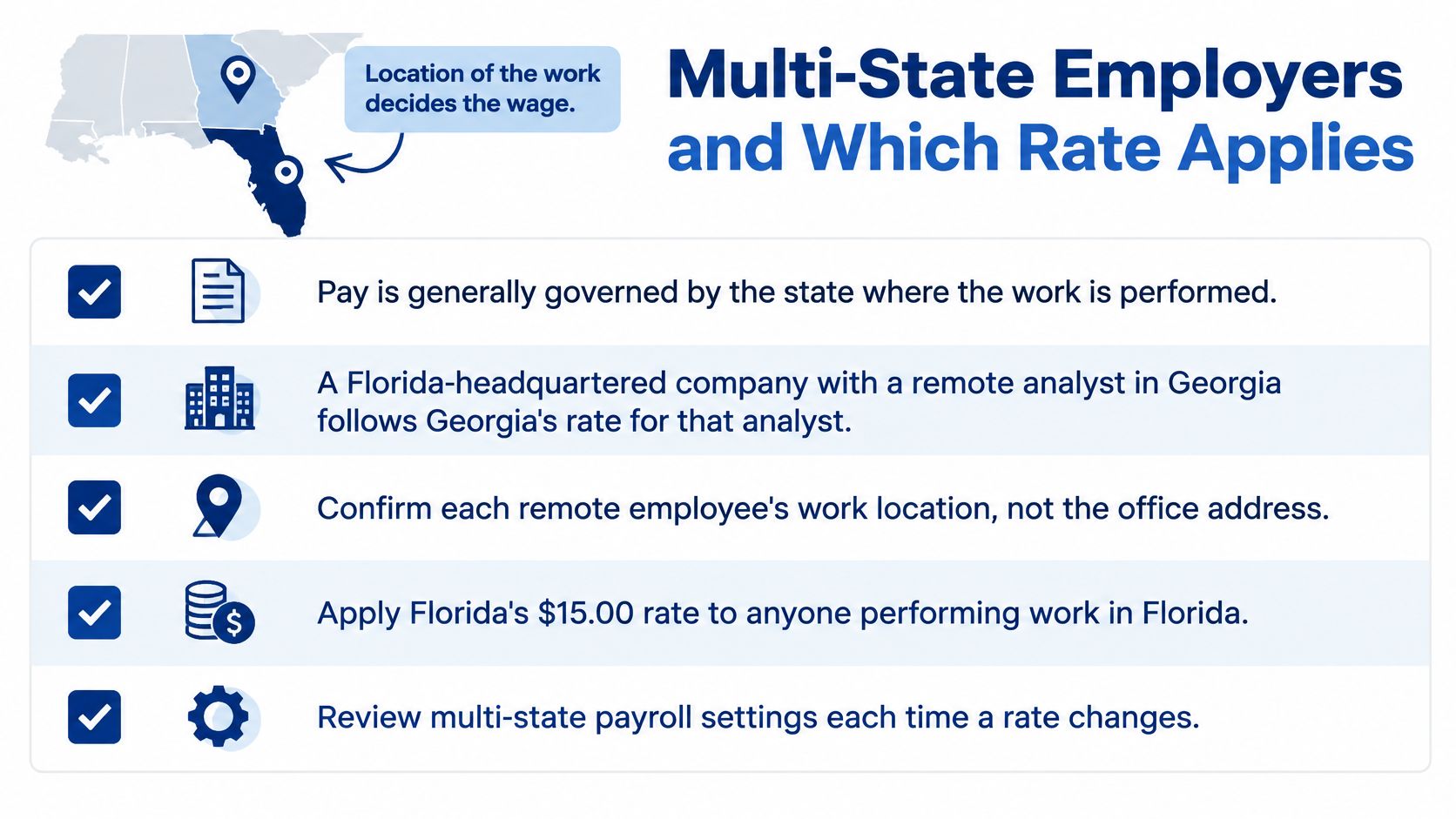
Work location generally determines the state wage rules that require review. A Florida-headquartered company with a remote analyst working in Georgia generally applies Georgia's state rules and the federal FLSA to that work, not Florida's wage schedule because payroll runs from Florida. Actual coverage and any cross-border complications should be checked under the laws applicable when the work occurs.
The employee's assigned office isn't enough. Payroll needs the actual work address and a reliable process for reporting changes. In states that permit local minimum wages, the review may need to reach the city or county level.
Remote recruiting also needs location discipline. A resource such as We Are Distributed, where candidates can find work-from-home roles in Florida, illustrates how remote vacancies remain location-specific. Recruiting and payroll should use consistent location information rather than treating remote as permission to work anywhere.
International Inc.'s multi-state case involved a nationwide employer with approximately 75 employees across multiple states and no in-house HR department. That operating structure makes ownership especially important: someone must reconcile employee locations, handbook provisions and payroll settings. Administrative processing alone doesn't establish that the underlying decisions are correct.
A practical wage-and-hour compliance review should connect those records rather than examine payroll in isolation. Confirm each state's current wage and notice requirements at the time of review. Don't copy Florida settings into Georgia or another state without checking the differences.
A consistent company policy doesn't mean identical legal requirements in every state.
Multi-state terminations and leave decisions warrant expert employment counsel before action, particularly after a complaint or when leave and disability obligations overlap. Investigations also deserve a defined response plan and qualified support. Payroll ownership shouldn't become an assumption that the same person can safely resolve every employment-law issue alone.
Approve a written payroll transition plan before September 30, 2026, and name an accountable owner. That owner should confirm completion of the payroll procedure, retain dated approvals and reconcile the employee roster with actual work states. The approval should cover tested earnings calculations, workplace notices and remote-worker communication.
The final file should show what changed, who checked it and who authorized release. Keep the employee list, test worksheet, posting confirmations and correction log together. A future reviewer shouldn't need to reconstruct the decision from separate inboxes.
For leaders who want a second look, the firm acts as the HR and compliance function for companies with 25–500 employees and people in several states. It is an HR consulting firm, not a law firm.
This article is general information, not legal advice. Employment laws change and vary by state; consult qualified employment counsel about your situation.
Paradigm International Inc. offers employer-side HR reviews that connect payroll setup, workplace notices and multi-state policies. Leaders can visit Paradigm International Inc. to learn about support for the Florida wage transition and ongoing compliance decisions. Book a Free HR Risk Review.