You're facing a termination decision this quarter. The employee's performance has deteriorated, the manager wants action, and the file contains a few scattered emails, an informal warning, and a recent complaint. The business reason may be legitimate. The process may still create a wrongful termination claim.
The safest approach isn't to search for a magic phrase or rely on at-will status. It's to build a decision that is documented, consistent, properly timed, and reviewed before anyone delivers the message. For SMBs operating across multiple states, documentation quality and comparator consistency often matter as much as the stated cause.
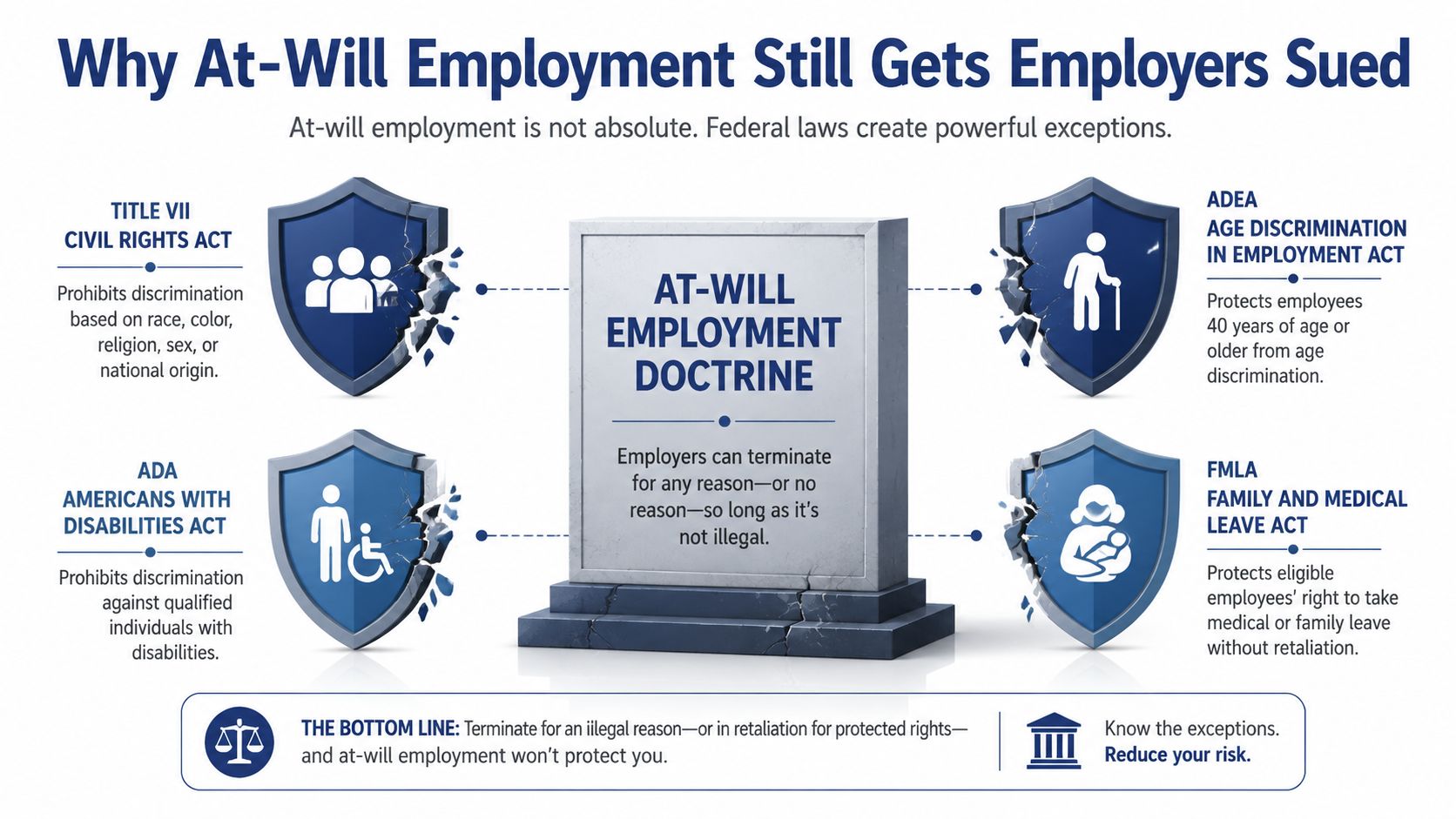
At-will employment gives an employer broad authority to end an employment relationship without a stated duration. It doesn't authorize termination for an unlawful reason, and it doesn't erase contract-like promises, public-policy protections, or retaliation rules.
The historical shift matters. By the late nineteenth century, employment without a stated duration increasingly fell under the at-will doctrine. By the 1980s, courts had expanded major exceptions that still shape defensible termination decisions today. A 1985 review found that 37 states recognized a public-policy exception, 31 recognized an implied-contract exception, and 5 recognized a covenant of good faith and fair dealing exception. Those figures and the development of these exceptions are discussed in the historical review of at-will employment doctrine.
Federal protections can also override an otherwise lawful business rationale. Title VII, the ADA, the ADEA, the FMLA, USERRA, and the NLRA protect employees in different circumstances, while state law can prohibit termination in violation of public policy. Public-policy claims may involve jury duty, workers' compensation claims, refusing to break the law, or whistleblowing, as summarized in this overview of at-will employment exceptions.
A manager may say, “We terminated for poor performance.” The employee's attorney will ask different questions:
Those questions explain why the cause is rarely the whole case. Litigation often turns on how the decision was built and timed.
For a practical overview of the at-will employment exceptions explained, review the legal framework before applying an at-will policy to a high-risk separation. Then operate through seven controls: documentation quality, comparator consistency, manager discipline, retaliation timing, multi-state compliance, training, and pre-decision review.
A termination file should read like a connected business record, not a folder assembled after the decision. Start with contemporaneous notes that identify the date, issue, people involved, policy or expectation at issue, and the source of the information.
Save those records in a controlled system. Don't leave the only copy in a manager's inbox, personal notebook, or text-message thread. Employment-risk guidance emphasizes that missing chronology, comparator information, complaint history, and post-termination paperwork can make a legitimate decision look pretextual, particularly when the employer creates documents retroactively. The documentation guidance for employment cases and workplace investigations addresses that practical exposure.
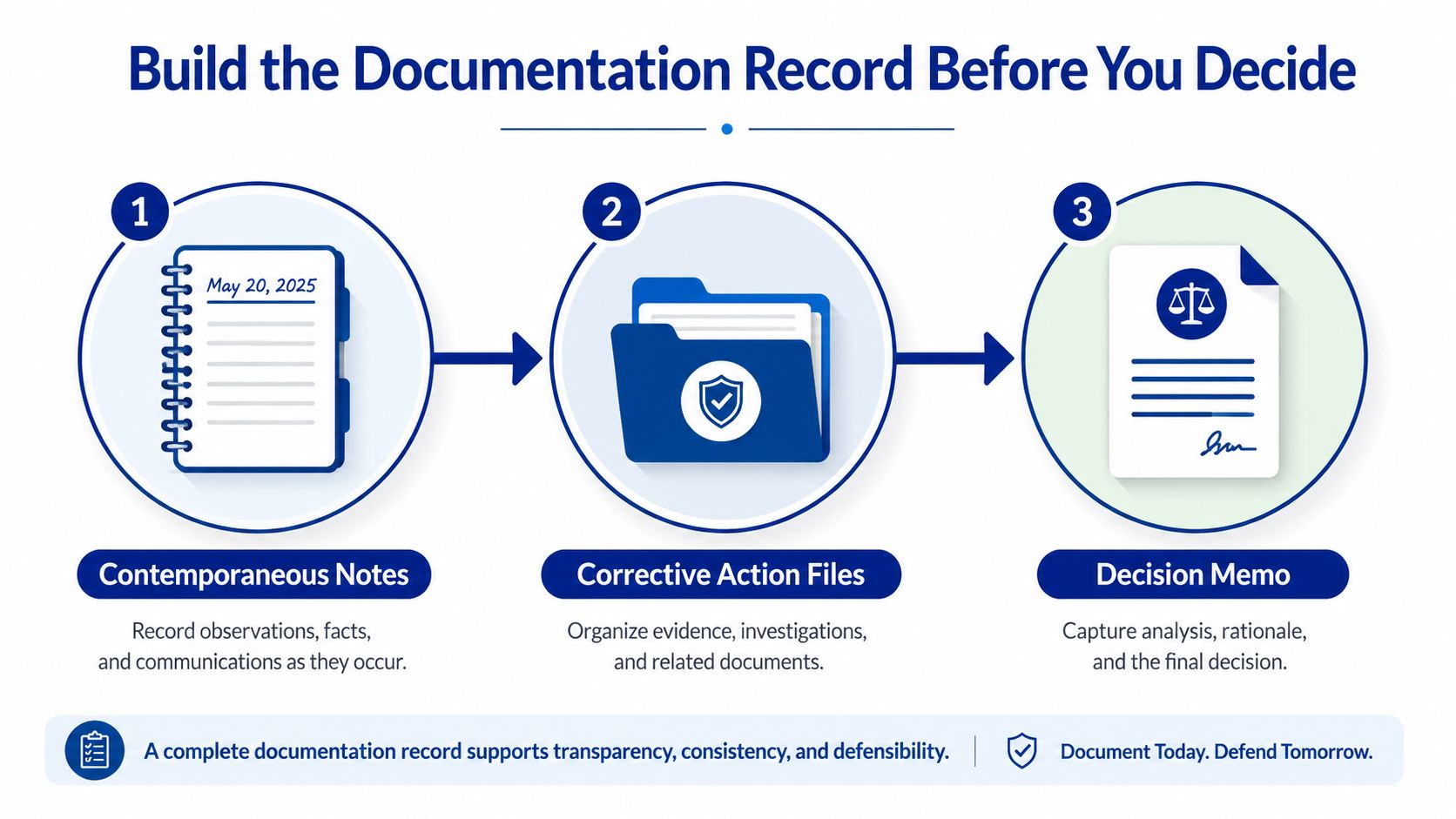
The sequence should be easy for someone outside the department to reconstruct:
The termination process guidance for in-house counsel recommends documenting issues, preserving the record, applying policies to similarly situated employees, reviewing protected activity, and confirming that the stated reason is supported by the file.
Practical rule: If the timeline only becomes clear after the employee challenges the decision, the record was built too late.
The file must also answer what the employer knew about complaints, accommodation requests, leave, safety reports, or other protected activity. A legitimate performance problem can become difficult to defend when the employer can't show whether decisionmakers knew about the protected event before acting.
Consistency is where many defenses fail. An employer may have a valid rule against insubordination, attendance violations, or poor performance, but the rule creates exposure if managers enforce it selectively.
Plaintiff counsel usually looks for employees with the same supervisor, similar duties, comparable conduct, and a different protected characteristic or protected activity. The comparison doesn't need to be perfect to become relevant. A retained employee who committed similar misconduct can create a difficult explanation for why another employee was terminated.
Common examples are simple:
Before signing the memo, identify at least two plausible comparators. Document why each person is or isn't similarly situated, including differences in role, seriousness, prior history, decisionmaker, and response to coaching.
| Factor | Employee A, Terminated | Employee B, Retained | Consistent? |
|---|---|---|---|
| Supervisor | Same or different supervisor | Same or different supervisor | Yes or no, with explanation |
| Role and duties | Comparable responsibilities | Comparable responsibilities | Yes or no, with explanation |
| Conduct | Specific policy violation | Similar or materially different conduct | Yes or no, with explanation |
| Prior history | Warnings, coaching, or no prior record | Warnings, coaching, or no prior record | Yes or no, with explanation |
| Protected activity | Complaint, leave, accommodation, or none | Complaint, leave, accommodation, or none | Yes or no, with explanation |
| Outcome | Proposed termination | Coaching, warning, or no action | Yes or no, with explanation |
If HR can't complete this analysis, stop the decision. Don't let a manager fill the gap with “this case was different” unless the file states exactly how and why.
A consistent rule applied inconsistently is not a strong defense. It's a fact pattern the other side can explain for you.
Handbooks can also create expectations that managers later treat as optional. Review your state employee handbook requirements before relying on a policy that varies by location or includes process language that sounds mandatory.
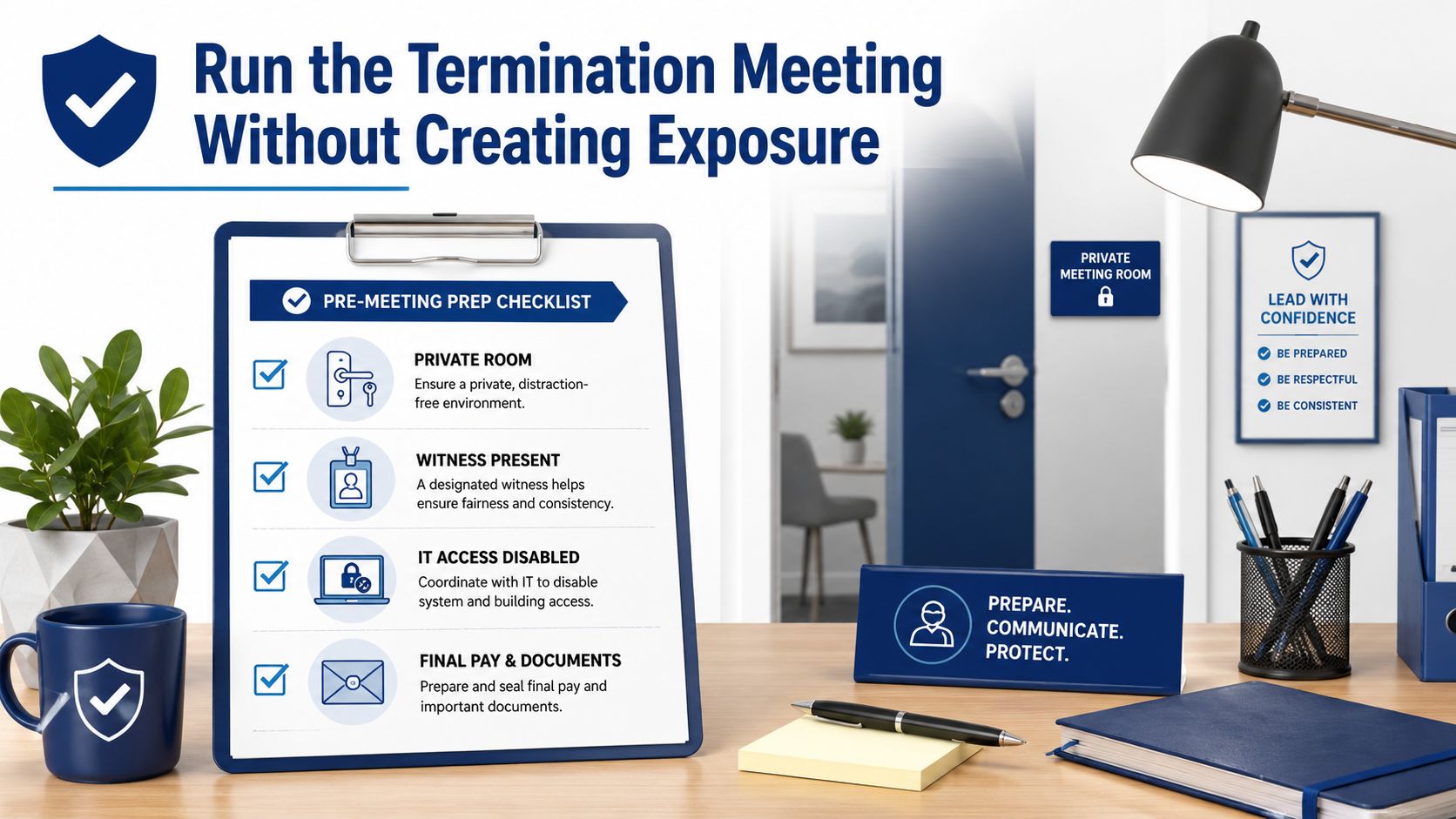
The termination meeting should be brief, private, and aligned with the written decision memo. It isn't the place to improvise, negotiate the facts, or explain every frustration a manager has accumulated.
Before the meeting, select a private room with no unnecessary access. Choose a witness, stage the termination letter and separation documents, confirm final-pay materials, and coordinate system access with IT. The manager should know who will collect company property and who will answer benefits or unemployment questions.
The manager should state the decision clearly, identify the documented performance or conduct reason, provide the letter, and explain the next administrative steps. A useful structure is:
The spoken explanation must match the memo. Don't introduce a new reason, soften the reason into a personal opinion, or blame senior leadership for a decision the company owns.
Avoid phrases such as “you'll be fine,” “we just don't like your attitude,” and “maybe you should sue.” Never refer to protected status, health, disability, family responsibilities, leave, or a complaint in a casual or speculative way.
After the meeting, return any signed acknowledgment to HR and record whether the employee signed or declined. Secure company property, adjust access, and write the internal summary while the details remain fresh.
The team communication should be limited to operational facts. State that the employee is no longer with the company and identify any interim responsibilities. Don't disclose performance details, personal circumstances, complaints, or medical information.
For nonemployees, use a separate process and review terminating independent contractors safely, because the contract terms and classification facts may control what the company can say or provide.
SHRM's termination checklist emphasizes preserving records beyond the meeting, including placing the employee's Form I-9 with terminated employees' I-9 records and recording the termination date and last day worked when they differ. Exact dates and storage steps prevent avoidable confusion over pay, benefits, and offboarding obligations.
The calendar can create more exposure than the conduct record. A termination that follows an internal complaint, accommodation request, leave request, safety report, or other protected activity requires a separate retaliation review before approval.
EEOC guidance centers on two questions: did the decisionmaker know about the protected activity, and did the adverse action occur shortly afterward? Timing alone does not prove retaliation, but close timing can support an inference, particularly when documentation starts after the complaint or the employer changes its explanation. The EEOC retaliation guidance explains the agency process and filing deadlines.
An employee generally files a U.S. retaliation or discrimination charge with the EEOC within 180 days of the adverse action. That period can extend to 300 days in most states with a state or local anti-discrimination agency. Federal employees generally must contact an EEO Counselor within 45 days, according to the same EEOC resource.
Pull the protected-activity log and compare it with the discipline timeline. Ask whether the manager knew, whether the complaint was escalated, and whether the proposed action changed after the complaint. In a multi-state workforce, use the same review process across locations, then check whether state-specific rules require additional handling.
Require HR sign-off when a protected event falls inside 90 days of the proposed action. That internal threshold is not a legal safe harbor. It is a practical control that forces a closer review of timing, decisionmakers, documentation, and comparable cases.
| Scenario | Protected Activity Date | Termination Date | Gap, Days | Risk Level |
|---|---|---|---|---|
| No protected activity identified | None identified | Proposed date | Not applicable | Review ordinary risk |
| Performance record predates complaint | Before complaint | Later proposed date | Document exact gap | Lower if record is consistent |
| Complaint precedes new discipline | Document exact date | Proposed date | Calculate exact gap | High, review required |
| Accommodation or leave request precedes action | Document exact date | Proposed date | Calculate exact gap | High, counsel review recommended |
| Decisionmaker learned of complaint immediately before action | Document knowledge date | Proposed date | Calculate exact gap | High, obtain counsel review |
The decision memo must state the business reason independently of the complaint. Avoid wording such as the employee was terminated “because of ongoing issues after complaining.” Identify the performance or conduct facts, dates, policy provisions, comparators, and review supporting the decision. If comparable employees were treated differently, resolve that inconsistency before signing. Retaliation timing and inconsistent treatment are the mistakes that turn an otherwise defensible termination into a lawsuit.
A single handbook won't solve a multi-state employment problem. An employee works under the law of the location where the work is performed, not merely the office listed in a contract. A policy written for one state can create compliance gaps when managers apply it to remote employees elsewhere.
The dispute environment also shows why state and local requirements deserve attention. Singapore reported 2,168 wrongful dismissal claims in 2025, up from 1,720 in 2024, while the rate rose from 0.46 to 0.57 per 1,000 employees, according to the U.S. government wrongful termination information. In the U.K., unfair dismissal tribunal claims nearly doubled from 10,686 in 2023/24 to 20,899 in 2024/25, as reported in the same source. These figures aren't U.S. rules, but they illustrate a broader operational point: dispute volume and local employment obligations require disciplined jurisdiction review.
Use a four-part process:
| Law Area | Federal Baseline | State Trigger Example | Action When Triggered |
|---|---|---|---|
| Final pay | Federal law does not create one universal final-pay deadline | State deadline may vary by separation type | Confirm the deadline before the meeting |
| Leave | Federal programs may apply based on eligibility and coverage | State sick-leave or family-leave rules may add obligations | Check the employee's work location and leave history |
| Disability accommodation | ADA rules may apply when coverage requirements are met | State law may cover smaller employers or add protections | Review accommodation records before action |
| Non-competes | Federal treatment doesn't provide one simple rule for every agreement | State enforceability varies | Review the agreement under the employee's work location |
| Wage and time records | Federal wage rules provide a baseline | State meal, rest, off-the-clock, or wage-theft rules may add duties | Audit time and payroll records before separation |
Use one HRIS as the source of truth, with jurisdiction fields that managers can't casually override. Create an escalation path for state-specific questions so a supervisor doesn't improvise an answer about final pay, leave, or policy coverage.
If you don't have internal capacity, evaluate HR consultant costs for small business against the cost of correcting a process after a claim arrives. The right advisor should help build repeatable controls, not merely answer questions after the decision.
Before the decisionmaker signs the termination memo, require a written answer to twelve questions. A “no” doesn't always stop the termination, but it must identify the unresolved risk and the person responsible for resolving it.
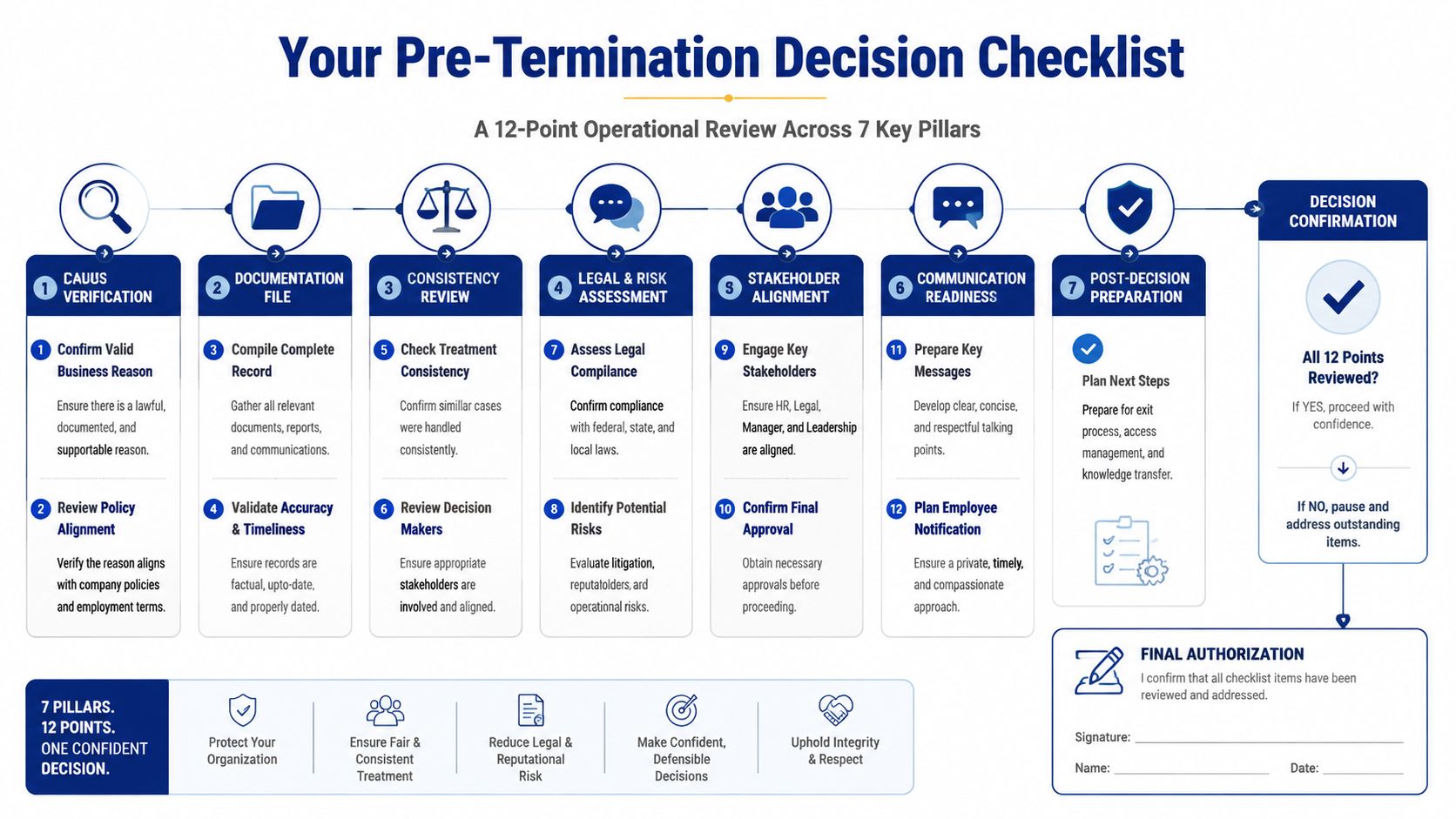
The signature shouldn't mean “I approve what the manager wants.” It should mean the leader has reviewed the cause, record, comparators, timing, jurisdiction, meeting plan, and administrative consequences.
The strongest process is deliberately repetitive in one respect. The written reason, comparator analysis, manager script, and final internal summary must tell the same story. If those records conflict, the conflict becomes part of the claim.
A termination can still be challenged even when the employer believes the decision was justified. The objective is to ensure the company can show a lawful rationale, consistent treatment, informed decisionmaking, and a record created before the dispute.
Paradigm International Inc. supports owners, COOs, and executive teams with sensitive terminations, investigations, manager conduct, documentation standards, and multi-state compliance decisions. If your organization needs a structured pre-termination review or a more defensible process, visit Paradigm International Inc. to discuss the situation with an HR risk advisor.