


Ensure your employee handbook meets compliance across all states. Follow key strategies to keep your HR practices up to date and effective.
A compliant employee handbook requires one master document, state-specific addenda, an annual review cycle, and documented employee acknowledgments — and that structure is what regulators expect to see when the EEOC, the U.S. Department of Labor, or OSHA comes calling.
Three actions HR leaders should complete this week:
Thomson Reuters recommends retaining prior handbook versions alongside current ones to defend against claims tied to past actions, which means version control is not optional — it is a legal safeguard.
A compliant employee handbook requires a master document, state addenda, annual review, and documented acknowledgments — maintained as a living risk-management instrument, not a one-time project.
| Point | Details |
|---|---|
| Master handbook + state addenda | Use one master document for federal and company-wide policies; add short jurisdiction-specific addenda for state and local mandatory language. |
| Annual review cadence | Review the full handbook every year and issue policy amendments immediately after any material federal, state, or local law change. |
| Acknowledgment discipline | Collect signed acknowledgments from every employee at each distribution; retain records with version identifiers for at least six years. |
| Avoid implied promises | Remove language that guarantees progressive discipline, promotion timelines, or job security beyond the at-will relationship. |
| Paradigm advisory support | Paradigm provides multi-state handbook drafting, addenda development, and acknowledgment system design as part of a structured HR risk advisory engagement. |
This article is general information, not a substitute for advice from a qualified lawyer. Consult a qualified legal professional about your own circumstances before acting on anything here.
A compliant handbook reduces legal exposure and creates the operational consistency that multi-location employers need to manage people decisions fairly. Without it, every disciplinary action, termination, or leave request becomes a judgment call that a plaintiff’s attorney can characterize as arbitrary.
Regulators rely on handbooks as evidence during investigations. The EEOC reviews harassment and anti-discrimination policies when evaluating whether an employer took reasonable steps to prevent and correct misconduct. DOL investigators examine wage-and-hour and leave language to determine whether employees received proper notice of their rights. OSHA auditors look for documented safety reporting procedures and training records. A handbook that is silent on any of these areas signals to investigators that the employer either did not know the requirement existed or chose to ignore it.
OSHA’s penalty structure includes serious violation fines up to $16,550 per violation and willful or repeated violations up to $165,514 per violation. A handbook that documents safety reporting procedures, required training, and injury-response protocols gives employers a concrete record that safety obligations were communicated to employees — a meaningful defense in any inspection.
Operational clarity matters just as much. When managers in different offices apply leave policies inconsistently because the handbook is ambiguous, the organization faces both discrimination claims and employee relations problems. A well-drafted handbook, as the University of Pittsburgh Law School notes, reduces employee mistakes and serves as evidence of communicated expectations during disputes.
A compliant handbook must address at least twelve policy areas. Omitting any of them creates a gap that regulators and plaintiffs will notice.
At-will employment. State clearly that employment is at-will and that nothing in the handbook creates a contract. Place this language prominently, ideally on the first substantive page and again in the acknowledgment form.
Equal employment opportunity and anti-discrimination. Reflect EEOC regulations and guidance on protected classes, complaint procedures, and the employer’s commitment to non-retaliation. Name the internal contact point for complaints.
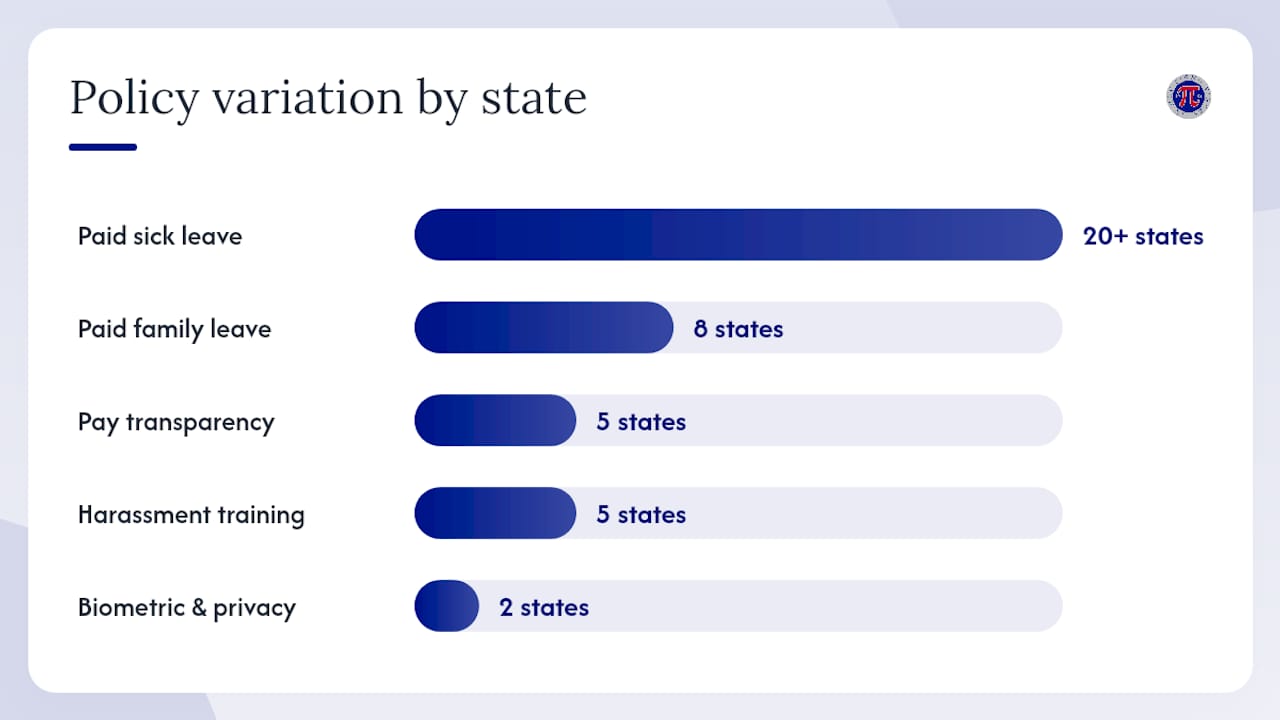
Harassment prevention and reporting. Describe prohibited conduct, the reporting process, investigation procedures, and non-retaliation protections. Several states (California, New York, Illinois, Connecticut) mandate specific policy elements and training frequencies beyond the federal baseline.
Wage and hour. Incorporate the FLSA’s exemption tests, overtime rules, timekeeping requirements, and pay-period schedules. State-specific rules (California daily overtime, New York spread-of-hours pay) belong in addenda.
Leave entitlements. Reference FMLA eligibility, notice procedures, and certification requirements for employers covered by the Act. Add state paid family leave and paid sick leave rules in the relevant addenda.
Workplace safety. Document OSHA reporting obligations, injury-response procedures, required safety training, and the process for reporting hazards. Reference any industry-specific safety programs.
Reasonable accommodation and ADA. Describe the interactive process, who to contact, and the confidentiality of medical information. Avoid language that implies automatic denial or approval of any specific accommodation.
Confidentiality, IT use, and AI use. Define what constitutes confidential information, acceptable use of company systems, and — increasingly important — permitted uses of AI tools. Prohibit entering sensitive company or employee data into public AI models, and document human oversight requirements for high-stakes HR processes such as hiring and discipline.
Discipline and termination. Describe the general framework without promising a specific sequence of steps. Language that guarantees progressive discipline (verbal warning, written warning, final warning, termination) can create an implied contractual obligation.
Benefits and time off. Summarize eligibility, accrual, carryover, and payout rules. Direct employees to the Summary Plan Description for health benefits rather than restating plan terms in the handbook, which can create conflicting obligations.
Pay transparency. Several states now require employers to post or disclose salary ranges; the handbook should reference the applicable policy and direct employees to the appropriate process.
Data privacy. Address how the organization collects, stores, and uses employee data, particularly in states with biometric privacy laws (Illinois BIPA) or broad consumer privacy statutes that extend to employees (California CPRA).
Pro Tip: Never use language that implies a guaranteed promotion timeline, a fixed disciplinary sequence, or job security beyond the at-will relationship. Phrases like “employees who meet performance standards will be considered for promotion after 12 months” have been read by courts as implied contractual commitments. Review every policy for language that limits managerial discretion without an explicit, documented process to back it up.
Use a staged workflow: plan, draft, legal review, pilot, roll out, document acknowledgments, and monitor. The process typically runs eight to twelve weeks for a mid-size employer, longer when multiple states are involved.
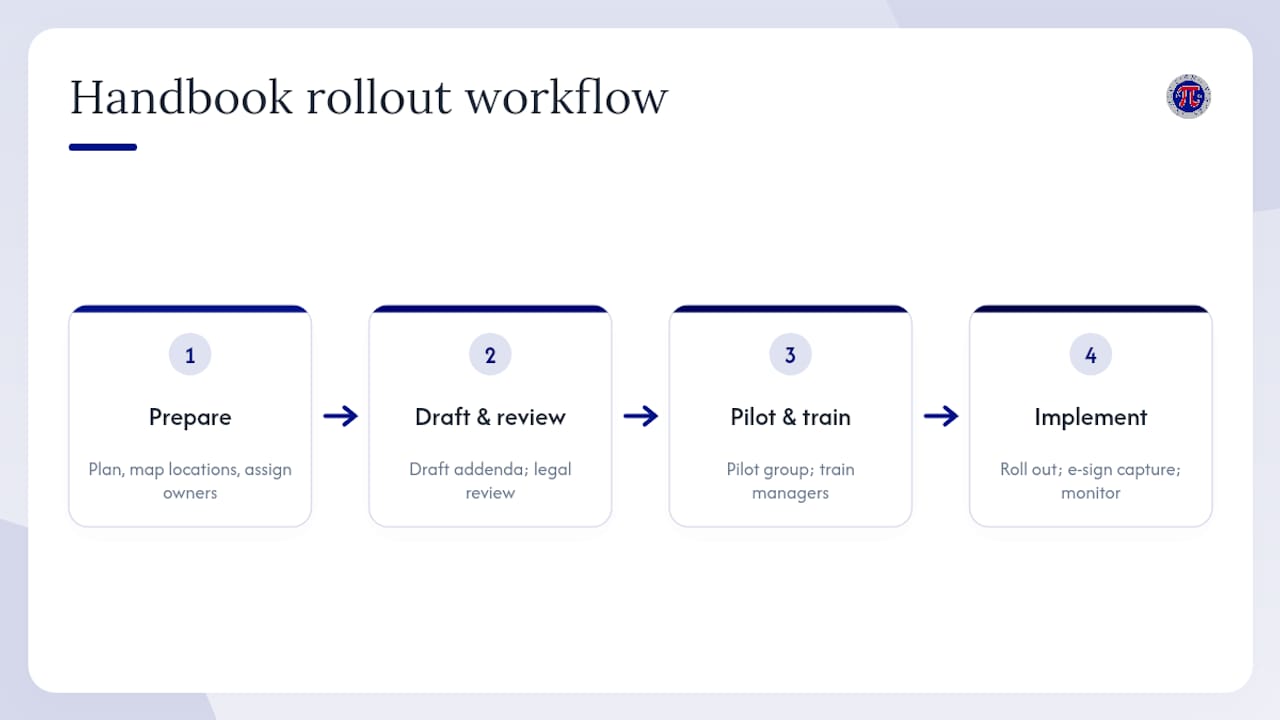
Step 1: Planning (1–3 weeks). HR maps all employee work locations, identifies applicable federal and state laws, and assigns policy owners. Leadership confirms the scope: new handbook or update to an existing one.
Step 2: Drafting (2–4 weeks). HR or outside counsel drafts the master handbook and state addenda. Use agency language verbatim where the law requires it (FMLA notice language, for example), and avoid paraphrasing that inadvertently narrows employee rights.
Step 3: Legal review (1–2 weeks). Employment counsel reviews every section for legal accuracy, implied-contract risk, and jurisdiction-specific gaps. This step is not optional for multi-state employers.
Step 4: Stakeholder pilot (1 week). Share the draft with a cross-functional group (operations, finance, a frontline manager) to surface ambiguities before distribution.
Step 5: Roll-out and training (1–2 weeks). Distribute digitally with e-signature capture. Train managers within two weeks of distribution so they can answer employee questions consistently.
Step 6: Acknowledgment capture. Collect signed acknowledgments from every employee and store them in personnel files or the HRIS.
Step 7: Ongoing monitoring. Maintain a federal-state-local tracker and update the handbook or issue policy amendments whenever a material law change occurs.
Costs scale with the number of states, the complexity of the industry, and whether the employer is starting from scratch or updating an existing document. A single-state employer with a clean existing handbook may complete a legal review for under $3,000; a 15-state employer building a master-plus-addenda architecture from scratch should budget toward the high band.
The most practical architecture for multi-state employers is a single master handbook covering federal and company-wide policies, paired with short state or local addenda that contain jurisdiction-specific mandatory language.
Writing the entire handbook to the most restrictive state’s standards is a common mistake. It overpromises in lighter jurisdictions — creating obligations the employer never intended — while still missing mandatory language that applies only in specific states. A state addenda model avoids both problems: the master document sets the baseline, and each addendum adds only what that location requires.
The policy areas that vary most frequently by state or locality include:
Centralizing employee work-location records is the operational foundation of this approach. When an employee moves or a new hire works remotely from a state where the employer has not previously operated, the location record triggers a review of which addendum applies. A living federal-state-local tracker, updated at least quarterly, feeds directly into the handbook generation process and prevents gaps from accumulating between annual reviews.
Collect and retain signed acknowledgments every time policies change, and preserve version metadata for the full statute-of-limitations period that applies to employment claims in each jurisdiction.
A practical acknowledgment and distribution checklist:
Data retention windows vary by jurisdiction and claim type. Employment discrimination claims under Title VII carry a 180-day or 300-day charge-filing deadline, but litigation can extend well beyond that. Wage-and-hour claims under the FLSA carry a two-year statute of limitations (three years for willful violations). State claims often run longer. A defensible practice is to retain acknowledgments and handbook versions for at least six years, indexed by employee name, version date, and work location, so records can be retrieved quickly during an investigation.
The most frequent errors are not obscure legal technicalities. They are structural problems that accumulate over time when handbooks are not reviewed on a consistent cadence.
Outdated state language. A handbook drafted in 2021 may not reflect paid leave expansions, pay transparency mandates, or harassment training requirements enacted since then. Fix: run the handbook against a current federal-state-local tracker annually and after any major legislative session.
Contradictory policy clauses. A leave policy that promises “up to 12 weeks” without specifying FMLA eligibility can conflict with a separate PTO policy that requires employees to exhaust accrued leave concurrently. Fix: have counsel read the handbook as a whole, not section by section.
Implied contractual promises. The most litigation-prone language includes guaranteed progressive discipline sequences, promotion timelines tied to tenure, and phrases like “employees in good standing will not be terminated without cause.”
Red-flag phrases to remove: “will receive,” “is guaranteed,” “will always,” “will not be terminated without cause,” “after completing [X] months you will be eligible for.” Replace with “may be considered,” “at the company’s discretion,” or simply remove the promise entirely and describe the process without committing to an outcome.
Missing state-mandated notice language. Several states require specific verbatim notices in handbooks or as standalone documents. Paraphrasing or summarizing required language can void the notice. Fix: pull required language directly from the agency source and insert it verbatim.
Failure to collect acknowledgments. An employer who cannot produce a signed acknowledgment cannot prove the employee received the policy. Fix: make acknowledgment capture a hard stop in the onboarding workflow and a tracked step in every handbook update rollout.
Inconsistent manager enforcement. A policy applied differently across departments creates discrimination exposure even when the written policy is sound. Fix: train managers within two weeks of any handbook update and document that training in personnel records.
Bring in outside counsel or an HR risk advisor when jurisdictional complexity exceeds internal capacity, when litigation risk is elevated, or when the organization is undergoing a structural change that affects the employment relationship across multiple locations.
Specific scenarios that warrant outside support:
When selecting an outside advisor, ask for sample deliverables (a completed state addendum, a version-control log, a sample acknowledgment form), request references from employers of similar size and industry, and verify that the advisor has direct experience with DOL, EEOC, and OSHA matters. An advisor who can demonstrate familiarity with HR compliance audits and reviews as a discipline, not just handbook drafting in isolation, will identify risks that a template-focused vendor will miss.
Pro Tip: Ask any prospective advisor how they handle mid-cycle law changes. The answer reveals whether they have a living tracker and a defined update process, or whether they deliver a document and consider the engagement closed. The former is what multi-state employers actually need.
Paradigm’s Employee Handbook service covers drafting, multi-state addenda, version control, and acknowledgment system design, with direct integration into broader HR risk advisory work when handbook policies intersect with investigations or classification disputes.
Use this checklist as a project plan template. Assign an owner and a due date to each item before beginning any handbook project.
The most defensible handbook is not the longest one. It is the one that accurately reflects current law, is written without implied promises, has been reviewed by counsel, and has a signed acknowledgment from every employee in the system. Complexity without accuracy creates more risk than a shorter, precise document.
Handbook compliance project checklist:
Templates to have on hand:
For mandatory policy language, use agency sources directly. The DOL’s FMLA pages publish required notice language that must appear in handbooks or be distributed separately to eligible employees. The EEOC’s regulations and guidelines page provides the current protected-class framework and complaint-procedure standards. OSHA’s enforcement and penalty guidance informs the safety section. Where a law requires verbatim language, copy it from the agency source rather than paraphrasing.
The conventional wisdom in HR circles is that a handbook is a one-time project: draft it, have counsel review it, distribute it, and revisit it when something goes wrong. That framing is the source of most of the compliance failures described in this article. A handbook is a living risk-management instrument, and the organizations that treat it as such are the ones that survive DOL audits, EEOC investigations, and wrongful termination claims with their documentation intact.
What that means in practice is that the review cadence matters as much as the initial draft. A handbook that was legally sound in 2022 may carry three or four compliance gaps today, particularly for employers operating in California, New York, or Illinois, where the legislative pace is relentless. The annual review is not a formality; it is the mechanism that keeps the document defensible.
The second underappreciated point is that acknowledgment discipline is where most employers lose the argument. A well-drafted policy that no one can prove was communicated to the employee is legally equivalent to no policy at all. Digital distribution with e-signature capture, tied to a version-controlled HRIS record, is the standard that regulators and plaintiffs’ attorneys now expect to see.
Paradigm’s approach to handbook compliance is built around these two principles: risk-weighted prioritization (address the highest-exposure gaps first, in the highest-risk jurisdictions) and documented evidence trails (acknowledgments, version logs, and training records that hold up under scrutiny). For organizations that want to review their current HR compliance posture before beginning a handbook project, that diagnostic step often surfaces the most urgent fixes.
Multi-state handbook compliance is one of the highest-leverage investments an employer can make in risk reduction, and it is also one of the most resource-intensive to execute correctly. Paradigm provides handbook drafting, multi-state addenda development, version-control architecture, and acknowledgment system design as part of a structured HR risk advisory engagement, not as a template sale.
For organizations that need more than a document, Paradigm’s advisory model integrates handbook compliance into broader workplace investigations support and HR audit work, so that policies, enforcement practices, and investigation procedures are aligned rather than developed in isolation. The result is a compliance posture that holds up when it is tested.
To discuss your organization’s handbook gaps or to request an HR compliance audit, request an advisory conversation with Paradigm’s team. Initial scoping calls are focused on identifying your highest-risk jurisdictions and the fastest path to a defensible document.